

32
2.
THE MASS OF THE ELECTRON
With the preceding equation, this gives
81/108
,
=
e.m.u./g.
(2—17)
V is the anode potential in volts. If the lament is of appreciable
size in comparison With the anode, a correction is needed.
Then
8V108
72
“2
6/7” =
<1
——
(?.—18)
where 7” is the radins of the lament in centimeters.
This method,
though simple, does not yield precision results 9 because of the
lack of sharpness in the cut-off of the current.
It is interesting to note that when the magnetron has been
adjusted to the critical region, the circling electrons act as simple
harmonic oscillators to produce radio waves whose period is
approximately equal to twice the running time of the electrons
from lament to anode. The wave—length of the radio waves in
centimeters is approximately given by
10
Mi. = 13,100.
(2—19)
Undamped radio waves whose wave-length is only 0.64 centimeters have been generated by this method.11
2—9.
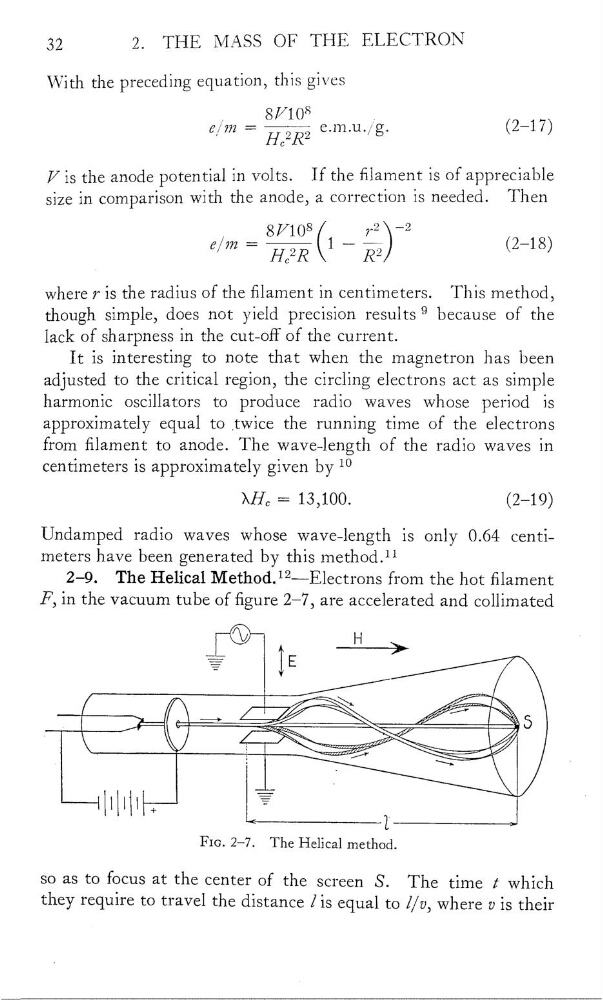
The Helical Method.”—Electrons from the hot lament
F, in the vacuum tube of gure 2—7, are accelerated and collimated
__
@
1E
H
.
‘
”"I;:Z…f
111111
1Î
'
___—1FIG. 2—7.
The Helical method.
so as to focus at the center of the screen S.
The time [ which
they require to travel the distance [ is equal to l/v, where 0 is their
2.
THE MASS OF THE ELECTRON
With the preceding equation, this gives
81/108
,
=
e.m.u./g.
(2—17)
V is the anode potential in volts. If the lament is of appreciable
size in comparison With the anode, a correction is needed.
Then
8V108
72
“2
6/7” =
<1
——
(?.—18)
where 7” is the radins of the lament in centimeters.
This method,
though simple, does not yield precision results 9 because of the
lack of sharpness in the cut-off of the current.
It is interesting to note that when the magnetron has been
adjusted to the critical region, the circling electrons act as simple
harmonic oscillators to produce radio waves whose period is
approximately equal to twice the running time of the electrons
from lament to anode. The wave—length of the radio waves in
centimeters is approximately given by
10
Mi. = 13,100.
(2—19)
Undamped radio waves whose wave-length is only 0.64 centimeters have been generated by this method.11
2—9.
The Helical Method.”—Electrons from the hot lament
F, in the vacuum tube of gure 2—7, are accelerated and collimated
__
@
1E
H
.
‘
”"I;:Z…f
111111
1Î
'
___—1FIG. 2—7.
The Helical method.
so as to focus at the center of the screen S.
The time [ which
they require to travel the distance [ is equal to l/v, where 0 is their