

424
18.
THE DETECTION OF PARTICLES
be thin, smooth and of light metal, in order to reduce the local
gamma rays as much as possible.
_
In the so—called
“
quantum
”
counters, a window is provided
so
that light may
reach the inner surface of the cathode.
This
surface is sensitized as in photoelectric cells and emits electrons
Which ionize the gas.
For less penetrating radiations such as alpha and beta particles,
very thin aluminum or glass (bubble) windows are used to permit
the particles to enter and ionize the gas directly.
It is advanta—
geous
to use small tubes with thin walled cathodes to reduce the
background of counts due to more penetrating radiations.
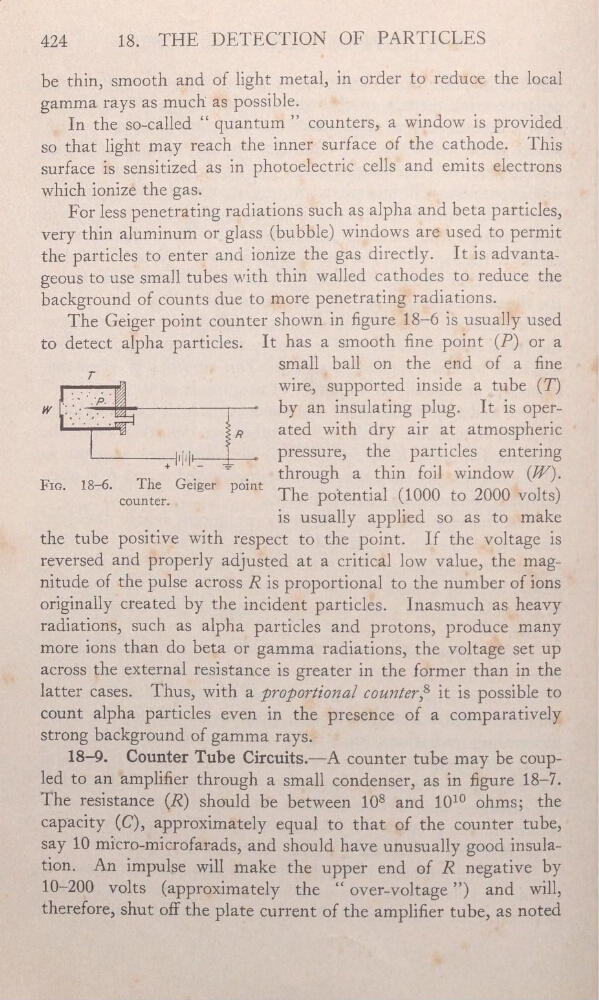
The Geiger point counter shown in gure 18—6 is usually used
to detect alpha particles. It has a smooth fine point (P) or a
r
small ball on the end of a ne
_
wire, supported inside a tube (T)
%
.
.
.
w
=É_
-
by an 1nsulat1ng plug.
It 1s oper—
”’â
;?
ated with dry air at atmospheric
_
||…
_
th}e pÊi‘Îicles ente(rin)g
+
,—
=
t
roug
a
t
in
oi
window
W.
Fm“
18_'6' …ÊÊÂ. _Gelger
p°mt
The potential (1000 to 2000 volts)
is usually applied so as to make
the tube positive with respect to the point. If the voltage is
reversed and properly adjusted at ‘a critical low value, the mag—
nitude of the pulse across R is proportional to the number of ions ‘
originally created by the incident particles.
Inasmuch as heavy
radiations, such as alpha particles and protons, produce many
more ions than do beta or gamma radiations, the voltage set up
_
across the external resistance is greater in the former than in the
_
latter cases.
Thus, with a proportional counter it is possible
to
count alpha particles even in the presence of a comparatively
strong background of gamma rays.
=
_
”
-
‘
led to an "amplier through a small condenser, as in gure 18—7.
-
The resistance (R)‘should be between 108 and 1010 ohms; the
.
capacity (C), approximately equal to that; of the counter tube,
say 10 micro—microfarads, and should have unusually good
"
tion.… An impulse Will make the upper end of, R negative
volts (approximately the “over—voltage”) and
'
therefore, ShutOfî the plate current of the amplier tube,as noted
18.
THE DETECTION OF PARTICLES
be thin, smooth and of light metal, in order to reduce the local
gamma rays as much as possible.
_
In the so—called
“
quantum
”
counters, a window is provided
so
that light may
reach the inner surface of the cathode.
This
surface is sensitized as in photoelectric cells and emits electrons
Which ionize the gas.
For less penetrating radiations such as alpha and beta particles,
very thin aluminum or glass (bubble) windows are used to permit
the particles to enter and ionize the gas directly.
It is advanta—
geous
to use small tubes with thin walled cathodes to reduce the
background of counts due to more penetrating radiations.
The Geiger point counter shown in gure 18—6 is usually used
to detect alpha particles. It has a smooth fine point (P) or a
r
small ball on the end of a ne
_
wire, supported inside a tube (T)
%
.
.
.
w
=É_
-
by an 1nsulat1ng plug.
It 1s oper—
”’â
;?
ated with dry air at atmospheric
_
||…
_
th}e pÊi‘Îicles ente(rin)g
+
,—
=
t
roug
a
t
in
oi
window
W.
Fm“
18_'6' …ÊÊÂ. _Gelger
p°mt
The potential (1000 to 2000 volts)
is usually applied so as to make
the tube positive with respect to the point. If the voltage is
reversed and properly adjusted at ‘a critical low value, the mag—
nitude of the pulse across R is proportional to the number of ions ‘
originally created by the incident particles.
Inasmuch as heavy
radiations, such as alpha particles and protons, produce many
more ions than do beta or gamma radiations, the voltage set up
_
across the external resistance is greater in the former than in the
_
latter cases.
Thus, with a proportional counter it is possible
to
count alpha particles even in the presence of a comparatively
strong background of gamma rays.
=
_
”
-
‘
led to an "amplier through a small condenser, as in gure 18—7.
-
The resistance (R)‘should be between 108 and 1010 ohms; the
.
capacity (C), approximately equal to that; of the counter tube,
say 10 micro—microfarads, and should have unusually good
"
tion.… An impulse Will make the upper end of, R negative
volts (approximately the “over—voltage”) and
'
therefore, ShutOfî the plate current of the amplier tube,as noted