

420
18.
THE DETECTION OF PARTICLES
which serves as one plate of the chamber, may consist of mica
coated With gold foil or sputtered with silver or of thin metallic
foil (e.g., aluminum several microns thick). The equivalent air
thickness of the window for the particles should be as small as
possible consistent with rigidity. Mechanical vibration of W
will change the capacity of the chamber and give
“
microphonic
”
impulses in the meter. The window may be 2 centimeters‘in
diameter.
(6) Extreme care must be taken in cleaning, and in
keeping clean, all parts of the chamber. Sandpapering or machining fresh surfaces Will make it possible to reduce the residual count
to one per
hour.
(7) The depth of the chamber should be between
0.2 and 1.5 centimeters depending on the range of the incident
-
particles. Ït is desirable to have the peak of ionization, near the
-
end of the range
of the particle, lie within the chamber. For
protons, the chamber should be not less than approximately
0.4 centimeter deep.
(8) The potential across the chamber should
be such as to produce a eld of from 100 to 1000 volts per centi—
meter.
The lead wire from W to the positive terminal of this
_
voltage supply should be enclosed in a separate grounded tube.
_
For neutrons, a parain block may be placed in front of the
chamber so that projected protons ionize the gas inside, or better,
the walls of the chamber may be lined with parain, over which a
_
light, conducting coat of graphite is brushed. A chamber lined
with parain and containing methane may also be used. A
_
lithium or boron lined chamber uses the ionization of alpha par»
ticles ejected by the
‘
trons and is very efcient,
.
'
particularly for slow
,,
'
trons.
_
o—>—
|
2
}.
‘2_40 V.
For single beta ' partzele
'
_
‘
,
detection, useachamber ten
‘
…
‘
T
centimeters
'f
;
‘
'a heavy gas such as methyl
“;
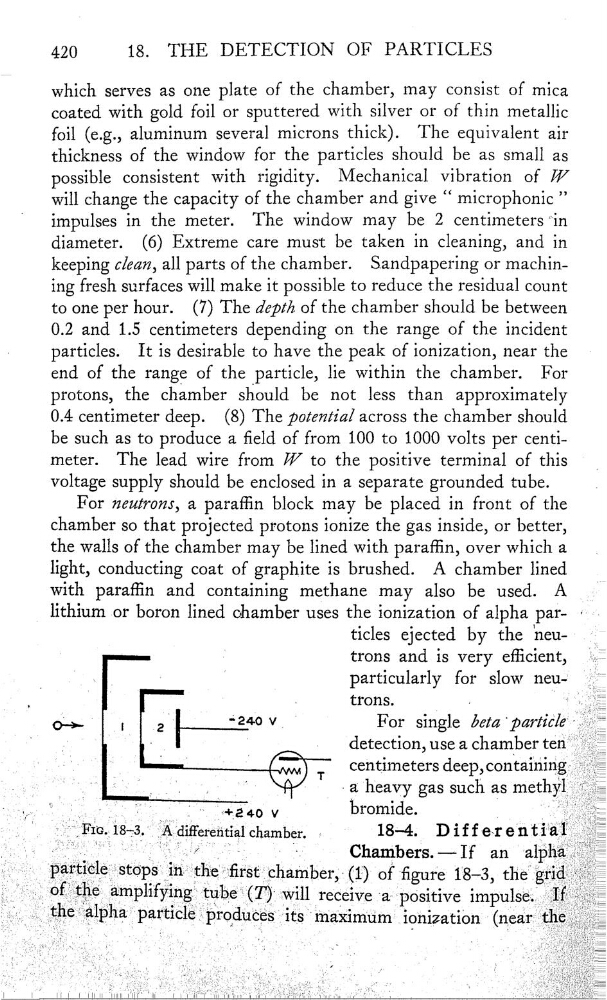
“'fï°Ï Fm
chamber.
18—4Diff erent1al
PamdeSËÔPS‘“.ÇW—ïztljî‘el*ï*fsfgchafnben‘:'(1) of gure 1‘8—3, thegrld
ofthe amphfymg tue (T) Will receive
positive
thealphaparticleprqduces-zgits‘maximumioniæÔn
18.
THE DETECTION OF PARTICLES
which serves as one plate of the chamber, may consist of mica
coated With gold foil or sputtered with silver or of thin metallic
foil (e.g., aluminum several microns thick). The equivalent air
thickness of the window for the particles should be as small as
possible consistent with rigidity. Mechanical vibration of W
will change the capacity of the chamber and give
“
microphonic
”
impulses in the meter. The window may be 2 centimeters‘in
diameter.
(6) Extreme care must be taken in cleaning, and in
keeping clean, all parts of the chamber. Sandpapering or machining fresh surfaces Will make it possible to reduce the residual count
to one per
hour.
(7) The depth of the chamber should be between
0.2 and 1.5 centimeters depending on the range of the incident
-
particles. Ït is desirable to have the peak of ionization, near the
-
end of the range
of the particle, lie within the chamber. For
protons, the chamber should be not less than approximately
0.4 centimeter deep.
(8) The potential across the chamber should
be such as to produce a eld of from 100 to 1000 volts per centi—
meter.
The lead wire from W to the positive terminal of this
_
voltage supply should be enclosed in a separate grounded tube.
_
For neutrons, a parain block may be placed in front of the
chamber so that projected protons ionize the gas inside, or better,
the walls of the chamber may be lined with parain, over which a
_
light, conducting coat of graphite is brushed. A chamber lined
with parain and containing methane may also be used. A
_
lithium or boron lined chamber uses the ionization of alpha par»
ticles ejected by the
‘
trons and is very efcient,
.
'
particularly for slow
,,
'
trons.
_
o—>—
|
2
}.
‘2_40 V.
For single beta ' partzele
'
_
‘
,
detection, useachamber ten
‘
…
‘
T
centimeters
'f
;
‘
'a heavy gas such as methyl
“;
“'fï°Ï Fm
chamber.
18—4Diff erent1al
PamdeSËÔPS‘“.ÇW—ïztljî‘el*ï*fsfgchafnben‘:'(1) of gure 1‘8—3, thegrld
ofthe amphfymg tue (T) Will receive
positive
thealphaparticleprqduces-zgits‘maximumioniæÔn