

18—3.
CONSTRUCTION OF SHALLOW CHAMBERS 419
leak away to the ground.
The pulse on the rst tube is amplied
in such a manner that the deection of the output meter (M) 13 in
direct proportion to the input voltage and hence to the ionization
produced in the shallow chamber (WC). When the instrument
has been properly constructed, the output meter registers one
count
for each particle which enters the chamber. When an
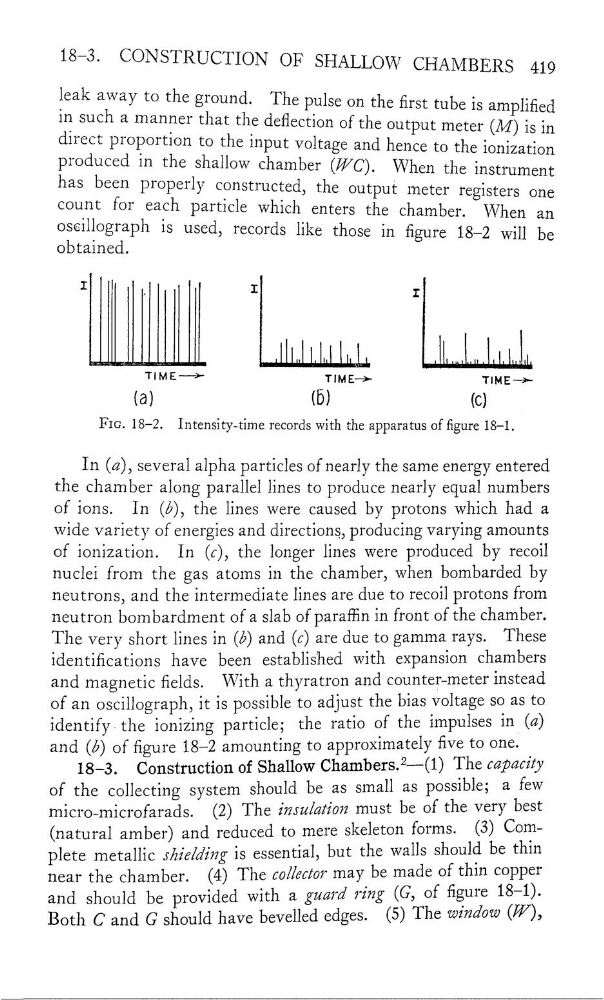
oseillograph is used, records like those in gure 18—2 will be
obtained.
TIME—>
(8)
(5)
(C)
FIG. 18—2.
Intensity-time records with the apparatus of gure 18—1.
In (a), several alpha particles of nearly the same energy entered
the chamber along parallel lines to produce nearly equal
numbers
of ions.
In (b), the lines were caused by protons Which had a
wide variety of energies and directions, producing varying amounts
of ionization.
In (C), the longer lines were produced by rec01l
nuclei from the gas
atoms in the chamber, when bombarded by
neutrons, and the intermediate lines are due to recorl protons from
neutron bombardment of a slab of parain in front of the chamber.
The very short lines in (à) and (6) are due to gamma rays.
These
identications have been established with expan31on chambers
and magnetic elds. With a thyratron and counter—meter
instead
of an oscillograph, it is possible to adjust
the bras voltage so
as to
identify the ionizing particle; the ratio of
the 1mpulses m (a)
and (b) of gure 18—2 amounting to approx1mately
ve to one.
18—3.
Construction of Shallow Chambers.2——(1) Îhe capaczty
of the collecting system
should be as small as possrble; a few
micro—microfarads.
(2) The insulaz‘ion must be of the
veryC
best
(natural amber) and reduced to mere skeleton forms.
(3)
om'
'
'
'
tial but the walls should be thin
plete metallic shzeldmg IS essen
,
f h'
er
near the chamber.
(4) The collector maybe
made o t rn c108ptî
and should be provided
with a guard rwg (G, Of g“ÿ
Both C and G should have bevelled edges.
(5) The wm aw
;
CONSTRUCTION OF SHALLOW CHAMBERS 419
leak away to the ground.
The pulse on the rst tube is amplied
in such a manner that the deection of the output meter (M) 13 in
direct proportion to the input voltage and hence to the ionization
produced in the shallow chamber (WC). When the instrument
has been properly constructed, the output meter registers one
count
for each particle which enters the chamber. When an
oseillograph is used, records like those in gure 18—2 will be
obtained.
TIME—>
(8)
(5)
(C)
FIG. 18—2.
Intensity-time records with the apparatus of gure 18—1.
In (a), several alpha particles of nearly the same energy entered
the chamber along parallel lines to produce nearly equal
numbers
of ions.
In (b), the lines were caused by protons Which had a
wide variety of energies and directions, producing varying amounts
of ionization.
In (C), the longer lines were produced by rec01l
nuclei from the gas
atoms in the chamber, when bombarded by
neutrons, and the intermediate lines are due to recorl protons from
neutron bombardment of a slab of parain in front of the chamber.
The very short lines in (à) and (6) are due to gamma rays.
These
identications have been established with expan31on chambers
and magnetic elds. With a thyratron and counter—meter
instead
of an oscillograph, it is possible to adjust
the bras voltage so
as to
identify the ionizing particle; the ratio of
the 1mpulses m (a)
and (b) of gure 18—2 amounting to approx1mately
ve to one.
18—3.
Construction of Shallow Chambers.2——(1) Îhe capaczty
of the collecting system
should be as small as possrble; a few
micro—microfarads.
(2) The insulaz‘ion must be of the
veryC
best
(natural amber) and reduced to mere skeleton forms.
(3)
om'
'
'
'
tial but the walls should be thin
plete metallic shzeldmg IS essen
,
f h'
er
near the chamber.
(4) The collector maybe
made o t rn c108ptî
and should be provided
with a guard rwg (G, Of g“ÿ
Both C and G should have bevelled edges.
(5) The wm aw
;