

‘
EXPERIMENT 17—1
41 5
EXPERIMENT 17—1
A STUDY OF A QUADRANT ELECTROMETER
The purpose of this experiment is to study the adjustment and
to measure the voltage sensitiveness of a quadrant electrometer
under various conditions.
When rst using an electrometer it
will be well to use a comparatively coarse suspension. A 0.0015
or 00007 gold galvanometer suspension will serve.
Âdjurtment.——l. Carefully raise and suspend the needle as
nearly as possible in the center of the quadrants. Two of the
quadrants should lie entirely on one side and two on the other
side of a line joining the center to the middle point of the scale.
R
_
T
lll"'
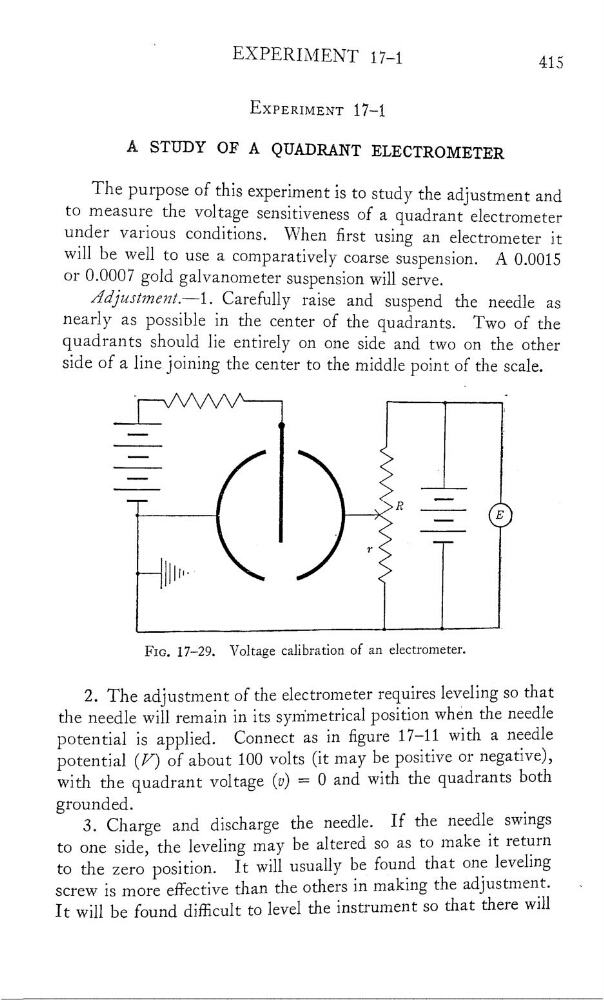
FIG. 17—29.
Voltage calibration of an electrometer.
2. The adjustment of the electrometer requires leveling
so that
the needle will remain in its syrrimetrical position when
the needle
potential is applied.
Connect as in gure
With a needle
potential (V) of about 100 volts (it may be p051t1ve or negative),
With the quadrant voltage (v) = 0 and With the quadrants both
rounded.
_
g
3. Charge and discharge the needle. If the needle sw1ngs
to one side, the leveling may
be altered so as to make it return
to the zero position.
It will usually be found
that one
leveling
screw is more effective than the others in making the
.
It Will be found difcult to level the instrument so that there Wi
EXPERIMENT 17—1
41 5
EXPERIMENT 17—1
A STUDY OF A QUADRANT ELECTROMETER
The purpose of this experiment is to study the adjustment and
to measure the voltage sensitiveness of a quadrant electrometer
under various conditions.
When rst using an electrometer it
will be well to use a comparatively coarse suspension. A 0.0015
or 00007 gold galvanometer suspension will serve.
Âdjurtment.——l. Carefully raise and suspend the needle as
nearly as possible in the center of the quadrants. Two of the
quadrants should lie entirely on one side and two on the other
side of a line joining the center to the middle point of the scale.
R
_
T
lll"'
FIG. 17—29.
Voltage calibration of an electrometer.
2. The adjustment of the electrometer requires leveling
so that
the needle will remain in its syrrimetrical position when
the needle
potential is applied.
Connect as in gure
With a needle
potential (V) of about 100 volts (it may be p051t1ve or negative),
With the quadrant voltage (v) = 0 and With the quadrants both
rounded.
_
g
3. Charge and discharge the needle. If the needle sw1ngs
to one side, the leveling may
be altered so as to make it return
to the zero position.
It will usually be found
that one
leveling
screw is more effective than the others in making the
.
It Will be found difcult to level the instrument so that there Wi