

414
17.
SMALL CURRENT TECHNlQUE
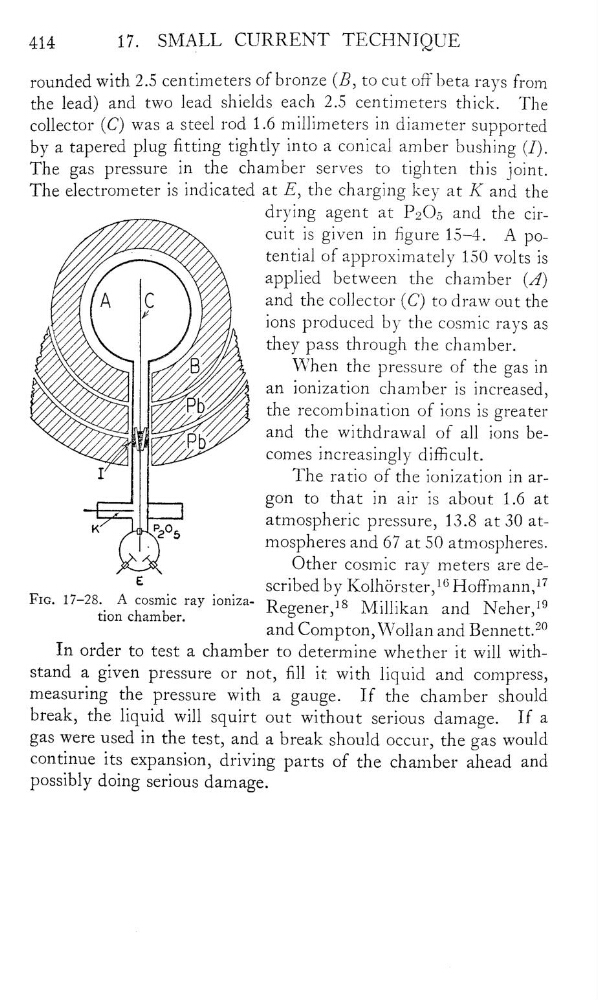
rounded With 2.5 centimeters of bronze (B, to cut
beta rays from
the lead) and two lead shields each 2.5 centimeters thick.
The
collector (C) was a steel rod 1.6 millimeters in diameter supported
by a tapered plug tting tightly into a conical amber bushing (I).
The gas pressure
in the chamber serves to tighten this joint.
The electrometer is indicated at E, the charging key at K and the
drying agent at P205 and the cir///////
cuit is given in gure 15—4. A po/
'
////
tential of approximately 150 volts is
// applied between the chamber (Â)
/
and the collector (C) to draw out the
/
ions produced by the cosmic rays as
_
they pass through the chamber.
'
When the pressure of the gas
in
/ /
'
an
ionization chamber is increased,
.b
the recombination of ions is greater
////// ,Ï
/ and the Withdrawal of all ions be/////Â
'/
comes increasingly difcult.
I
The ratio of the ionization in ar—
gon to that in air is about 1.6 at
K
-
atmospheric pressure, 13.8 at 30 at—
Q2
5
mospheres and 67 at 50 atmospheres.
,,
\\
Other cosmic ray meters are de—
5
_
_
_
scribed by
FIG‘
10n12aMillikan and Neher,19
and Compton, Wollan and Bennett.20
In order to test a chamber to determine whether it will withstand a given pressure or not, ll it with liquid and compress,
measuring the pressure With a gauge.
If the chamber should
break, the liquid Will squirt out Without serious damage.
If a
gas were used in the test, and a break should occur, the gas
would
continue its expansion, driving parts of the chamber ahead and
possibly doing serious damage.
17.
SMALL CURRENT TECHNlQUE
rounded With 2.5 centimeters of bronze (B, to cut
beta rays from
the lead) and two lead shields each 2.5 centimeters thick.
The
collector (C) was a steel rod 1.6 millimeters in diameter supported
by a tapered plug tting tightly into a conical amber bushing (I).
The gas pressure
in the chamber serves to tighten this joint.
The electrometer is indicated at E, the charging key at K and the
drying agent at P205 and the cir///////
cuit is given in gure 15—4. A po/
'
////
tential of approximately 150 volts is
// applied between the chamber (Â)
/
and the collector (C) to draw out the
/
ions produced by the cosmic rays as
_
they pass through the chamber.
'
When the pressure of the gas
in
/ /
'
an
ionization chamber is increased,
.b
the recombination of ions is greater
////// ,Ï
/ and the Withdrawal of all ions be/////Â
'/
comes increasingly difcult.
I
The ratio of the ionization in ar—
gon to that in air is about 1.6 at
K
-
atmospheric pressure, 13.8 at 30 at—
Q2
5
mospheres and 67 at 50 atmospheres.
,,
\\
Other cosmic ray meters are de—
5
_
_
_
scribed by
FIG‘
10n12aMillikan and Neher,19
and Compton, Wollan and Bennett.20
In order to test a chamber to determine whether it will withstand a given pressure or not, ll it with liquid and compress,
measuring the pressure With a gauge.
If the chamber should
break, the liquid Will squirt out Without serious damage.
If a
gas were used in the test, and a break should occur, the gas
would
continue its expansion, driving parts of the chamber ahead and
possibly doing serious damage.