

’
17—11.
VOLTAGE MEASUREMENTS
401
With the
the needle potential V is
great compared With the potentials of the quadrants, i.e.,
Ül + 02
.
.
‘
V,> —2——
so that equation 17—7 reduces to"
‘
6 = KV(vl — 02) = KVv'
(17—9)- '
where
v = vl — 02
(17—10)
.
.
.
9
_
and the sen31tweness13
S = — = KV_
'
(17—11)
stating that the deections are linearly proportional to the
rant voltage. This is found to be nearly true in practice but for
_
accurate work it is necessary to calibrate the scale in terms of
volts or to use a small part of the
c—
scale near the zero reading.
_
_
‘
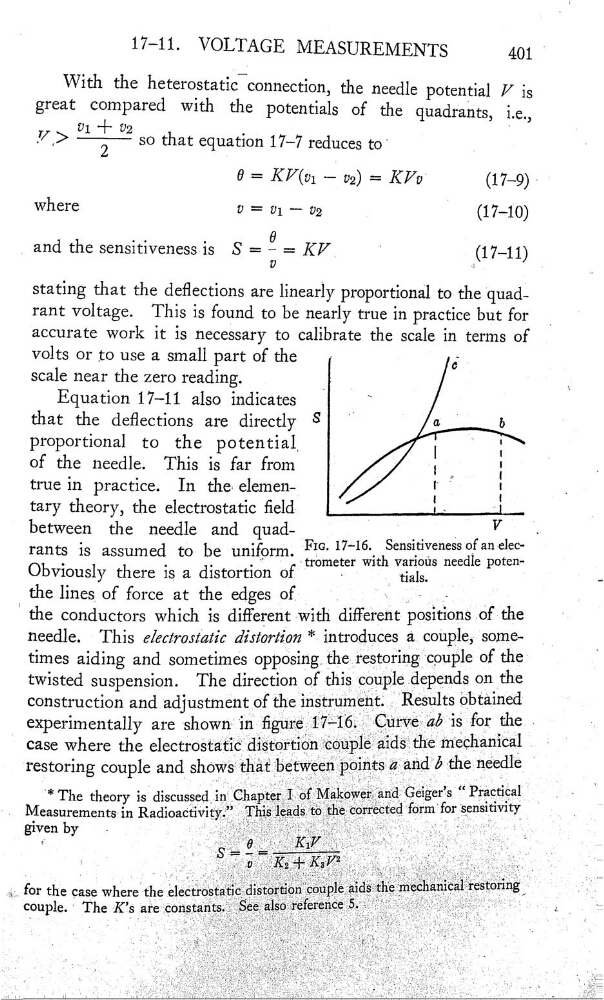
Equation 17—11 also indicates
that the deections are directly
S
'
a
_
b
‘
proportional to the potential,
|
;
of the needle.
This is far from
__
:
.
true in practice. In the elemen_
-
:
'
:
.
tary theory, the electrostatic eld
_
—
‘
between
the
needle and quadF
7
6
S' _ _
,
{
V]
‘
'
'
—
IG. 1 —1
.
ensmve'ness o aneec—
IS
assumed.
to 13.6 11111form. trômeter With varioùs needle poten—
Obv10usly there is a distortion of
_
als,
_
_
.
-
the lines of force at the edges of;
.
"
. __—
the conductors which is different With different p031tions
of the
-,
needle.
This electrasz‘àtz‘c distortion
introduœs‘ a couple,—- some—
_
times aiding and sometimes
the;reî$t9rmgÏC9uple
Of the
-
twisted suspension. The direction of this
construction and adjustment of the instrument
pbta1ned
experimentally are shown" in
13f0r the ‘
_
“
case where the elecüoStàtiëdistortlonC0upleaïdsthe mechanical
_
'
restoring couple and
_
*The theor
s
_
…
-
.
“form
forsenmtmtÿ
:
'
iven b
.
,
«
l
“
g
y
,
S_K1Ï’
.
g
°°“Ple-' The K’S are°°nSmntsSeeals°‘°feœnœs
u
17—11.
VOLTAGE MEASUREMENTS
401
With the
the needle potential V is
great compared With the potentials of the quadrants, i.e.,
Ül + 02
.
.
‘
V,> —2——
so that equation 17—7 reduces to"
‘
6 = KV(vl — 02) = KVv'
(17—9)- '
where
v = vl — 02
(17—10)
.
.
.
9
_
and the sen31tweness13
S = — = KV_
'
(17—11)
stating that the deections are linearly proportional to the
rant voltage. This is found to be nearly true in practice but for
_
accurate work it is necessary to calibrate the scale in terms of
volts or to use a small part of the
c—
scale near the zero reading.
_
_
‘
Equation 17—11 also indicates
that the deections are directly
S
'
a
_
b
‘
proportional to the potential,
|
;
of the needle.
This is far from
__
:
.
true in practice. In the elemen_
-
:
'
:
.
tary theory, the electrostatic eld
_
—
‘
between
the
needle and quadF
7
6
S' _ _
,
{
V]
‘
'
'
—
IG. 1 —1
.
ensmve'ness o aneec—
IS
assumed.
to 13.6 11111form. trômeter With varioùs needle poten—
Obv10usly there is a distortion of
_
als,
_
_
.
-
the lines of force at the edges of;
.
"
. __—
the conductors which is different With different p031tions
of the
-,
needle.
This electrasz‘àtz‘c distortion
introduœs‘ a couple,—- some—
_
times aiding and sometimes
the;reî$t9rmgÏC9uple
Of the
-
twisted suspension. The direction of this
construction and adjustment of the instrument
pbta1ned
experimentally are shown" in
13f0r the ‘
_
“
case where the elecüoStàtiëdistortlonC0upleaïdsthe mechanical
_
'
restoring couple and
_
*The theor
s
_
…
-
.
“form
forsenmtmtÿ
:
'
iven b
.
,
«
l
“
g
y
,
S_K1Ï’
.
g
°°“Ple-' The K’S are°°nSmntsSeeals°‘°feœnœs
u