

'
400
17.
SMALL CURRENT TECHNIQUE
slightly, until, with K closed, a zero deection is obtained. Either
of the methods for current measurement may then be used.
17—11.
Calibration for Voltage Measurements.—The proce_
dure to be used in the adjustment and voltage calibration of an
electrometer is given in experiment 17—1.
There are three things to be considered in calibrating an electrometer for voltage measurements; rst, the voltage sensitiveness
or
number of millimeters deflection on a scale one meter away
caused by one volt across the quadrants; second, the variations of
the sensitiveness With deection and with needle potential; third,
the period of free swing. It is desirable that the sensitiveness be
constant over the entire scale and that it be high when dealing
with small differences of voltage, even at a sacrifice of the range of
the instrument.
Further, the period must not be too great for
convenience in making the readings.
The curve showing the deections at increasing voltage across
the quadrants (constant needle potential) is not, in general, a
straight line. In other words, the voltage to cause a deection
from 0 to 3 centimeters is not the same as that from 3 to 6 centi—
meters, etc.
The elementary theory (Starling,
“
Electricity and
Magnetism,” p. 157, 4th Edition) of a Dolezalek electrometer leads
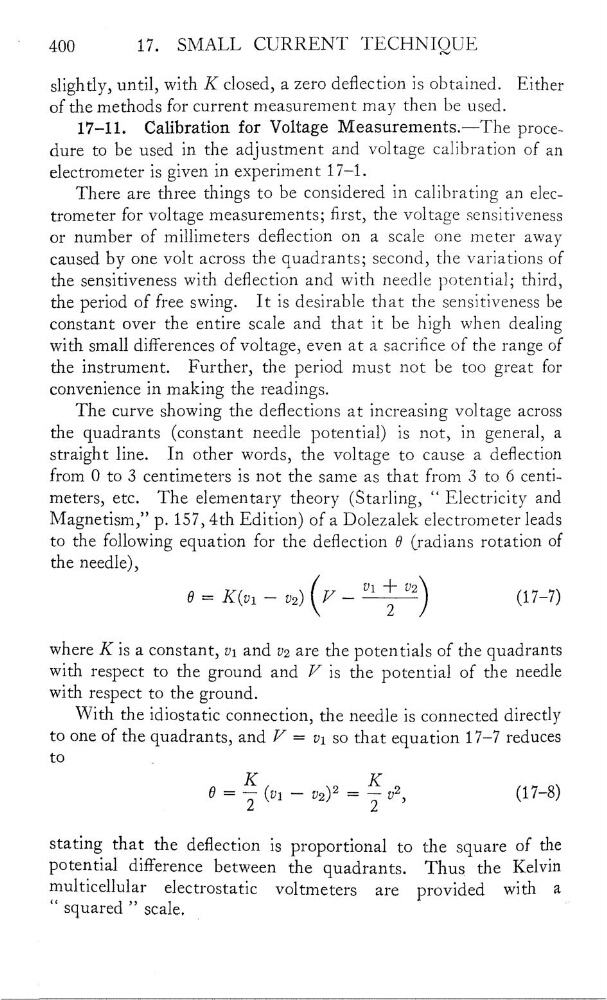
to the following equation for the deection @ (_radians rotation of
the needle),
@ = K… — 02) (V — ”—1i 2“—UÊ>
(17—7)
where K is a constant, 01 and 02 are the potentials of the quadrants
with respect to the ground and V is the potential of the needle
With respect to the ground.
With the idiostatic connection, the needle is connected directly
to one of the quadrants, and V = vl so that equation 17—7 reduces
tO
.
6 =
5
(01 — Z)2)2 = 502,
(17—8)
2
2
stating that the deection is proportional to the square
of the
potential difference between the quadrants. Thus the Kelvin
multicellular
electrostatic
voltmeters
are
provided
With
a
“
squared
”
scale.
_
400
17.
SMALL CURRENT TECHNIQUE
slightly, until, with K closed, a zero deection is obtained. Either
of the methods for current measurement may then be used.
17—11.
Calibration for Voltage Measurements.—The proce_
dure to be used in the adjustment and voltage calibration of an
electrometer is given in experiment 17—1.
There are three things to be considered in calibrating an electrometer for voltage measurements; rst, the voltage sensitiveness
or
number of millimeters deflection on a scale one meter away
caused by one volt across the quadrants; second, the variations of
the sensitiveness With deection and with needle potential; third,
the period of free swing. It is desirable that the sensitiveness be
constant over the entire scale and that it be high when dealing
with small differences of voltage, even at a sacrifice of the range of
the instrument.
Further, the period must not be too great for
convenience in making the readings.
The curve showing the deections at increasing voltage across
the quadrants (constant needle potential) is not, in general, a
straight line. In other words, the voltage to cause a deection
from 0 to 3 centimeters is not the same as that from 3 to 6 centi—
meters, etc.
The elementary theory (Starling,
“
Electricity and
Magnetism,” p. 157, 4th Edition) of a Dolezalek electrometer leads
to the following equation for the deection @ (_radians rotation of
the needle),
@ = K… — 02) (V — ”—1i 2“—UÊ>
(17—7)
where K is a constant, 01 and 02 are the potentials of the quadrants
with respect to the ground and V is the potential of the needle
With respect to the ground.
With the idiostatic connection, the needle is connected directly
to one of the quadrants, and V = vl so that equation 17—7 reduces
tO
.
6 =
5
(01 — Z)2)2 = 502,
(17—8)
2
2
stating that the deection is proportional to the square
of the
potential difference between the quadrants. Thus the Kelvin
multicellular
electrostatic
voltmeters
are
provided
With
a
“
squared
”
scale.
_