

390
17.
SMALL CURRENT TECHNIQUE
plate and is vigorously repelled. Ions formed in the gas around the
leaf neutralize its charge until it is again attracted to the plate.
The number of oscillations of the leaf each second is a measure of
the strength of the ionizing source.
Bela my electroscopes are similar to those of gure 17—1 and 2,
except that an aluminum sheet about 0.006 centimeter thick is
placed over the active material to cut off all alpha rays. The ion-ization in the leaf chamber is then due to the beta and gamma rays
together. The former, however, are much better ionizers than
the latter, so that the fall of the leaf is largely due to the beta
activity.
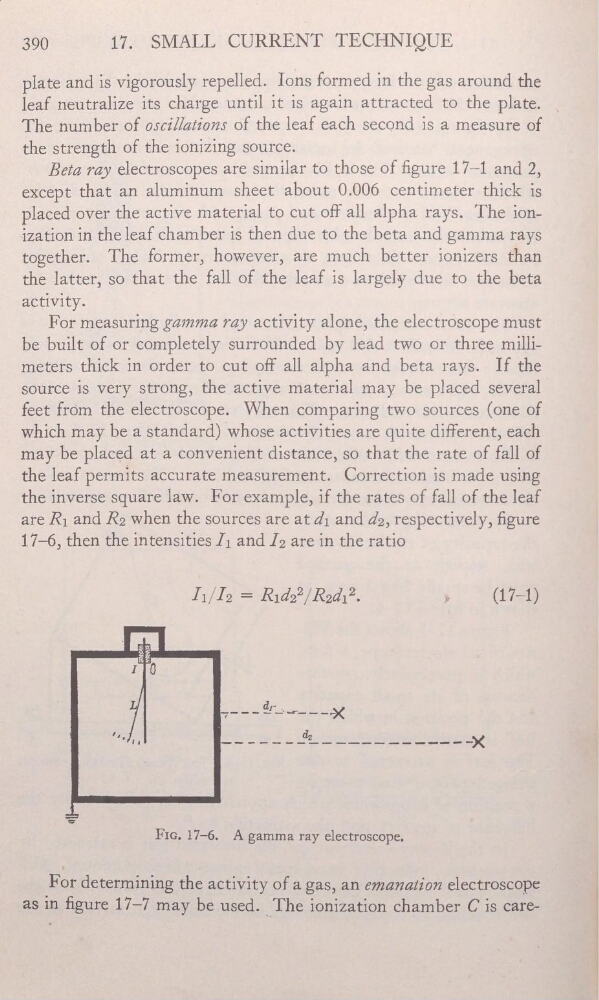
For measuring gamma my activity alone, the electroscope must
be built of or completely surrounded by lead two or three millimeters thick in order to cut oE all alpha and beta rays. If the
source is very strong, the active material may be placed several
feet fr0m the electroscope. When comparing two sources (one of
Which may
be a standard) whose activities are quite different, each
may
be placed at a convenient distance, so that the rate of fall of
the leaf permits accurate measurement. Correction is made using
the inverse square law. For example, if the rates of fall of the leaf
are R1 and R2 when the sources are at dl and dg, respectively, gure
17—6, then the intensities Il and 12 are in the ratio
11/12 = R1d22/R2d12.
(17—1)
'
IËË0
.
_
,
—,———d—"—=—r————x
_
,
.
l,,“
———————d“———————————-—X
—
'
FIG. 17—6.
A gamma
electroscope.
'
_
For determining the activityof a gas, an emanaz‘ion electroscope
as in gure 17—7 may be used. __The ionization chamber C is care—
'
17.
SMALL CURRENT TECHNIQUE
plate and is vigorously repelled. Ions formed in the gas around the
leaf neutralize its charge until it is again attracted to the plate.
The number of oscillations of the leaf each second is a measure of
the strength of the ionizing source.
Bela my electroscopes are similar to those of gure 17—1 and 2,
except that an aluminum sheet about 0.006 centimeter thick is
placed over the active material to cut off all alpha rays. The ion-ization in the leaf chamber is then due to the beta and gamma rays
together. The former, however, are much better ionizers than
the latter, so that the fall of the leaf is largely due to the beta
activity.
For measuring gamma my activity alone, the electroscope must
be built of or completely surrounded by lead two or three millimeters thick in order to cut oE all alpha and beta rays. If the
source is very strong, the active material may be placed several
feet fr0m the electroscope. When comparing two sources (one of
Which may
be a standard) whose activities are quite different, each
may
be placed at a convenient distance, so that the rate of fall of
the leaf permits accurate measurement. Correction is made using
the inverse square law. For example, if the rates of fall of the leaf
are R1 and R2 when the sources are at dl and dg, respectively, gure
17—6, then the intensities Il and 12 are in the ratio
11/12 = R1d22/R2d12.
(17—1)
'
IËË0
.
_
,
—,———d—"—=—r————x
_
,
.
l,,“
———————d“———————————-—X
—
'
FIG. 17—6.
A gamma
electroscope.
'
_
For determining the activityof a gas, an emanaz‘ion electroscope
as in gure 17—7 may be used. __The ionization chamber C is care—
'