

17—3.
VARIOUS FORMS _OF ELECTROSCÛPES 389
ionization current but, since the alpha rays are by far the strongest
,
ionizers, the instrument is spoken of as an alpha my electroscope.
In gure 17—3, the leaf system L is entirely endosed in. the
upper metal box and the ionization chamber is in a separate compartment below.
'
The leaf is charged by means of the ne wire W
which is then rotated to touch the groùnded case. The capacity
of the leaf and the lower metal plate, with respect to the case, is
comparatively large in this type of instrument,perhaps seŸeral
hundred e.s.u.
Therefore, a comparatively JZ‘TOÜg radioactive
substance is needed to discharge .theleaf at a suicientrate for
accurate timing.
_
‘
The electroscope of gures 17—‘1 or 2 usually has a capacity of
approximately 10. to 60 e.s.u.
If the leaf is found to drop more f
,
rapidly than desired for accurate timing, due to the usé of a strong
source, add a condenser of several hundred e.s.u., capacity in parallel with the leaf and case.
This may consist of a small concentric
cylinder condenser, as in the dotted linesof gure 17—2 or an
auxiliary condenser built with excellent ihsula—tion and connected
with a shielded lead wire to the leaf and case.
The natural leak of
-
the instrument will be altered by the addition of the condenser.
.
For measuringfeeâle sources,
.
,
the capacity of the leaf system
.
'
I
with respect to the ground
.
-
_
must be small; 2 or 3 e.s.u. as
_
_
_
shown in figure 17—4.
‘
.
!
p
L‘
»
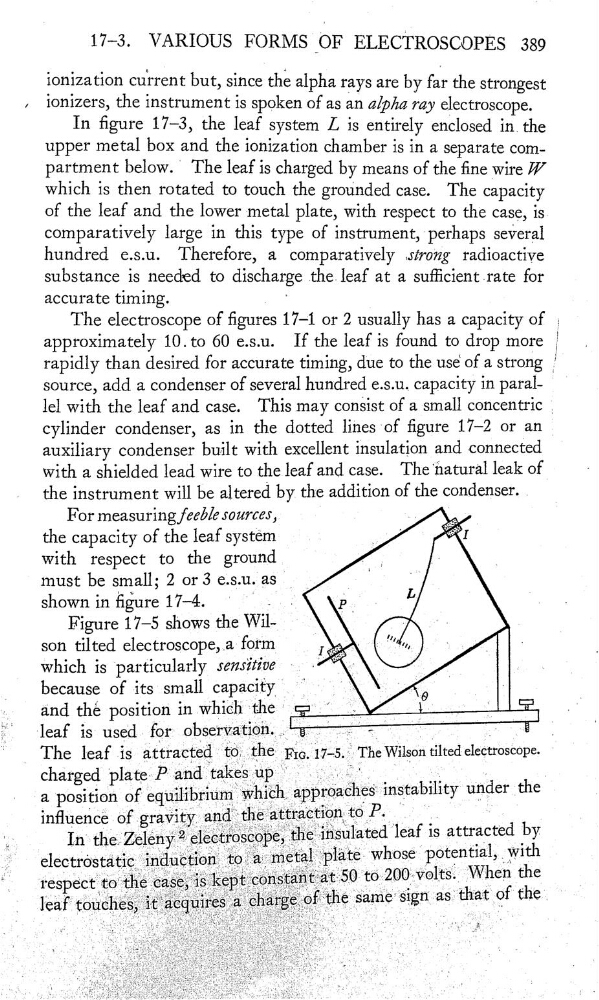
Figure 17—5 shows the
‘
_
‘
-
son tilted electroscope,a form
—
“
‘
.
|
'
,
which is particularly semïz‘ive -
=
]
.
.
_
_
because of its small capacity
‘
A
and thé position in
‘
-
‘
leaf is used for
…
1
1
_
.‘
‘
‘
The leaf is attractèë tOthe
tiltedele°tf°3°°Pe°
char ed
'
_
'
.“Ç
‘
-
.
_
a poÎitioii of equ1hbrlumwhlchappr03Ch631nstablllty under
_
inueñeè Of
.—"
_
»
electrostatlC1nd\lCt10toametalplaœ
whose
VARIOUS FORMS _OF ELECTROSCÛPES 389
ionization current but, since the alpha rays are by far the strongest
,
ionizers, the instrument is spoken of as an alpha my electroscope.
In gure 17—3, the leaf system L is entirely endosed in. the
upper metal box and the ionization chamber is in a separate compartment below.
'
The leaf is charged by means of the ne wire W
which is then rotated to touch the groùnded case. The capacity
of the leaf and the lower metal plate, with respect to the case, is
comparatively large in this type of instrument,perhaps seŸeral
hundred e.s.u.
Therefore, a comparatively JZ‘TOÜg radioactive
substance is needed to discharge .theleaf at a suicientrate for
accurate timing.
_
‘
The electroscope of gures 17—‘1 or 2 usually has a capacity of
approximately 10. to 60 e.s.u.
If the leaf is found to drop more f
,
rapidly than desired for accurate timing, due to the usé of a strong
source, add a condenser of several hundred e.s.u., capacity in parallel with the leaf and case.
This may consist of a small concentric
cylinder condenser, as in the dotted linesof gure 17—2 or an
auxiliary condenser built with excellent ihsula—tion and connected
with a shielded lead wire to the leaf and case.
The natural leak of
-
the instrument will be altered by the addition of the condenser.
.
For measuringfeeâle sources,
.
,
the capacity of the leaf system
.
'
I
with respect to the ground
.
-
_
must be small; 2 or 3 e.s.u. as
_
_
_
shown in figure 17—4.
‘
.
!
p
L‘
»
Figure 17—5 shows the
‘
_
‘
-
son tilted electroscope,a form
—
“
‘
.
|
'
,
which is particularly semïz‘ive -
=
]
.
.
_
_
because of its small capacity
‘
A
and thé position in
‘
-
‘
leaf is used for
…
1
1
_
.‘
‘
‘
The leaf is attractèë tOthe
tiltedele°tf°3°°Pe°
char ed
'
_
'
.“Ç
‘
-
.
_
a poÎitioii of equ1hbrlumwhlchappr03Ch631nstablllty under
_
inueñeè Of
.—"
_
»
electrostatlC1nd\lCt10toametalplaœ
whose