

362
—
16.
VACUUM TECHNIQUE
heated by passing an electrical current through them, by continued bombardment by electrons from a hot lament or by the
use
of an induction furnace which uses high frequency currents
produced by the discharge of a condenser or by a vacuum tube
'
oscillatôr.
16—5.
The Sorption Processes.—Sorption is a property of cer—
tain substances for occluding and retaining gases and vapors. =Âäsorpz‘ion is a true solution in a solid and takes place rapidly at rst,
.
'
then more and more slowly. Âdsorption consists of a condensation
on the,surface and is practically instantaneous. Certain chemical
'
reactions may occur to reduce the
amount
of gas or vapor
in a
chamber.
These three sorption
‘
’
...—_
pr0cesses may occur simultane—
-
ously.
Charcoczl which has been previously freed from gases has the
_
property of adsorbing large quantities of gases, especially at low
temperatures such as produced by
liquid air. Ordinary wood or co—
coanut 'charcoal does not ShOW'
this property to any appreciable
extent until it has been subjected
'
-
to
a
heat treatment at
about
'
'
'
800° C., called “activation.”
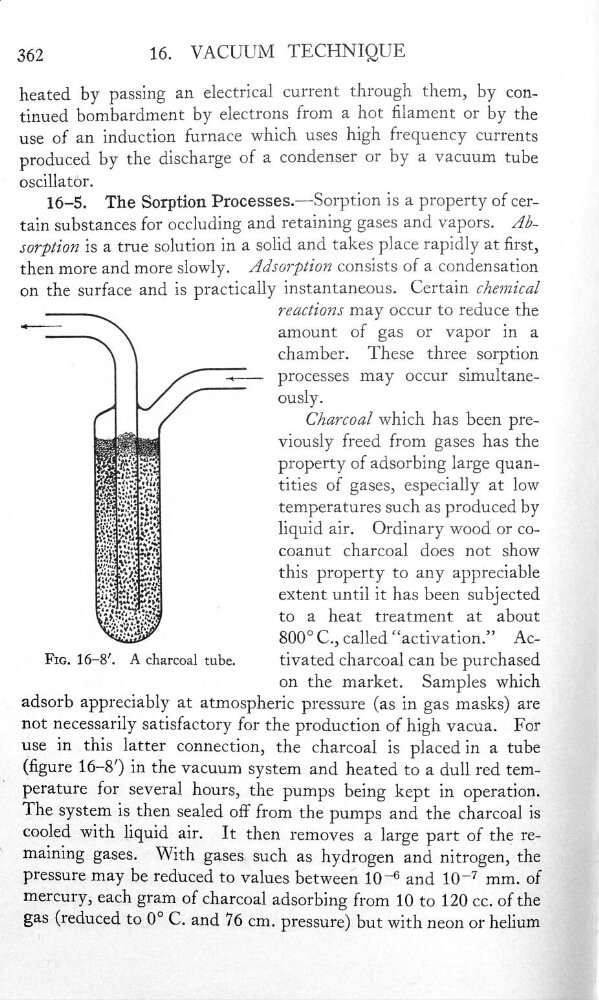
Ac-FIG. 16—8'. -A charcoal tube.
tivated charcoal can be purchased
_
_
.
on
the
Samples which
adsorb,appreCiably at atmospheric pressure (as in gas masks) are
._
not necessarily satisfactory for the production of high vacua. For
use
in this latter connection, the charcoal is placed in a tube
(gure 16—8’ ) in the vacuum system and heated to a dull red tem—
perature for several hours, the pumps being kept in operation.
,
The system is then sealed off from ’thepumps and the charcoal‘is
cooled with liquid air. It then removes a large part of the re—
‘
maining gases.
With gases such as hydrogen and nitrogen, the
—
'
pressure maybe reduced to_values between 10"6 and 10“7 mm. of
,
.
gram of charcoal adsorbing from 10 to 120 cc. of the
_
,
gas"(reduced to 0° C. and 76 cm. pressure) but with neon or helium
i
—
16.
VACUUM TECHNIQUE
heated by passing an electrical current through them, by continued bombardment by electrons from a hot lament or by the
use
of an induction furnace which uses high frequency currents
produced by the discharge of a condenser or by a vacuum tube
'
oscillatôr.
16—5.
The Sorption Processes.—Sorption is a property of cer—
tain substances for occluding and retaining gases and vapors. =Âäsorpz‘ion is a true solution in a solid and takes place rapidly at rst,
.
'
then more and more slowly. Âdsorption consists of a condensation
on the,surface and is practically instantaneous. Certain chemical
'
reactions may occur to reduce the
amount
of gas or vapor
in a
chamber.
These three sorption
‘
’
...—_
pr0cesses may occur simultane—
-
ously.
Charcoczl which has been previously freed from gases has the
_
property of adsorbing large quantities of gases, especially at low
temperatures such as produced by
liquid air. Ordinary wood or co—
coanut 'charcoal does not ShOW'
this property to any appreciable
extent until it has been subjected
'
-
to
a
heat treatment at
about
'
'
'
800° C., called “activation.”
Ac-FIG. 16—8'. -A charcoal tube.
tivated charcoal can be purchased
_
_
.
on
the
Samples which
adsorb,appreCiably at atmospheric pressure (as in gas masks) are
._
not necessarily satisfactory for the production of high vacua. For
use
in this latter connection, the charcoal is placed in a tube
(gure 16—8’ ) in the vacuum system and heated to a dull red tem—
perature for several hours, the pumps being kept in operation.
,
The system is then sealed off from ’thepumps and the charcoal‘is
cooled with liquid air. It then removes a large part of the re—
‘
maining gases.
With gases such as hydrogen and nitrogen, the
—
'
pressure maybe reduced to_values between 10"6 and 10“7 mm. of
,
.
gram of charcoal adsorbing from 10 to 120 cc. of the
_
,
gas"(reduced to 0° C. and 76 cm. pressure) but with neon or helium
i