

16—4.
THE ELIMINATION OF OCCLUDED GASES 361
out of the high vacuum system (H) In fact, for very high vacua,
it has been found necessary to add a bend in the large tube leading
from the second stage to the system to be evacuated, or to use a
trap cooled With ice water.
The main tubing of the pump may be
made of stainless steel and should be thinned down, as shown in
gure 16—7, to keep the boiler heat from the water jacket. It is
,
silver soldered to the copper base plate… The particular pumps
shown operated at maximum speed (21 liters/sec.) when 135 watts
were used to heat (Â) and 150 watts for (B). A fore pressure of
0.05 millimeter of mercury was used.
‘
,
A more volatile oil should be used in the rst stage than in—
the second stage diffusion pump. _ A pumping system3 in which
°
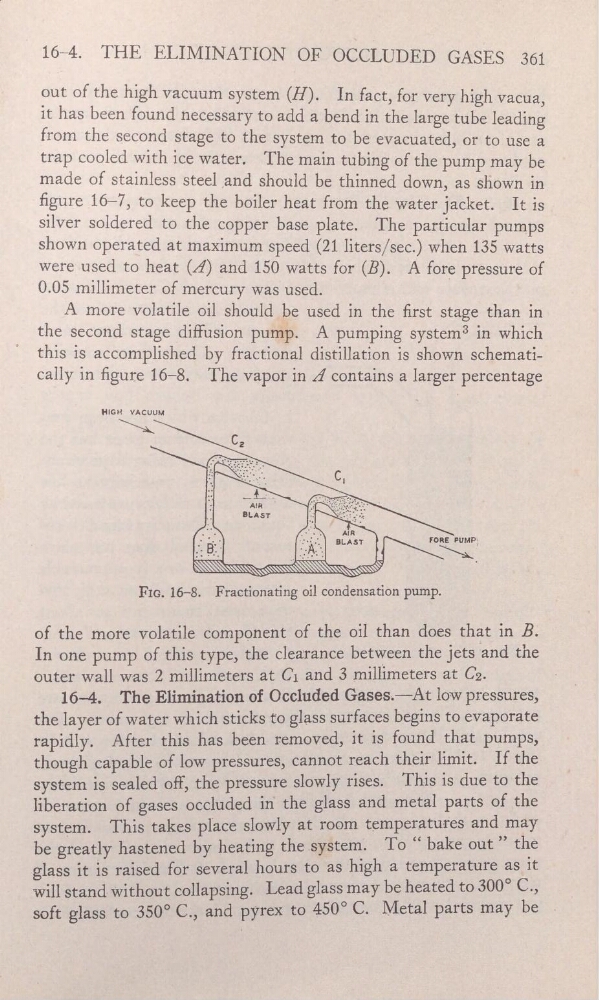
this is accomplished by fractional distillation is shown schematically in gure 16—8. The vapor in zî’ contains a larger percentage
HIGH
VACUUM
'
\
C2
16—8.
Fractionating oil condensation pump.
;
’
of the more volatile component of the oil than does that
in B:
‘
In one pump
of this type, the clearance between
the Jets
and the
outer wall was 2 millimeters at C1 and 3 millimeters at Cg. ‘
_
.
_
16—4.
The Elimination of Occluded Gases.—At low
[
the layer of water Which sticks
to glaSs surfaces begins to evaporate
rapidly. After this hasbeen removed, it 15 found that pumps,
though‘capable of low pressures, cannot reach their limit.
If the
”system is sealed off, the pressure slowly uses.“
This 1s due to the
liberation of gases
occluded irf the-glass and metal parts
of
system. This takes place slowly at room temperatures
_
be greatly hastened by heating the iSysteml;
To
out the
glass it israised for several hours
to as ‘h1gha temperature Îs_it
_
-
will stand without collapsing. Lead glass‘ may be heated
to 300 C.,-_ .
_
soft glass to 3500
'andpÿrex t045'0° C.
parts may
be
._
_
THE ELIMINATION OF OCCLUDED GASES 361
out of the high vacuum system (H) In fact, for very high vacua,
it has been found necessary to add a bend in the large tube leading
from the second stage to the system to be evacuated, or to use a
trap cooled With ice water.
The main tubing of the pump may be
made of stainless steel and should be thinned down, as shown in
gure 16—7, to keep the boiler heat from the water jacket. It is
,
silver soldered to the copper base plate… The particular pumps
shown operated at maximum speed (21 liters/sec.) when 135 watts
were used to heat (Â) and 150 watts for (B). A fore pressure of
0.05 millimeter of mercury was used.
‘
,
A more volatile oil should be used in the rst stage than in—
the second stage diffusion pump. _ A pumping system3 in which
°
this is accomplished by fractional distillation is shown schematically in gure 16—8. The vapor in zî’ contains a larger percentage
HIGH
VACUUM
'
\
C2
16—8.
Fractionating oil condensation pump.
;
’
of the more volatile component of the oil than does that
in B:
‘
In one pump
of this type, the clearance between
the Jets
and the
outer wall was 2 millimeters at C1 and 3 millimeters at Cg. ‘
_
.
_
16—4.
The Elimination of Occluded Gases.—At low
[
the layer of water Which sticks
to glaSs surfaces begins to evaporate
rapidly. After this hasbeen removed, it 15 found that pumps,
though‘capable of low pressures, cannot reach their limit.
If the
”system is sealed off, the pressure slowly uses.“
This 1s due to the
liberation of gases
occluded irf the-glass and metal parts
of
system. This takes place slowly at room temperatures
_
be greatly hastened by heating the iSysteml;
To
out the
glass it israised for several hours
to as ‘h1gha temperature Îs_it
_
-
will stand without collapsing. Lead glass‘ may be heated
to 300 C.,-_ .
_
soft glass to 3500
'andpÿrex t045'0° C.
parts may
be
._
_