

356
16.
VACUUM TECHNIQUE
C’
,
are isolated from each other by the oiled vane E, which is held
_
in close contact with the rotor by a spring at its top. Two such
-
pumps
are mounted on the same shaft with a small phase displacement to each other, connected in series and immersed in oil. A
valve is provided
at the inlet F to prevent oil being sucked back
into the evacuated system.
Such pumps operate
at approximately
six liters per
minute and, when new, can reduce the pressure to
Ÿ
10“3 mm.
,
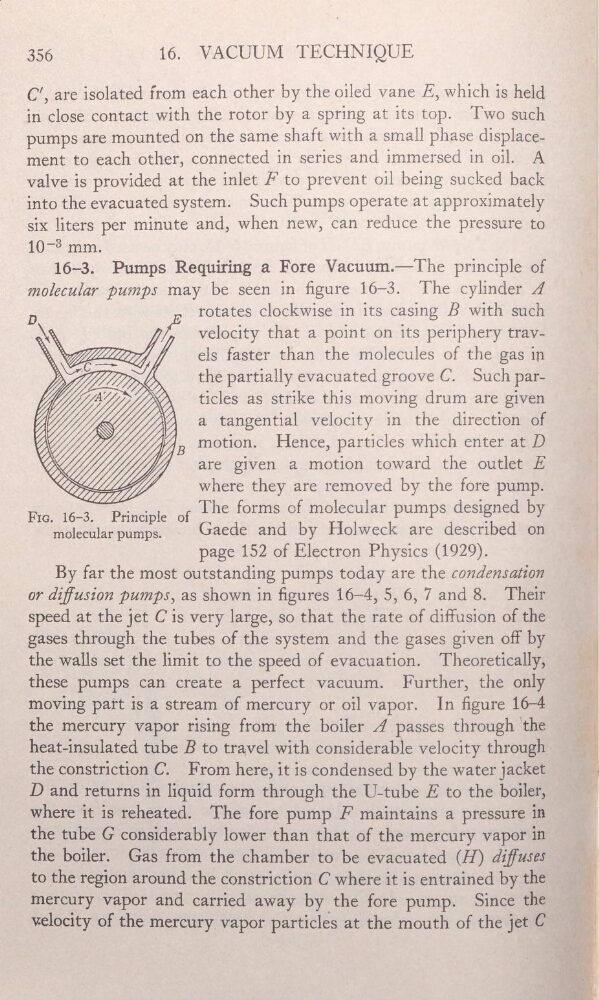
16—3.
Pumps Requiring a Fore Vacuum.—The principle of
.
molecular pumps may be seen in gure 16—3. The cylinder Â
D
rotates clockwise in its casing B with such
/E velocity that a point on its periphery travels faster than the molecules of the gas in
/"/
‘
{,
the partially evacuated groove
C.
Such par_
//
ticles as strike this mov1ng drum
are given
%
a
tangential velocity in the direction of
«
%
/\
/B motion. Hence, particles which enter at D
-
/ /
are
given a motion toward the outlet E
"
'%
/ where they are removed by the fore pump.
Ill/
.
_
Fm. 16—3.
Principle of
The forms of molecular pumps des1gned by …
molecular pumps_
.
Gaede and by Holweck are described on
page
152 of Electron Physics (1929).
,
By far the most outstanding pumps today are the condensation
_
_
-
or dusion pumps, as shown in gures 16—4, 5, 6, 7 and 8. Their =
'
speed at the jet C is very large, so that the rate of diusion of the
_
gases through the tubes of the system and the gases given off by
_
’
the walls set the limit to the speed of evacuation. Theoretically,
these pumps can create a perfect vacuum. Further, the only
moving partis a stream of mercury or oil vapor.
In gure 16—4
the mercury vapor rising from the boiler  passes through ‘the ‘
[
heat-insulated tube B to travel With Considerable velocity through
.
the constriction C.
From here, it is condensed by the water jacket
D and returns in liquid form through the U-tube E to the boiler,
‘
-'
where ”it is reheated. The fore pump
F maintains a pressure
in
.
the tube G considerably lower than that of the mercury vapor in
_
'
the boiler. Gas from the chamber to be evacuated (H) dus€J
to the region around the constriction C where it is entrained
mercury vapor and carried away by the fore pump.
Sincethê
_
velocity
'of the
vapor particles at the mouth of the jet C
16.
VACUUM TECHNIQUE
C’
,
are isolated from each other by the oiled vane E, which is held
_
in close contact with the rotor by a spring at its top. Two such
-
pumps
are mounted on the same shaft with a small phase displacement to each other, connected in series and immersed in oil. A
valve is provided
at the inlet F to prevent oil being sucked back
into the evacuated system.
Such pumps operate
at approximately
six liters per
minute and, when new, can reduce the pressure to
Ÿ
10“3 mm.
,
16—3.
Pumps Requiring a Fore Vacuum.—The principle of
.
molecular pumps may be seen in gure 16—3. The cylinder Â
D
rotates clockwise in its casing B with such
/E velocity that a point on its periphery travels faster than the molecules of the gas in
/"/
‘
{,
the partially evacuated groove
C.
Such par_
//
ticles as strike this mov1ng drum
are given
%
a
tangential velocity in the direction of
«
%
/\
/B motion. Hence, particles which enter at D
-
/ /
are
given a motion toward the outlet E
"
'%
/ where they are removed by the fore pump.
Ill/
.
_
Fm. 16—3.
Principle of
The forms of molecular pumps des1gned by …
molecular pumps_
.
Gaede and by Holweck are described on
page
152 of Electron Physics (1929).
,
By far the most outstanding pumps today are the condensation
_
_
-
or dusion pumps, as shown in gures 16—4, 5, 6, 7 and 8. Their =
'
speed at the jet C is very large, so that the rate of diusion of the
_
gases through the tubes of the system and the gases given off by
_
’
the walls set the limit to the speed of evacuation. Theoretically,
these pumps can create a perfect vacuum. Further, the only
moving partis a stream of mercury or oil vapor.
In gure 16—4
the mercury vapor rising from the boiler  passes through ‘the ‘
[
heat-insulated tube B to travel With Considerable velocity through
.
the constriction C.
From here, it is condensed by the water jacket
D and returns in liquid form through the U-tube E to the boiler,
‘
-'
where ”it is reheated. The fore pump
F maintains a pressure
in
.
the tube G considerably lower than that of the mercury vapor in
_
'
the boiler. Gas from the chamber to be evacuated (H) dus€J
to the region around the constriction C where it is entrained
mercury vapor and carried away by the fore pump.
Sincethê
_
velocity
'of the
vapor particles at the mouth of the jet C