

‘
16—2.
FORE PUMPS
'
_
355 '
pounds per square inch, passes through
"
the constricted tube
Â, dragging along the air in the surrounding chamber. This air" "
forms a sheath around the water for a short distance, then mixes
with it to pass out
Such pumps are fast but cannot reduce the pressure much below that of the vapor pressure of water
at the existing temperature. This amounts to 9 mm. at 10°
and 20 mm. at 23° C.
.
'f
_
7"
The Toep/er pump, EFGH of gure 16—13, may be used to reduce
'
'
the pressure to as low a value as 2 X 10—5 mm. but works slowly
_
as the operation is carried on by hand. -It is more often used in
the collection of gases as described in connection with the gure.
However, its action as a pump in'evacuating the bulb D is as
'
'
follows.
The gas in F is compressed by lifting the mercury reser'
voir E and is forced out through the capillary tube H. _E is then
lowered, gas expands from D into F and the process is repeated.
‘
The side tubeG serves to prevent excessive bumping of the mer,
cury as it is being lowered, which is caused by_the gas from D_
‘
expanding into F when the pressure
in the former exceeds that in
the latter.
,
‘
'
_
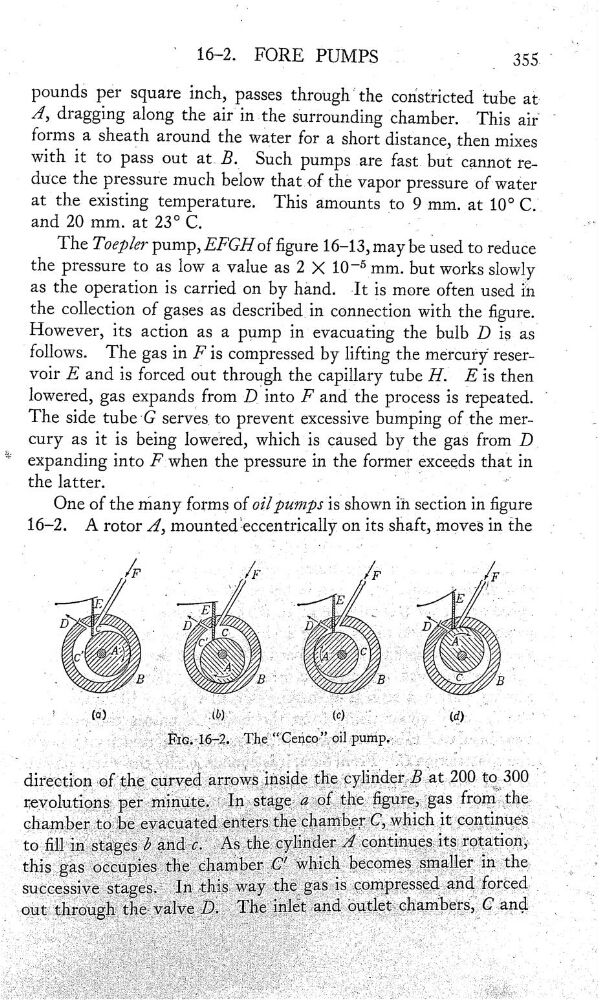
One of the many forms of oil pump: is shown in section in gure
16—2.
A rotor zî, mounted Îeccentrically on its shaft, _moves in the ;
425”!
‘
«cim
31
\;êW
"
‘\4fâ"/I/'
"
"
'
.
_ …ŸÏ _ é ï
“>
.
îÿ<‘4>ï
'
'
_.
»
.
,
…
‘
*, …Ï
Fxe16—2TheCenœopump :
,
jj…
-
.
direction fthecurvedarrwsmsetheyhndeBat200 ”0 ' ?
.
'
th1sgasoccuplesthechamberC'Wh1°hbecomessmaermthe
16—2.
FORE PUMPS
'
_
355 '
pounds per square inch, passes through
"
the constricted tube
Â, dragging along the air in the surrounding chamber. This air" "
forms a sheath around the water for a short distance, then mixes
with it to pass out
Such pumps are fast but cannot reduce the pressure much below that of the vapor pressure of water
at the existing temperature. This amounts to 9 mm. at 10°
and 20 mm. at 23° C.
.
'f
_
7"
The Toep/er pump, EFGH of gure 16—13, may be used to reduce
'
'
the pressure to as low a value as 2 X 10—5 mm. but works slowly
_
as the operation is carried on by hand. -It is more often used in
the collection of gases as described in connection with the gure.
However, its action as a pump in'evacuating the bulb D is as
'
'
follows.
The gas in F is compressed by lifting the mercury reser'
voir E and is forced out through the capillary tube H. _E is then
lowered, gas expands from D into F and the process is repeated.
‘
The side tubeG serves to prevent excessive bumping of the mer,
cury as it is being lowered, which is caused by_the gas from D_
‘
expanding into F when the pressure
in the former exceeds that in
the latter.
,
‘
'
_
One of the many forms of oil pump: is shown in section in gure
16—2.
A rotor zî, mounted Îeccentrically on its shaft, _moves in the ;
425”!
‘
«cim
31
\;êW
"
‘\4fâ"/I/'
"
"
'
.
_ …ŸÏ _ é ï
“>
.
îÿ<‘4>ï
'
'
_.
»
.
,
…
‘
*, …Ï
Fxe16—2TheCenœopump :
,
jj…
-
.
direction fthecurvedarrwsmsetheyhndeBat200 ”0 ' ?
.
'
th1sgasoccuplesthechamberC'Wh1°hbecomessmaermthe