

14—3.
ALPHA PARTICLE CAPTURED BY NUCLEUS 309
‘
The yield or number of protons ejected by each alpha particle
,
Was found to be very small.
It was estimated that from one to,
‘
tWenty out of each million incident alpha particles collided inelastically with nuclei to give rise to protons. In one year all of the ’
alpha particles from one gram of radium could only cause the
ejection of protons equivalent to approximately 3 X 10“4 cubic
millimeters of hydrogen.
.
-
.
In several cases, the kinetic energy of the ejected protons was
.
found to exceed that of the incident alpha particles. Now,
tons with a 70 centimeter
the Same energy as the alpha
particles from radium C' (see tables 4 and 8 in the back of this
book). Thus, the 90 centimeter protons from the transmutation
of aluminum were found to have an energy approximately seven.
teen per cent greater than that of the incident
and
.
—
the residual nucleus must also have been given kinetic energy.
The excess energy
must have been given up by the nuclei during
the transmutation.
,
-
14—3.
The Alpha Particle Is Captured by_the
1925, Blackett3 studied thepassage
of alpha particles. through
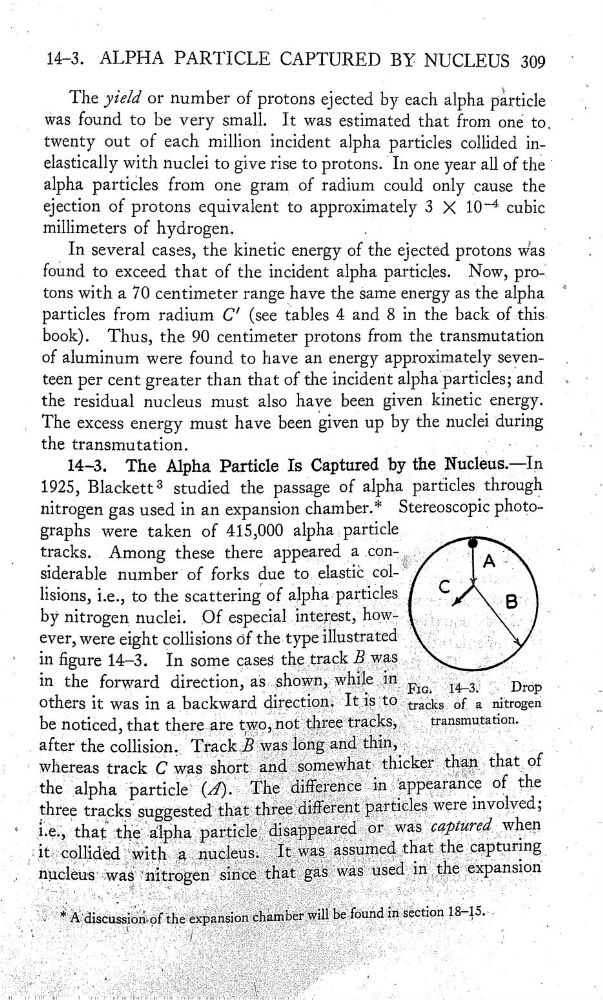
_nitrogen gas used in an expansion chamber.* Stereoscopic photographs were taken of 415,000 alphaparticle
'
_
tracks.
Among these there appeared a
;
«_ , A
’
siderable number’of forks due
'
'
:
lisi0ns, i.e., to the scattering of
.Ç
_
-
by nitrogen nuclei. Of e8pecial
h0W—
;
»
ever, were eight collisions of the-typèillust—r‘aæd
…
7
,:
_
-
}
in gure 14—3. In some cases thetrack Bwas
in the forward
asshown,Whllemle4_3
»
_
others it was in a
directlon Ït18 tQtracks Ï{o
nitrogen
be notîC€d» that
twonotthfeeffa°ksümtü
,
after” the
Trackaaslongandthm>
'
.
'
_
.:«Qfp;
the
ALPHA PARTICLE CAPTURED BY NUCLEUS 309
‘
The yield or number of protons ejected by each alpha particle
,
Was found to be very small.
It was estimated that from one to,
‘
tWenty out of each million incident alpha particles collided inelastically with nuclei to give rise to protons. In one year all of the ’
alpha particles from one gram of radium could only cause the
ejection of protons equivalent to approximately 3 X 10“4 cubic
millimeters of hydrogen.
.
-
.
In several cases, the kinetic energy of the ejected protons was
.
found to exceed that of the incident alpha particles. Now,
tons with a 70 centimeter
the Same energy as the alpha
particles from radium C' (see tables 4 and 8 in the back of this
book). Thus, the 90 centimeter protons from the transmutation
of aluminum were found to have an energy approximately seven.
teen per cent greater than that of the incident
and
.
—
the residual nucleus must also have been given kinetic energy.
The excess energy
must have been given up by the nuclei during
the transmutation.
,
-
14—3.
The Alpha Particle Is Captured by_the
1925, Blackett3 studied thepassage
of alpha particles. through
_nitrogen gas used in an expansion chamber.* Stereoscopic photographs were taken of 415,000 alphaparticle
'
_
tracks.
Among these there appeared a
;
«_ , A
’
siderable number’of forks due
'
'
:
lisi0ns, i.e., to the scattering of
.Ç
_
-
by nitrogen nuclei. Of e8pecial
h0W—
;
»
ever, were eight collisions of the-typèillust—r‘aæd
…
7
,:
_
-
}
in gure 14—3. In some cases thetrack Bwas
in the forward
asshown,Whllemle4_3
»
_
others it was in a
directlon Ït18 tQtracks Ï{o
nitrogen
be notîC€d» that
twonotthfeeffa°ksümtü
,
after” the
Trackaaslongandthm>
'
.
'
_
.:«Qfp;
the