

308
14.
ARTIFICIAL TRANSMUTATION
meterS (air equivalent), which greatly exceeds the maximum value
of 28 centimeters to be expected from the head—on elastic collision
of an alpha particle with a hydrogen atom.
In 1919, Rutherford1 proposed that the exceptionally long
range pr0tons had been driven out of the nuclei of the nitrogen
atoms by occasional violent blows of the incident alpha particles.
_
This, the rst evidence for an atomic transformation accomplished
_
by articial means, has been amply veried by later work. We
shall refer to these as alpha-proton (oz—p) transmutations.
14—2.
Early Alpha—Proton Transmutaüons.—Rutherford and
Chad_wick, as well as Kirsch and Pettersson, carried out extensive
studies2 of the disintegration of the lighter elements under alpha
‘
particle bombardment. Protons were the only particles observed
-
leaving the various elements.
:
»
Since the number of protons
ËQ
Ë°‘
pr0Jected by elastic coll1s1on
E
|
@
—
“
A
decreases
very
rap1dly on
° _
q
either side of the direct path
Â
of the alpha particles, obser-.
-
_
(a)
.
(b)
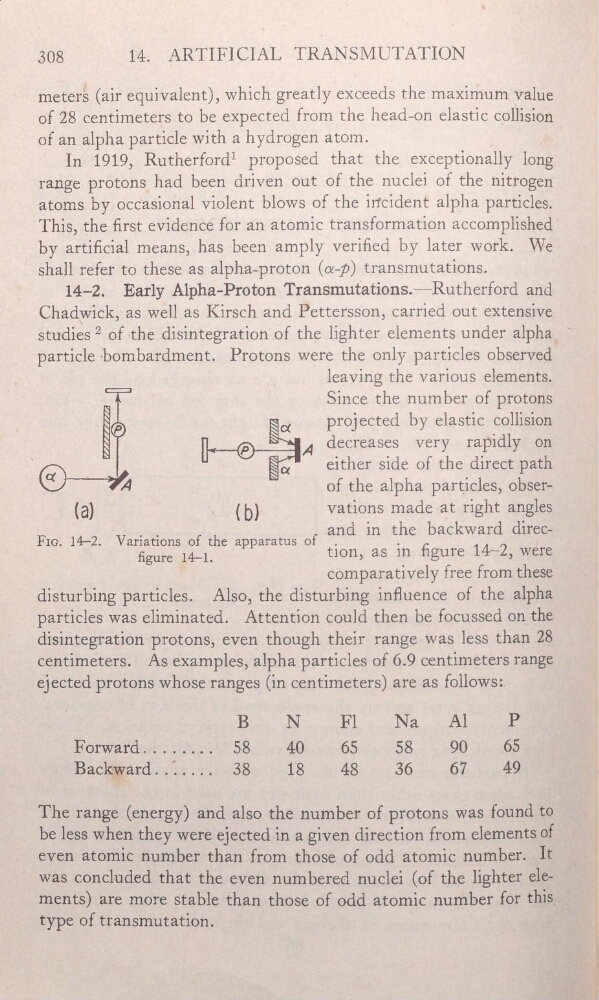
vations made at right angles
Flo. 14—2.
Variations of the apparatus of
m
t.he
baCkward d1re,C_
_
gure 14_1_
mon, as in gure 14—2, were
_
comparative1y free from these
.
disturbing particles.
Also, the disturbing inuence of the alpha ,
particles was eliminated. Attention could then be focussed on the
'
disintegration protons, even though their range was less than 28
centimeters.
As examples, alpha particles of 6.9 centimeters range ,
ej ected protons whose ranges (in centimeters) are as follows:.
,
:
B
.
N
Fl
Na
Al
P
f
‘
58
40
65
90
65
—
,
Back—ward.
.
.
.
.
»
38
18
48
36
67
49
'
-
.
The range (energy) and also the number of protons was found td
—
be less when they wereejecŒdin a given direction from elements of »
.even atomic'_num-ber than from those of Ôdd atomic number—.
lt _
,
was _concluded,_that the even numbered nuclei (of the ghter
:
ments) are more stable
those of odd atomic number for this,
_
.
type oftransmutation.
‘
'
14.
ARTIFICIAL TRANSMUTATION
meterS (air equivalent), which greatly exceeds the maximum value
of 28 centimeters to be expected from the head—on elastic collision
of an alpha particle with a hydrogen atom.
In 1919, Rutherford1 proposed that the exceptionally long
range pr0tons had been driven out of the nuclei of the nitrogen
atoms by occasional violent blows of the incident alpha particles.
_
This, the rst evidence for an atomic transformation accomplished
_
by articial means, has been amply veried by later work. We
shall refer to these as alpha-proton (oz—p) transmutations.
14—2.
Early Alpha—Proton Transmutaüons.—Rutherford and
Chad_wick, as well as Kirsch and Pettersson, carried out extensive
studies2 of the disintegration of the lighter elements under alpha
‘
particle bombardment. Protons were the only particles observed
-
leaving the various elements.
:
»
Since the number of protons
ËQ
Ë°‘
pr0Jected by elastic coll1s1on
E
|
@
—
“
A
decreases
very
rap1dly on
° _
q
either side of the direct path
Â
of the alpha particles, obser-.
-
_
(a)
.
(b)
vations made at right angles
Flo. 14—2.
Variations of the apparatus of
m
t.he
baCkward d1re,C_
_
gure 14_1_
mon, as in gure 14—2, were
_
comparative1y free from these
.
disturbing particles.
Also, the disturbing inuence of the alpha ,
particles was eliminated. Attention could then be focussed on the
'
disintegration protons, even though their range was less than 28
centimeters.
As examples, alpha particles of 6.9 centimeters range ,
ej ected protons whose ranges (in centimeters) are as follows:.
,
:
B
.
N
Fl
Na
Al
P
f
‘
58
40
65
90
65
—
,
Back—ward.
.
.
.
.
»
38
18
48
36
67
49
'
-
.
The range (energy) and also the number of protons was found td
—
be less when they wereejecŒdin a given direction from elements of »
.even atomic'_num-ber than from those of Ôdd atomic number—.
lt _
,
was _concluded,_that the even numbered nuclei (of the ghter
:
ments) are more stable
those of odd atomic number for this,
_
.
type oftransmutation.
‘
'