

13—8.
ION GUNS
305
13—8.
Ion Guns—A large number of ions are to be with—
drawn from their source and then focused into a parallel beam.
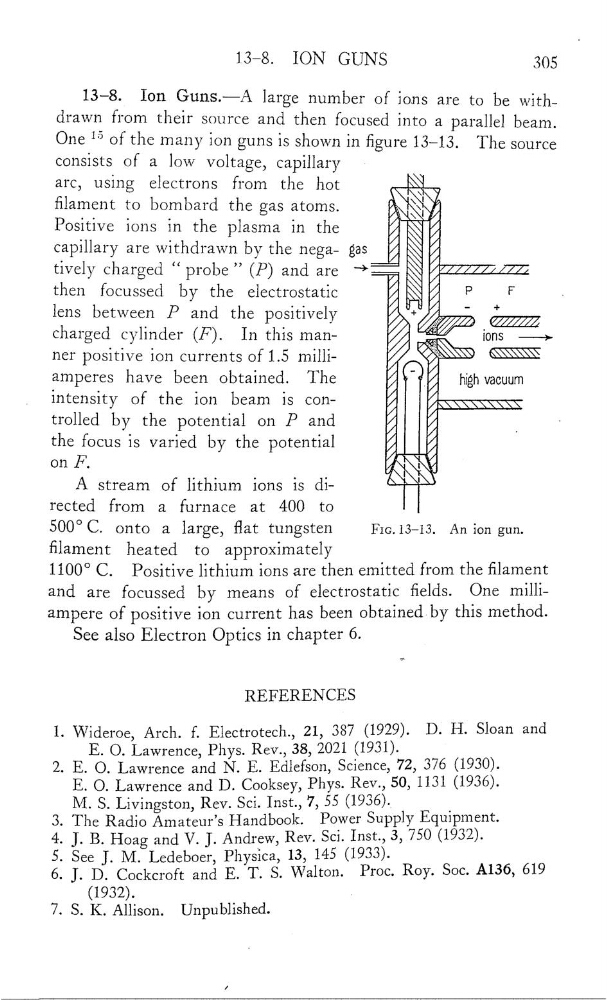
One 15 of the many ion guns is shown in gure 13—13. The source
consists of a low voltage, capillary
arc,
using electrons from the hot
lament to bombard the gas atoms.
Positive ions in the plasma in the
?‘\‘â
capillary are withdrawn by the nega- gas
tively charged
“
probe
”
(P) and are “*
7
?VIIII
"
then
focussed by the electrostatic
?
P
F
.
lens between P and the positively
{
charged cylinder (F). In this man—
ions
_»
ner positive ion currents of 1.5 milli/
®
amperes have been obtained.
The
? ?
high vacuum
intensity of the ion beam is controlled by the potential on P and
—
the focus is varied by the potential
? ?
on F.
A stream of lithium ions is di—
“
rected from a furnace
at
400
to
500° C. onto a large, at tungsten
F1c.13—13.
An ion gun.
lament
heated
to
approximately
1100° C.
Positive lithium ions are then emitted from the lament
and are focussed by means of electrostatic elds. One
milliampere of positive ion current has been obtainedby this method.
See also Electron Optics in chapter 6.
REFERENCES
1. VVid€roe, Arch. {. Electrotech., 21ê03)Î7(1(913912)9).
D. H. Sloan and
.
Rev., 38,
-
-
2.
E. Edlefson, Science, 72, 376 (1930).
E. O. Lawrence and D. Cooksey, Phys. Rev., 50, 1131 (1936).
M. S. Livingston, Rev. Sci. Inst., 7, 55 (1936).
3. The Radio Amateur’s Handbook.
Power Supply Equlpment.
4. ]. B. Hoag and V. ]. Andrew,
Rev. SC]. Inst., 3, 750 (1932).
5. See ]. M. Ledeboer, Physica, 13, 145 (1933)—
6. ]. D. Cockcroft and E. T. S. Walton.
Proc. Roy. Soc. A136, 619
(1932).
—
7. S. K. Allison.
Unpublished.
ION GUNS
305
13—8.
Ion Guns—A large number of ions are to be with—
drawn from their source and then focused into a parallel beam.
One 15 of the many ion guns is shown in gure 13—13. The source
consists of a low voltage, capillary
arc,
using electrons from the hot
lament to bombard the gas atoms.
Positive ions in the plasma in the
?‘\‘â
capillary are withdrawn by the nega- gas
tively charged
“
probe
”
(P) and are “*
7
?VIIII
"
then
focussed by the electrostatic
?
P
F
.
lens between P and the positively
{
charged cylinder (F). In this man—
ions
_»
ner positive ion currents of 1.5 milli/
®
amperes have been obtained.
The
? ?
high vacuum
intensity of the ion beam is controlled by the potential on P and
—
the focus is varied by the potential
? ?
on F.
A stream of lithium ions is di—
“
rected from a furnace
at
400
to
500° C. onto a large, at tungsten
F1c.13—13.
An ion gun.
lament
heated
to
approximately
1100° C.
Positive lithium ions are then emitted from the lament
and are focussed by means of electrostatic elds. One
milliampere of positive ion current has been obtainedby this method.
See also Electron Optics in chapter 6.
REFERENCES
1. VVid€roe, Arch. {. Electrotech., 21ê03)Î7(1(913912)9).
D. H. Sloan and
.
Rev., 38,
-
-
2.
E. Edlefson, Science, 72, 376 (1930).
E. O. Lawrence and D. Cooksey, Phys. Rev., 50, 1131 (1936).
M. S. Livingston, Rev. Sci. Inst., 7, 55 (1936).
3. The Radio Amateur’s Handbook.
Power Supply Equlpment.
4. ]. B. Hoag and V. ]. Andrew,
Rev. SC]. Inst., 3, 750 (1932).
5. See ]. M. Ledeboer, Physica, 13, 145 (1933)—
6. ]. D. Cockcroft and E. T. S. Walton.
Proc. Roy. Soc. A136, 619
(1932).
—
7. S. K. Allison.
Unpublished.