

294
13.
THE ACCELERATION OF IONS
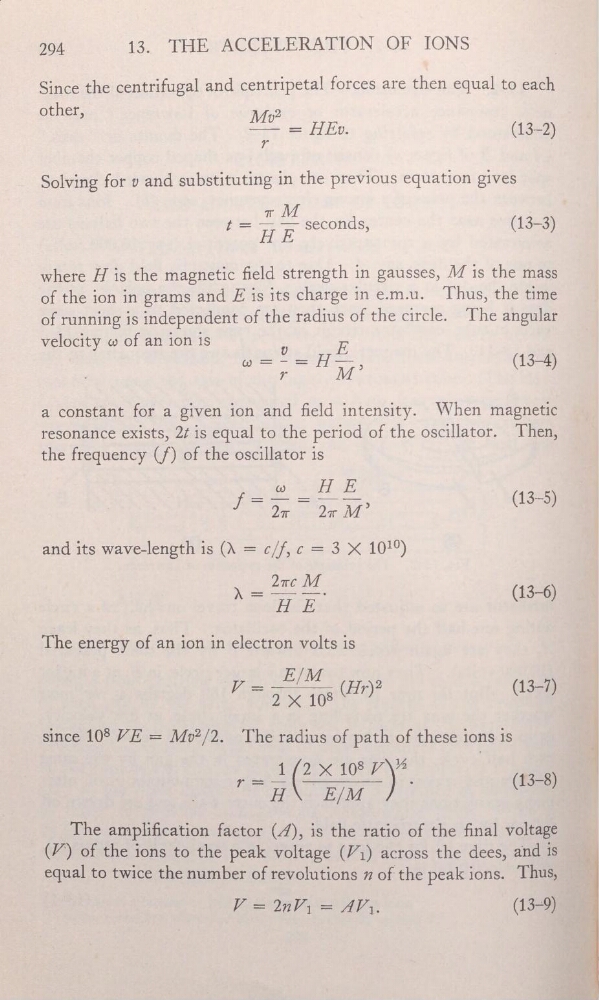
Since the centrifugal and centripetal forces are then equal to each
other,
2
"
_]\£v_
=
HEv.
(13—2)
,
,.
_
—.
Solving for 0 and substituting in the previous equation gives
,
M
,.
.
t = ä_ Î
seconds,
'
(13—3)
where H is the magnetic eld strength in gausses,
M is the mass
—
of the ion in grams
and E is its charge in e.m.u.
Thus, the time
_
of running is independent of the radins of the circle. The angular
velocity co of an ion is
0
E
=
—
=
H ——
13—4
‘
_
w
7_
M,
<
>
a
constant for a given ion and eld intensity.
When magnetic
resonance exists, 22“ is equal to the period of the oscillator. Then,
_‘
-
the frequency (f) of the oscillator is
'
-
w
H E
'
—
=
—
=
—
——
13—5
and its wave—length is (>\ = c/f, c = 3 X 10…)
'
27rc‘ M
.
>\ = —— —13—6
,
_
H E
(
_
The energy of an ion in electron volts is
'
,
.
E/M
'
.
V = ——.————
2
13—7
_
_
(
)
since 108
VE = Mv2/2. The radins of path of these ions is
,
-
”
,
8
%
,
_
10
V)
__
(13_8)
amplication factor (Â), is the ratioof the nal voltage
_
'
_.
(V‘ ) Of the ions'to the peak voltage (V1) across the dees, and is
_
_
,
equal to
number of revolutions 71 of the peak ions. Thus,
_
;"
_
_
,
-
V_V= 27771 = A’V1.
_
"(13=9)
‘
13.
THE ACCELERATION OF IONS
Since the centrifugal and centripetal forces are then equal to each
other,
2
"
_]\£v_
=
HEv.
(13—2)
,
,.
_
—.
Solving for 0 and substituting in the previous equation gives
,
M
,.
.
t = ä_ Î
seconds,
'
(13—3)
where H is the magnetic eld strength in gausses,
M is the mass
—
of the ion in grams
and E is its charge in e.m.u.
Thus, the time
_
of running is independent of the radins of the circle. The angular
velocity co of an ion is
0
E
=
—
=
H ——
13—4
‘
_
w
7_
M,
<
>
a
constant for a given ion and eld intensity.
When magnetic
resonance exists, 22“ is equal to the period of the oscillator. Then,
_‘
-
the frequency (f) of the oscillator is
'
-
w
H E
'
—
=
—
=
—
——
13—5
and its wave—length is (>\ = c/f, c = 3 X 10…)
'
27rc‘ M
.
>\ = —— —13—6
,
_
H E
(
_
The energy of an ion in electron volts is
'
,
.
E/M
'
.
V = ——.————
2
13—7
_
_
(
)
since 108
VE = Mv2/2. The radins of path of these ions is
,
-
”
,
8
%
,
_
10
V)
__
(13_8)
amplication factor (Â), is the ratioof the nal voltage
_
'
_.
(V‘ ) Of the ions'to the peak voltage (V1) across the dees, and is
_
_
,
equal to
number of revolutions 71 of the peak ions. Thus,
_
;"
_
_
,
-
V_V= 27771 = A’V1.
_
"(13=9)
‘