

CHAPTER 13
”
THE ACCELERATION OF IONS*
.
THE MULTIPLE ACCBLERATION or IONS
13—1.
Linear Multiple Acceleration.—The same potential may
.
be used repeatedly to accelerate ions to high speeds.1 In the
_
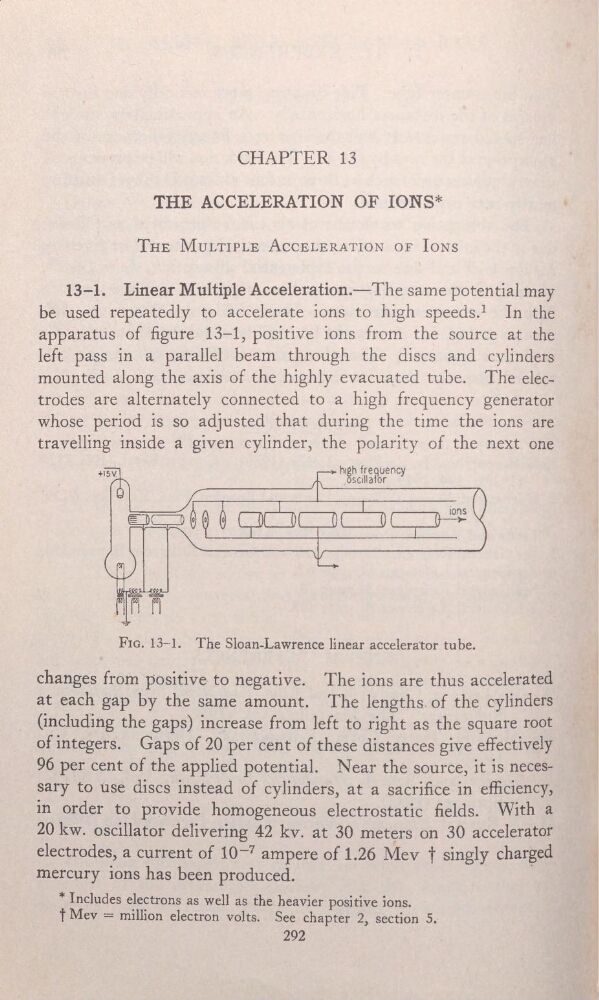
apparatus of gure 13—1, positive ions from the source at the 7
left pass in a parallel beam through the discs and
mounted along the axis of the highly evacuated tube. The electrodes are alternately connected to a high frequency generator
whose period is so adjusted that during the time the ions are
,
travelling inside a given cylinder, the polarity of the next one
'
'
+usv.
._
!
.
.
Ë‘-' M @ -0-0-0-0 -G
!"…ë— '_Â_Îl
m
,
Frs. 13—1.
The Shan-Lawrence linear accelerator tube.
'
changes from positive to negative. The ions are thus accelerated _
at each gap by the same amount. The lengths. of the cylmderS
(including the gaps) increase from left to right as the squareroot
_
of integers'. Gaps of 20 per cent of these distances give efÏœt1vely
'
96 .per cent of the applied potential. Near the source, it1s neces—
,
sary to use discs instead of 'Çylinders, at a saCrice in eicrenCY>'
'
in order to provide homogeneous electrostatic elds. With a
_
20 kw. oscillator delivering 42 kv. at 30 meters on 30 accelerator , ,
electrodes, a current of 10—7 ampere of 1.26 Mev T singly charged
_
mercury ions has been produced.
_
_
'
'
-
’* Includes electrons as Well as, the heavier positive ions.
.
*
_
_
TMev = million electron volts. See chapter 2, section 5.,
'
'
_
292
”
THE ACCELERATION OF IONS*
.
THE MULTIPLE ACCBLERATION or IONS
13—1.
Linear Multiple Acceleration.—The same potential may
.
be used repeatedly to accelerate ions to high speeds.1 In the
_
apparatus of gure 13—1, positive ions from the source at the 7
left pass in a parallel beam through the discs and
mounted along the axis of the highly evacuated tube. The electrodes are alternately connected to a high frequency generator
whose period is so adjusted that during the time the ions are
,
travelling inside a given cylinder, the polarity of the next one
'
'
+usv.
._
!
.
.
Ë‘-' M @ -0-0-0-0 -G
!"…ë— '_Â_Îl
m
,
Frs. 13—1.
The Shan-Lawrence linear accelerator tube.
'
changes from positive to negative. The ions are thus accelerated _
at each gap by the same amount. The lengths. of the cylmderS
(including the gaps) increase from left to right as the squareroot
_
of integers'. Gaps of 20 per cent of these distances give efÏœt1vely
'
96 .per cent of the applied potential. Near the source, it1s neces—
,
sary to use discs instead of 'Çylinders, at a saCrice in eicrenCY>'
'
in order to provide homogeneous electrostatic elds. With a
_
20 kw. oscillator delivering 42 kv. at 30 meters on 30 accelerator , ,
electrodes, a current of 10—7 ampere of 1.26 Mev T singly charged
_
mercury ions has been produced.
_
_
'
'
-
’* Includes electrons as Well as, the heavier positive ions.
.
*
_
_
TMev = million electron volts. See chapter 2, section 5.,
'
'
_
292