

EXPER‘IMENT 12—3
287
or add a small, well-insulated condenser in parallel With E. In front
-
of the ionization chamber, at a distance of approximately 2 millimeters, there is a grounded wire gauze  whose function is to pre—
vent ions formed in front of B, from entering the chamber.‘ The
collimated source (S) may consist of pulverized radium D tubes,
as in the preceding experiment, and is supported by a rod passing
through a rubber cork in the enclosing glass tube.
—
Experiment—Record the temperature and pressure. Measure
the ionization in terms of the rate of fall of the leaf of the electroscope or movement of the electrometer needle (coræcted for the
natural leak) when the source is at various distances (d). Plot,
with ionization currents as ordinates and distances (41) as abscissae.
Record on the graph the extrapolated range (r) reduced to 15° C.
and a pressure
of 76 centimeters.
If desired, the pressure in the
'
glass tube may be lowered to, say 30 centimeters of mercury, and
_
the straggling effect near the end of the path of the alpha particles
studied in greater detail.
EXPERIMENT 12—3
—
AIR EQUIVALENT AND STOPPING POWER FOR ALPHA RAYS
A thin foil is to be introduced in the path of an alpha ray
and the
_
reduction in range measured
by the scintillation method.
-
C
Appamz‘us.—The
various
_
B/ '
parts of the apparatus may be
‘
/
CÔveniently mounted as
in
'
_
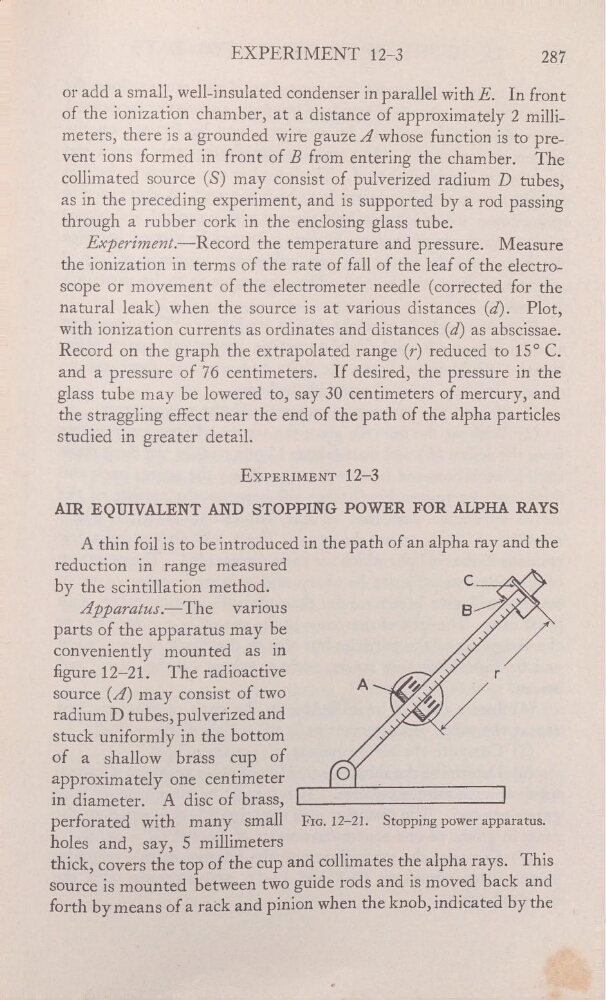
gure 12—21. The radioactive
r
source (Â) may consist of two
A
@
radium D tubes, pulvefi2ed and _
—
‘
“=.
‘
stuck uniformly in the bottom
-
'
_
Of a
shallow brass
cup
of
approximately
centimètèr '
a _‘
’
-
in diameter.
A disc of brass, __ -
‘
perforated with many small FIG. _12—21. Stopping power apparatus.
holes and, say,
millimeters
_
_
‘
-
_
_
thick, covers the top
of
cup
and collimates the alpha rays. This
source is mounted between two guide rods and is moved baCk and
forth by means of a ra‘ck and pinion when the knob, indicated by the
287
or add a small, well-insulated condenser in parallel With E. In front
-
of the ionization chamber, at a distance of approximately 2 millimeters, there is a grounded wire gauze  whose function is to pre—
vent ions formed in front of B, from entering the chamber.‘ The
collimated source (S) may consist of pulverized radium D tubes,
as in the preceding experiment, and is supported by a rod passing
through a rubber cork in the enclosing glass tube.
—
Experiment—Record the temperature and pressure. Measure
the ionization in terms of the rate of fall of the leaf of the electroscope or movement of the electrometer needle (coræcted for the
natural leak) when the source is at various distances (d). Plot,
with ionization currents as ordinates and distances (41) as abscissae.
Record on the graph the extrapolated range (r) reduced to 15° C.
and a pressure
of 76 centimeters.
If desired, the pressure in the
'
glass tube may be lowered to, say 30 centimeters of mercury, and
_
the straggling effect near the end of the path of the alpha particles
studied in greater detail.
EXPERIMENT 12—3
—
AIR EQUIVALENT AND STOPPING POWER FOR ALPHA RAYS
A thin foil is to be introduced in the path of an alpha ray
and the
_
reduction in range measured
by the scintillation method.
-
C
Appamz‘us.—The
various
_
B/ '
parts of the apparatus may be
‘
/
CÔveniently mounted as
in
'
_
gure 12—21. The radioactive
r
source (Â) may consist of two
A
@
radium D tubes, pulvefi2ed and _
—
‘
“=.
‘
stuck uniformly in the bottom
-
'
_
Of a
shallow brass
cup
of
approximately
centimètèr '
a _‘
’
-
in diameter.
A disc of brass, __ -
‘
perforated with many small FIG. _12—21. Stopping power apparatus.
holes and, say,
millimeters
_
_
‘
-
_
_
thick, covers the top
of
cup
and collimates the alpha rays. This
source is mounted between two guide rods and is moved baCk and
forth by means of a ra‘ck and pinion when the knob, indicated by the