

286
12.
ALPHA, BETA AND GAMMA RAYS
pressure
when the scintillations rst cease.
Repeat these steps
eight or ten times and average all values to nd the pressure
corresponding
to
d.
Repeat with the source at various distances farther away from
the screen.
From the relation that the range is inversely proportional to
the pressure
and directly proportional to the absolute temperature,
compute
the range (7) at 76 cm. and 15° C. from each set of data.
Average these readings and compare
With the accepted value.
'
The nal value will be found to be somewhat smaller than the
accepted'range because of absorbing lms such as grease from the
ngers, thin layers of water glass, etc., and because it is difcult to
distinguish between the spurious scintillations and those of the
alpha particles of maximum range.
EXPERIMENT 12—2
RANGE OF ALPHA PARTICLES—ELECTRÏCAL METHOD
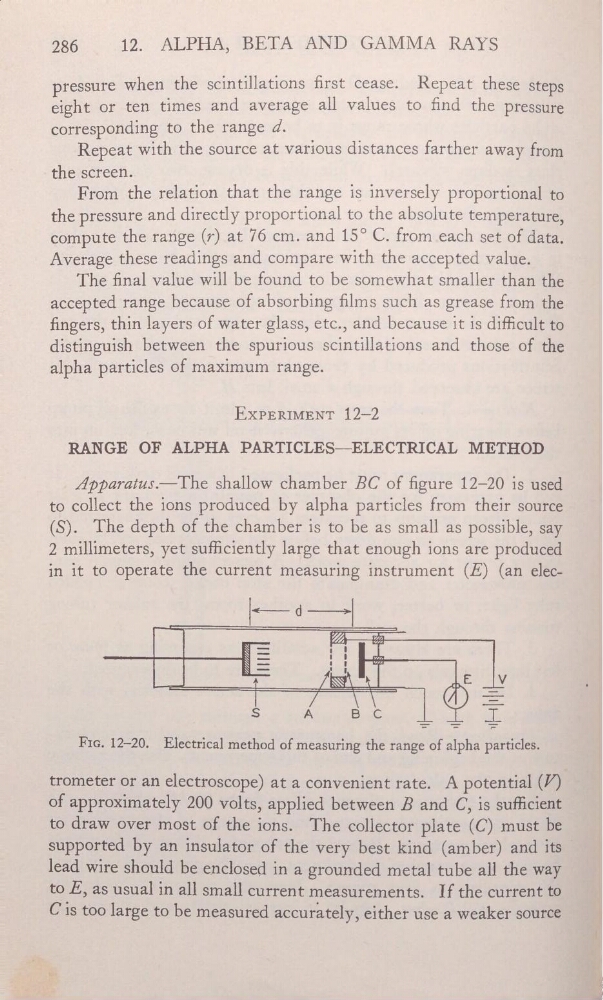
Appamz‘us.—The shallow chamber BC of gure 12—20 is used
to collect the ions produced by alpha particles from their source — '
'
(S). The depth of the chamber is to be as small as possible, say
2 millimeters, yet suiciently large that enough ions are produced
in it to operate the current measuring instrument (E) (an elec—
_
d ___,l
-
€
5 :
.
\
"
______
“E
V
.
_
_
s
A
B
(:
_
_
Î
,
Fm. 12—20.
Electrical method of measuring
the range of alpha particles.
trometer or an electroscope) at a convenient rate. A potential
'
of approximately 200 volts, applied between B and, C, is sufcient
to draw over
most of the ions.
The collector plate (C‘) must be
_
supported by an insulator of the very best kind (amber) and its
lead wire should be enclosed in a grounded metal tube all the way
—
as usual in all small current measurements.
If the current to
C 13 too large to be measured accurately, either use a weâker source
12.
ALPHA, BETA AND GAMMA RAYS
pressure
when the scintillations rst cease.
Repeat these steps
eight or ten times and average all values to nd the pressure
corresponding
to
d.
Repeat with the source at various distances farther away from
the screen.
From the relation that the range is inversely proportional to
the pressure
and directly proportional to the absolute temperature,
compute
the range (7) at 76 cm. and 15° C. from each set of data.
Average these readings and compare
With the accepted value.
'
The nal value will be found to be somewhat smaller than the
accepted'range because of absorbing lms such as grease from the
ngers, thin layers of water glass, etc., and because it is difcult to
distinguish between the spurious scintillations and those of the
alpha particles of maximum range.
EXPERIMENT 12—2
RANGE OF ALPHA PARTICLES—ELECTRÏCAL METHOD
Appamz‘us.—The shallow chamber BC of gure 12—20 is used
to collect the ions produced by alpha particles from their source — '
'
(S). The depth of the chamber is to be as small as possible, say
2 millimeters, yet suiciently large that enough ions are produced
in it to operate the current measuring instrument (E) (an elec—
_
d ___,l
-
€
5 :
.
\
"
______
“E
V
.
_
_
s
A
B
(:
_
_
Î
,
Fm. 12—20.
Electrical method of measuring
the range of alpha particles.
trometer or an electroscope) at a convenient rate. A potential
'
of approximately 200 volts, applied between B and, C, is sufcient
to draw over
most of the ions.
The collector plate (C‘) must be
_
supported by an insulator of the very best kind (amber) and its
lead wire should be enclosed in a grounded metal tube all the way
—
as usual in all small current measurements.
If the current to
C 13 too large to be measured accurately, either use a weâker source