

12—3.
THE RANGE OF ALPHA PARTICLES
265
source is increased.
One must conclude that the process by which
alpha particles lose energy in their passage _thr0ugh a gas is essen—
tially difïerent from that for the other cases just mentioned. We
shall return to this later, in the discussion of the Ionization by
Alpha Particles.
'
.
The alpha particles from a given radioactive substance do not
all penetrate a gas exactly the same distance. ThisSo—called
stmgg’Ïing may be seen in the drop tracks of gure 12——3 and by the
rounded drop at the end of curve ] in gure 12—4. If the slope of
the latter is calculated, the dierential distribution in
_
range
(curve D) is obtained.
This gives the number of particles with
ranges between R and R + dR and is approximately a Gaussian
curve,
indicating a statistical or random uctuation in those
'
processes which operate
to stop the alpha particles. The average
range of alpha particles is located by the peak of the curve and
is indicated at R in gure
'
12—4. The practical 07‘ extm—
.
—
_
p0/aled range is shown at
r.
The methods described
A
S
.
\
below give values of 7”. They
may be converted to _R by
»S°
,
.
_
the empirical equation
-
E
7» = 1.011 R
(1243)“î"‘
"ËË
\
.—E—
,
in the domain of natural
"'
%
_
—:°——B
radioactive rays.:
.
“:.“
One of the best methods
,
2
for measuring the range of
‘
_
'
alpha particles is to use a
_
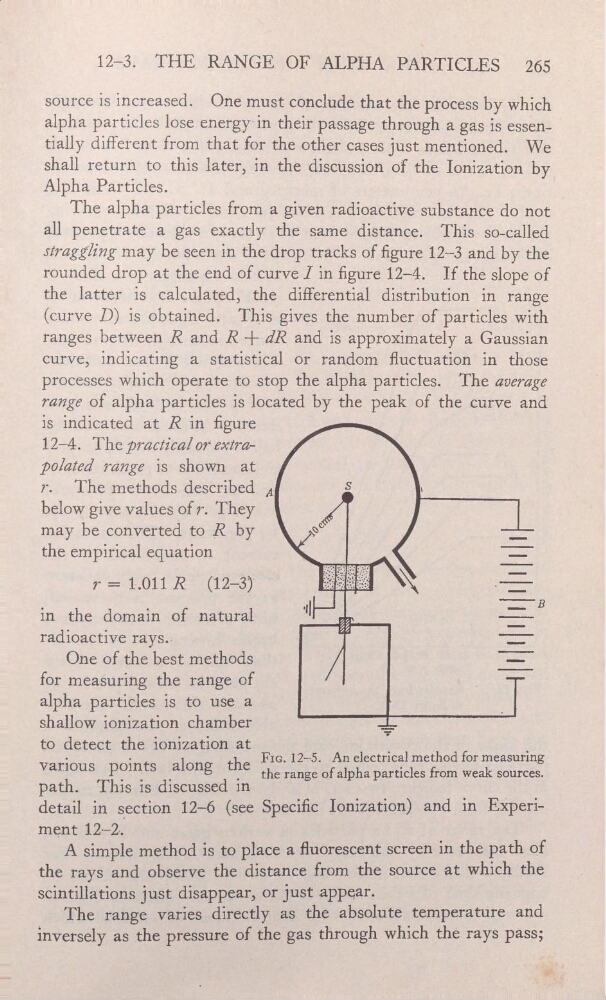
shallow ionization chamber
—
___
,
to detect the“ ionization at
-
_
_
°
-
'
.
FIG.12—5. An electrical method formeasunng
various
along tl_1€ the range of alpha particles from Weak sources;
path. This is discussed 1n
_
_
,
—_
_.
C
detail in section 12—6 (see Specic Ionization)” and in”E>äperi—
ment
-
A simple method is to place a uorescent screen’in the path of
the rays and observe thedistance from the source at which the
.
sCintillations just disappear, or.just'.appear.
'
'
_
‘
,
'
_The range varies directly as the absolute temperature and
inversely
the pressure of the gas through which the rays pass;
THE RANGE OF ALPHA PARTICLES
265
source is increased.
One must conclude that the process by which
alpha particles lose energy in their passage _thr0ugh a gas is essen—
tially difïerent from that for the other cases just mentioned. We
shall return to this later, in the discussion of the Ionization by
Alpha Particles.
'
.
The alpha particles from a given radioactive substance do not
all penetrate a gas exactly the same distance. ThisSo—called
stmgg’Ïing may be seen in the drop tracks of gure 12——3 and by the
rounded drop at the end of curve ] in gure 12—4. If the slope of
the latter is calculated, the dierential distribution in
_
range
(curve D) is obtained.
This gives the number of particles with
ranges between R and R + dR and is approximately a Gaussian
curve,
indicating a statistical or random uctuation in those
'
processes which operate
to stop the alpha particles. The average
range of alpha particles is located by the peak of the curve and
is indicated at R in gure
'
12—4. The practical 07‘ extm—
.
—
_
p0/aled range is shown at
r.
The methods described
A
S
.
\
below give values of 7”. They
may be converted to _R by
»S°
,
.
_
the empirical equation
-
E
7» = 1.011 R
(1243)“î"‘
"ËË
\
.—E—
,
in the domain of natural
"'
%
_
—:°——B
radioactive rays.:
.
“:.“
One of the best methods
,
2
for measuring the range of
‘
_
'
alpha particles is to use a
_
shallow ionization chamber
—
___
,
to detect the“ ionization at
-
_
_
°
-
'
.
FIG.12—5. An electrical method formeasunng
various
along tl_1€ the range of alpha particles from Weak sources;
path. This is discussed 1n
_
_
,
—_
_.
C
detail in section 12—6 (see Specic Ionization)” and in”E>äperi—
ment
-
A simple method is to place a uorescent screen’in the path of
the rays and observe thedistance from the source at which the
.
sCintillations just disappear, or.just'.appear.
'
'
_
‘
,
'
_The range varies directly as the absolute temperature and
inversely
the pressure of the gas through which the rays pass;