

264
12.
ALPHA, BETA AND GAMMA RAYS
dew point. Small drops of water then form on condensation ce“nters, such as dust particles or ions.
C. T. R. Wilson has used this
principle to make visible the paths traversed by single ionizing
'
radiations such as alpha, beta, gamma and X—rays.
(See chapter
18 for details of the expansion
chambem.)
The type of drop
_
”tracks produced by alpha par—
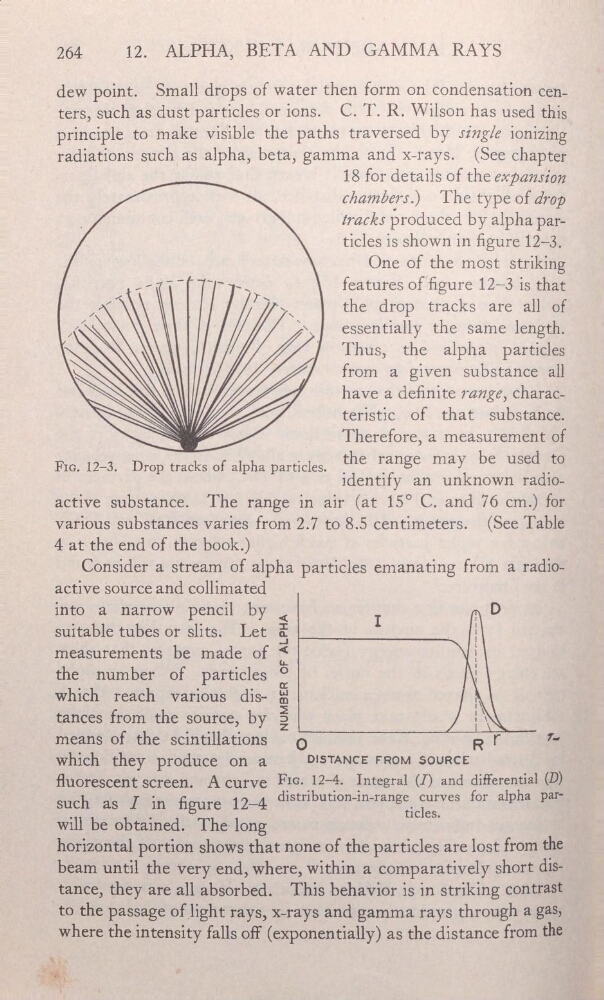
ticles is shown in gure 12—3.
'
One of the most striking
"”
features of gure 12—3 is that
/
\
the drop tracks are all of
/
/
essentially the same length.
Thus, the alpha particles
'
from a given substance all
have a denite range, characteristic
of
that
substance.
.
Therefore, a measurement of
.
Fm. 12—3.
Drop tracks of alpha particles.
_the range may be used _tO
identify an unknown radio—
active substance.
The range in air (at 15° C. and 76 cm.) for
various substances varies from 2.7 to 8.5 centimeters.
(See Table
,
4 at the end of the book.)
Consider a stream of alpha particles emanating from a radio-‘
active source and collimated
‘
into
a
narrow
pencil by
(
I
D
'
suitable tubes or slits.
Let %
_
measurements be made of î
__
the
number
of
particles î
\
_
'WhlCh reach various dis- Æ
,
tances from the source, by â
.À\
'
_
means of
.
the scintillations
0
,
R
r
7Which they produce on a
DISTANCE FROM SOURCE
__
uorescent screen_ A curve FIG._12—fl. lntegral (]) and differential (D)
Such as I in' gure
distributzon—1n—rangîicîïsrves
for
Ï
_
_
will be
long,
_
'
horizontal portion shows that none of the particles are lost from
the
beam until the Very end, where, within a comparatively short distance, -they are all abs0rbed. This behavior is in striking contrast
the passage
of light rays, X—rays and gamma rays through a gas,
Where the intensity falls olî (éxponentially) as the distance from the
‘
12.
ALPHA, BETA AND GAMMA RAYS
dew point. Small drops of water then form on condensation ce“nters, such as dust particles or ions.
C. T. R. Wilson has used this
principle to make visible the paths traversed by single ionizing
'
radiations such as alpha, beta, gamma and X—rays.
(See chapter
18 for details of the expansion
chambem.)
The type of drop
_
”tracks produced by alpha par—
ticles is shown in gure 12—3.
'
One of the most striking
"”
features of gure 12—3 is that
/
\
the drop tracks are all of
/
/
essentially the same length.
Thus, the alpha particles
'
from a given substance all
have a denite range, characteristic
of
that
substance.
.
Therefore, a measurement of
.
Fm. 12—3.
Drop tracks of alpha particles.
_the range may be used _tO
identify an unknown radio—
active substance.
The range in air (at 15° C. and 76 cm.) for
various substances varies from 2.7 to 8.5 centimeters.
(See Table
,
4 at the end of the book.)
Consider a stream of alpha particles emanating from a radio-‘
active source and collimated
‘
into
a
narrow
pencil by
(
I
D
'
suitable tubes or slits.
Let %
_
measurements be made of î
__
the
number
of
particles î
\
_
'WhlCh reach various dis- Æ
,
tances from the source, by â
.À\
'
_
means of
.
the scintillations
0
,
R
r
7Which they produce on a
DISTANCE FROM SOURCE
__
uorescent screen_ A curve FIG._12—fl. lntegral (]) and differential (D)
Such as I in' gure
distributzon—1n—rangîicîïsrves
for
Ï
_
_
will be
long,
_
'
horizontal portion shows that none of the particles are lost from
the
beam until the Very end, where, within a comparatively short distance, -they are all abs0rbed. This behavior is in striking contrast
the passage
of light rays, X—rays and gamma rays through a gas,
Where the intensity falls olî (éxponentially) as the distance from the
‘