

__
10—8. ATOMIC, ISOTOPÏÇ AND NUCLEAR WEIGHTS 231
was 235 and not 234, in agreement with a suggestion by Ruther»:
ford.
Together With the chemical determination of the atomic
weight of proto-actinium as 231, by v. Grosse, it is now established
that the elements of the actinium series (see section 11v4) have
Odd, rather than even, atomic weights.
Bainbridge
15
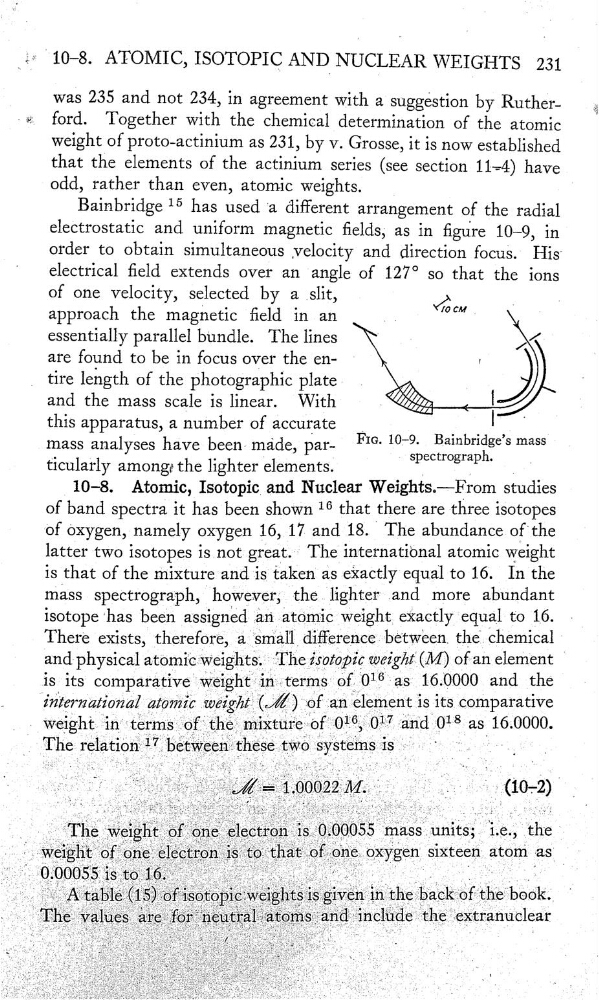
has used ‘a different arrangement of the radial
eleCtrostatic and uniform magnetic elds, as in gure 10—9, in
order to obtain simultaneous velocity and direction focus. His
'
electrical eld extends over an angle of 127° so that the ions
of one velocity, selected by a slit,
_
_
approach the magnetic eld in an
.
.
la…“
'
.
essentially parallel bundle. The lines
‘
—
//
are found to be in focus over the en—
'
v
_
tire length of the phot0graphic plate _
'
and the mass scale is linear.
With
.
l
'
this apparatus, a number of accurate
_
_
|
mass analyses have been made, parFIG' 10-_9'
Bambrldge’s mass
_.
.
.
_
spectrograph.
ticulay
the lighter elements.
_
.
10—8.
Atomic, Isotopic_ and Nuclear Weights.—From studies
of band spectra it has been shown 16 that there are three isotopes
of Oxygen, namely oxygen 16, 17 and 18. The abundance of
'
the
latter two isotopes is not great; Theinternatibnal atomic weight
is that of the mixture and is taken as exactly equal to 16. In the
mass speCtrograph, however, the ghter and more abundant
isotope has been assigned anatomie Weight exactly equal
to 1.6 -
_
There exists, therefore, a
difference between, the chemical '
andphysical
(M) ofan element
is its
160000 and the
,
_
q;g7hifc wezgt(.//l) of ;an clement
comparative
_
_
Weight m terms ofthe m1xture
cand»01f$ as_16.0000.
…
‘The»relatwn”betweenthesetwosystemsïs
-
‘
»“ ‘
—
10—8. ATOMIC, ISOTOPÏÇ AND NUCLEAR WEIGHTS 231
was 235 and not 234, in agreement with a suggestion by Ruther»:
ford.
Together With the chemical determination of the atomic
weight of proto-actinium as 231, by v. Grosse, it is now established
that the elements of the actinium series (see section 11v4) have
Odd, rather than even, atomic weights.
Bainbridge
15
has used ‘a different arrangement of the radial
eleCtrostatic and uniform magnetic elds, as in gure 10—9, in
order to obtain simultaneous velocity and direction focus. His
'
electrical eld extends over an angle of 127° so that the ions
of one velocity, selected by a slit,
_
_
approach the magnetic eld in an
.
.
la…“
'
.
essentially parallel bundle. The lines
‘
—
//
are found to be in focus over the en—
'
v
_
tire length of the phot0graphic plate _
'
and the mass scale is linear.
With
.
l
'
this apparatus, a number of accurate
_
_
|
mass analyses have been made, parFIG' 10-_9'
Bambrldge’s mass
_.
.
.
_
spectrograph.
ticulay
the lighter elements.
_
.
10—8.
Atomic, Isotopic_ and Nuclear Weights.—From studies
of band spectra it has been shown 16 that there are three isotopes
of Oxygen, namely oxygen 16, 17 and 18. The abundance of
'
the
latter two isotopes is not great; Theinternatibnal atomic weight
is that of the mixture and is taken as exactly equal to 16. In the
mass speCtrograph, however, the ghter and more abundant
isotope has been assigned anatomie Weight exactly equal
to 1.6 -
_
There exists, therefore, a
difference between, the chemical '
andphysical
(M) ofan element
is its
160000 and the
,
_
q;g7hifc wezgt(.//l) of ;an clement
comparative
_
_
Weight m terms ofthe m1xture
cand»01f$ as_16.0000.
…
‘The»relatwn”betweenthesetwosystemsïs
-
‘
»“ ‘
—