

230
10.
POSITIVE RAYS AND TSOTOPES
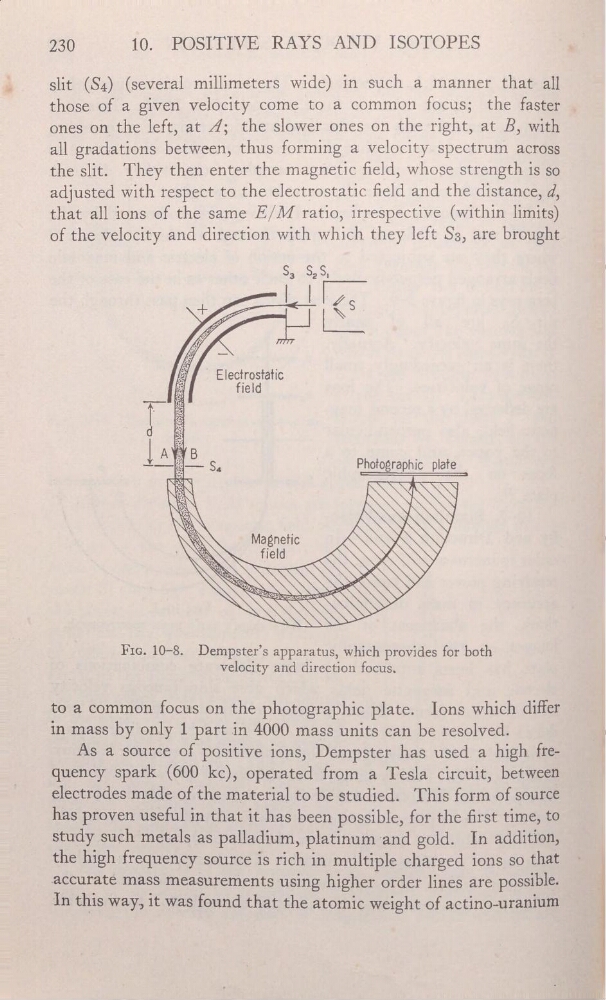
slit (84) (several millimeters wide) in such a manner that all
those of a given velocity come to a common focus; the faster
.
ones on the left, at  ; the slower ones on the right, at B, With
all gradations between, thus forming a velocity spectrum across
the slit.
They then enter the magnetic eld, whose strength is so
adjusted with respect
to the electrostatic eld and the distance, cl,
that all ions of the same E/M ratio, irrespective (within limits)
of the velocity and direction with which they left S3, are brought
_
5,
+
I- | I|
\
field
.
_.
3
54
Photographic plate
_
Ë°Ë\‘
\‘
_
.
_
,
«
\\\\\\
'
\ \
.
\\
Magnetic
\\ \
_
‘.
‘
\
field
\ \
FIG. 10—8.
Dempster’s apparatus, which provides for both
_
"
.
,
_
-
velocity
and direction focus.
to.a common
focus on the photographic plate. Ions Which differ
in mass by only 1 part in 4000 mass units can be resolved.
As a source of positive ions, Dempster has used a high fre—
quency spark
operated from a Tesla circuit, between
'
electrodes made of the material to be studied. This form of source
‘
has proven useful in that it has been possible, for the rst time, to
.
studysuCh'metals as palladium, platinum and gold. In addition,
1
'_
the highfrequency source is rich in multiple charged ions so that. ‘
accurate mass 'meaSurenients using higher order lines are possible
-InÎthis Way, it was found that the atomic weight of actino—umnium
_
10.
POSITIVE RAYS AND TSOTOPES
slit (84) (several millimeters wide) in such a manner that all
those of a given velocity come to a common focus; the faster
.
ones on the left, at  ; the slower ones on the right, at B, With
all gradations between, thus forming a velocity spectrum across
the slit.
They then enter the magnetic eld, whose strength is so
adjusted with respect
to the electrostatic eld and the distance, cl,
that all ions of the same E/M ratio, irrespective (within limits)
of the velocity and direction with which they left S3, are brought
_
5,
+
I- | I|
\
field
.
_.
3
54
Photographic plate
_
Ë°Ë\‘
\‘
_
.
_
,
«
\\\\\\
'
\ \
.
\\
Magnetic
\\ \
_
‘.
‘
\
field
\ \
FIG. 10—8.
Dempster’s apparatus, which provides for both
_
"
.
,
_
-
velocity
and direction focus.
to.a common
focus on the photographic plate. Ions Which differ
in mass by only 1 part in 4000 mass units can be resolved.
As a source of positive ions, Dempster has used a high fre—
quency spark
operated from a Tesla circuit, between
'
electrodes made of the material to be studied. This form of source
‘
has proven useful in that it has been possible, for the rst time, to
.
studysuCh'metals as palladium, platinum and gold. In addition,
1
'_
the highfrequency source is rich in multiple charged ions so that. ‘
accurate mass 'meaSurenients using higher order lines are possible
-InÎthis Way, it was found that the atomic weight of actino—umnium
_