

204
9.
X—RAYS
momentum, Compton predicted that the increase in wave-length
should be
Ah=i(1—cosdÿ
'
mc
_
=
0.024 (1 —— cos çb), angstroms,
(9—7)
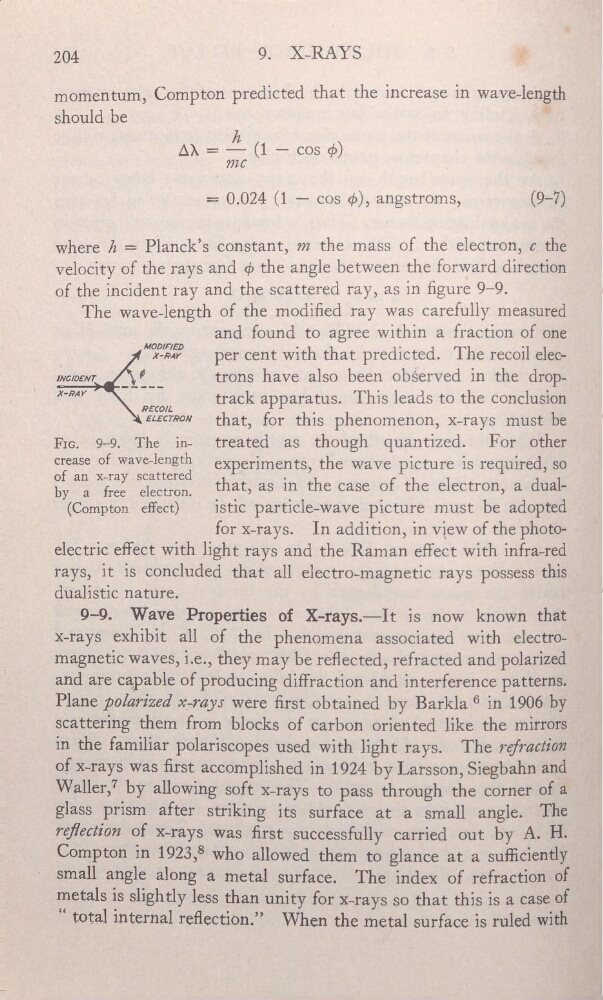
where /z = Planck’s constant, 772 the mass of the electron, c the
velocity of the rays
and the angle between the forward direction
_
of the incident ray
and the scattered ray, as in gure 9—9.
—
The wave-length of the modied ray was carefully measured
and found to agree within a fraction of one
per
cent With that predicted. The recoil elec—
ve/DENT
__î
__
trons have also been observed in the drop““””
[mo/L
track apparatus. This leads to the conclusion
ELECTRO”
that, for this phenomenon, X-rays must be
Fra.
9—9.
The
in—
treated
as
though quantized.
For other
Grease
Of wave—length
experiments, the wave picture is required, so
of an X—ray scattered
.
by a free electron.
that, as in the case of the electron, a dual(Compton effect)
istic particle—wave picture must be adopted
for X-rays.
In addition, in view of the photo—
electric effect with light rays and the Raman effect with infra-red
‘
rays, it is concluded that all electro-magnetic rays possess
this
dualistic nature.
'
9—9.
Wave Properties of X—rays.—It is now known that
'
x-rays exhibit all of the phenomena associated with electromagnetic waves, i.e., they may be reected, refracted and polarized
.
and are capable
of producing diffraction and interference patterns.
_
Plane polarized x_—mys were rst obtained by Barkla
6 in 1906 by
scattering them from blocks of carbon oriented like the mirrors
in the familiar polariscopes used with light rays. The 7'cÿ‘mci‘ian.
,
of X-rays was rst accomplished in 1924 by Larsson, Siegbahn and
Waller,7 by allowing soft X-rays to pass through the corner of a,
glass prism after striking its surface at a small angle.‘ The
Of X—rays was rst successfully carried out by A. —HCompton in 1923,8 who allowed them to glance at a sufciently
_
—
small angle along a
metal surface.
The index of refraction of
metals is slightly less than unity for X-rays so that this is a case of
“
internal reecti0n.”
When the metal surface is
9.
X—RAYS
momentum, Compton predicted that the increase in wave-length
should be
Ah=i(1—cosdÿ
'
mc
_
=
0.024 (1 —— cos çb), angstroms,
(9—7)
where /z = Planck’s constant, 772 the mass of the electron, c the
velocity of the rays
and the angle between the forward direction
_
of the incident ray
and the scattered ray, as in gure 9—9.
—
The wave-length of the modied ray was carefully measured
and found to agree within a fraction of one
per
cent With that predicted. The recoil elec—
ve/DENT
__î
__
trons have also been observed in the drop““””
[mo/L
track apparatus. This leads to the conclusion
ELECTRO”
that, for this phenomenon, X-rays must be
Fra.
9—9.
The
in—
treated
as
though quantized.
For other
Grease
Of wave—length
experiments, the wave picture is required, so
of an X—ray scattered
.
by a free electron.
that, as in the case of the electron, a dual(Compton effect)
istic particle—wave picture must be adopted
for X-rays.
In addition, in view of the photo—
electric effect with light rays and the Raman effect with infra-red
‘
rays, it is concluded that all electro-magnetic rays possess
this
dualistic nature.
'
9—9.
Wave Properties of X—rays.—It is now known that
'
x-rays exhibit all of the phenomena associated with electromagnetic waves, i.e., they may be reected, refracted and polarized
.
and are capable
of producing diffraction and interference patterns.
_
Plane polarized x_—mys were rst obtained by Barkla
6 in 1906 by
scattering them from blocks of carbon oriented like the mirrors
in the familiar polariscopes used with light rays. The 7'cÿ‘mci‘ian.
,
of X-rays was rst accomplished in 1924 by Larsson, Siegbahn and
Waller,7 by allowing soft X-rays to pass through the corner of a,
glass prism after striking its surface at a small angle.‘ The
Of X—rays was rst successfully carried out by A. —HCompton in 1923,8 who allowed them to glance at a sufciently
_
—
small angle along a
metal surface.
The index of refraction of
metals is slightly less than unity for X-rays so that this is a case of
“
internal reecti0n.”
When the metal surface is