

…
9—8.
THE COMPTON EFFECT
203
is always of longer wave—length than that of the primary rays,
'
corresponding to Stokes’ law in optics.
A discussion of the photo-electrons ejected from atoms will be
found in the chapter on photo-electricity.
As the wave-length of the X—ray decreases, below about '
0.2 angstroms,* the second absorption process, scattering, becomes
the predominating factor.
.“
becomes increasingly great in
'
comparison with 7'. The scattered X—rays have nearly the same
-
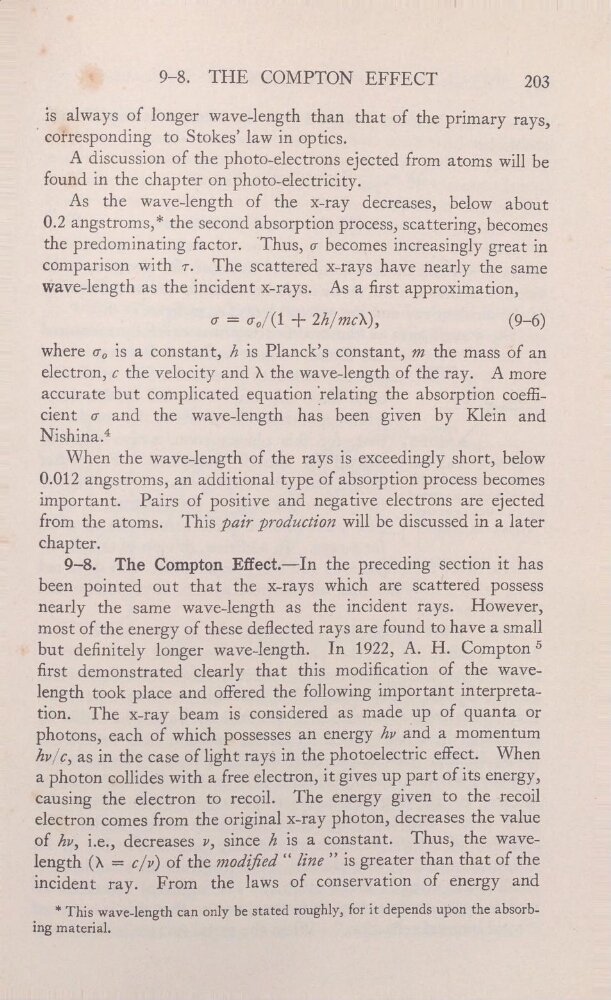
Wave—length as the incident x-rays. As a rst approximation,
a
=
cra/(1 + 2/z/mck),
(9—6)
where cro is a constant, & is Planck’s constant,
the mass Of an
electron, c the velocity and >\ the wave—length of the ray. A more '
accurate but complicated equation
the absorption c0eñicient 0 and the
wave—length has been given by Klein and
Nishina.4
-
_
.
When the wave—length of the rays is exceedingly short, below
,
0.012 angstroms, an additional type of absorption process becomes
important. Pairs of positive and negative electrons are ejected
from the atoms.
This pair production will be discussed in a later
chapter.
.
'
9—8.
The Compton Effect—In the preceding Section it has
been pointed out that the X—rays which are scatterëd possess
nearly the same wave-length as the incident rays. However,
most of the energy of these deected rays are found to have a small
—
'
but denitély longer wave-length.
1922, A. H. Compton5
rst demonstrated clearly that this modication of the wavelength took place and offered the following important interpreta'
tion.
The _x-ray
beam is considered as made _up
of quanta or
photons, each of which possesses
an energy -/zv and a momentum
'
Îw/c, as in the case of light rays in the photoelectric effect. When
a photon collide‘s with a free electron, it gives up part of its energy,
causing the electron to reçoil. The energy given to the --recoil
.
electron comes from the original x-ray photon, decreases the value
of iiv,i.e., decreases.v, since }} is a constant. Thus, the wavelength (>\
: c/v) of the modied
“
line
”
is greater than that of the
_
incident ray.
From the laws of conservation of - energy“ and
* This wave-length can only be stated roughly, for it depends upon the absorbing material.
_
.
_
_
‘
-
l
9—8.
THE COMPTON EFFECT
203
is always of longer wave—length than that of the primary rays,
'
corresponding to Stokes’ law in optics.
A discussion of the photo-electrons ejected from atoms will be
found in the chapter on photo-electricity.
As the wave-length of the X—ray decreases, below about '
0.2 angstroms,* the second absorption process, scattering, becomes
the predominating factor.
.“
becomes increasingly great in
'
comparison with 7'. The scattered X—rays have nearly the same
-
Wave—length as the incident x-rays. As a rst approximation,
a
=
cra/(1 + 2/z/mck),
(9—6)
where cro is a constant, & is Planck’s constant,
the mass Of an
electron, c the velocity and >\ the wave—length of the ray. A more '
accurate but complicated equation
the absorption c0eñicient 0 and the
wave—length has been given by Klein and
Nishina.4
-
_
.
When the wave—length of the rays is exceedingly short, below
,
0.012 angstroms, an additional type of absorption process becomes
important. Pairs of positive and negative electrons are ejected
from the atoms.
This pair production will be discussed in a later
chapter.
.
'
9—8.
The Compton Effect—In the preceding Section it has
been pointed out that the X—rays which are scatterëd possess
nearly the same wave-length as the incident rays. However,
most of the energy of these deected rays are found to have a small
—
'
but denitély longer wave-length.
1922, A. H. Compton5
rst demonstrated clearly that this modication of the wavelength took place and offered the following important interpreta'
tion.
The _x-ray
beam is considered as made _up
of quanta or
photons, each of which possesses
an energy -/zv and a momentum
'
Îw/c, as in the case of light rays in the photoelectric effect. When
a photon collide‘s with a free electron, it gives up part of its energy,
causing the electron to reçoil. The energy given to the --recoil
.
electron comes from the original x-ray photon, decreases the value
of iiv,i.e., decreases.v, since }} is a constant. Thus, the wavelength (>\
: c/v) of the modied
“
line
”
is greater than that of the
_
incident ray.
From the laws of conservation of - energy“ and
* This wave-length can only be stated roughly, for it depends upon the absorbing material.
_
.
_
_
‘
-
l