

166
8.
ELECTRICITY THROUGH GASES
8—8.
Probes.9—It is possible to obtain a great deal of information as to the potentials, positive ion and electron concentrations
and the equivalent temperatures of the electrons and ions
various points in a discharge tube by means of probes or exploring
“.
electrodes.
For many years the procedure in determinations of
the potential and potential gradient in a gas-lled tube was to
»
insert a small wire or probe
at the desired point and to measure
.
the potential which it acquired, by means of an electroscope or
electrometer.
When the discharge is rst started, electrons and '
ions move to the probe. However, the electrons move much
faster than the ions, so that more of them reach the probe in a
_
ΑÏ
given time and hence give it a,
.
potential which is negative
with
___
3
v
respect to that of the gas in the
î*‘°‘-QV
tube.
Thus
“
Heating
”
probe
%
°
potentials made in this manner
_+2sv
differ from the potential of the.
T
.
discharge at the point under test
'8}{8Ë
.THE
pROBE
by an appreciable amount.
'
,
+20V‘
In 1924, Langmuir made an ex—
.
%?
WELL OF Hg‘.
tensive study of probe methods and
'
showed in what manner one may
_
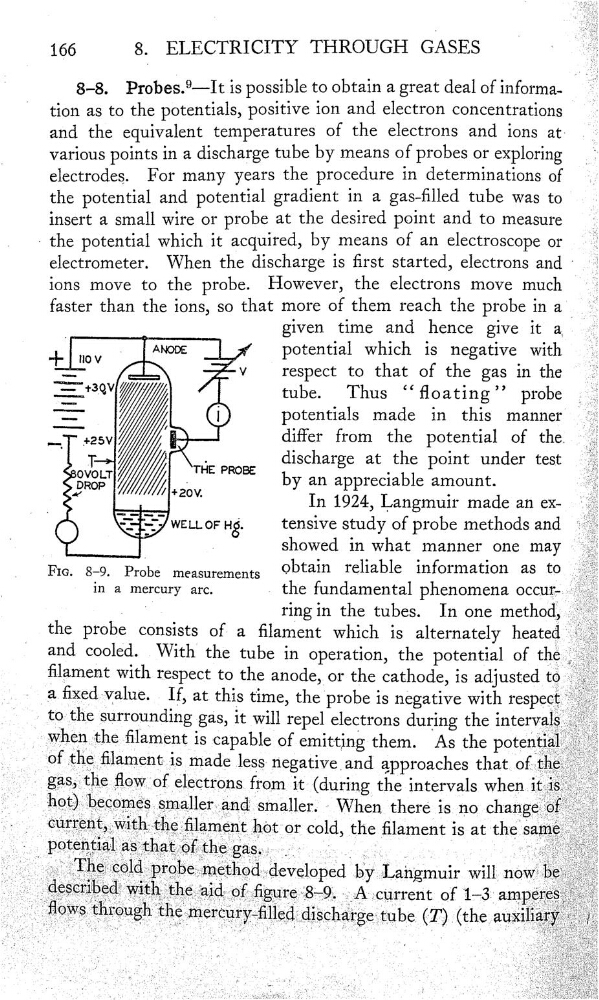
Frs. 8_9_ probe measurements
obtain reliable information as to
in a mercury arc.
»
the fundamental phenomena
.
’
ring in the tubes.
In one method,
the probe consists of a lament which is alternately heated
and cooled.
With the tube in operation, the potential of the
lament with respect to the anode,_or the cathode, is adjusted to
-
,
a xedvalue. I_f, at this time, the probe is negative with
‘
to
the surrounding gas, it will repel electrons during the 1ntervals
…
_
=
whenthe l.ament is capable of emitting them. As the potent1al“
}°f
is made l€S_S' negative_and approaches that., ofthe
gas,the OW/0f électr0ns from it (during the intervals when1t18
h0t)b600messmallerand smaller.“ When there is no changeOf
current>Wlththelamentghot‘or cold, the _lament is at the, same
TheCOldPr0beme'h—OddeVelopecl by LahÏgmuir will nowbe
desmbedwuhthea1dofgure8—9 A .:»cfurrent of 1-3 amperes
8.
ELECTRICITY THROUGH GASES
8—8.
Probes.9—It is possible to obtain a great deal of information as to the potentials, positive ion and electron concentrations
and the equivalent temperatures of the electrons and ions
various points in a discharge tube by means of probes or exploring
“.
electrodes.
For many years the procedure in determinations of
the potential and potential gradient in a gas-lled tube was to
»
insert a small wire or probe
at the desired point and to measure
.
the potential which it acquired, by means of an electroscope or
electrometer.
When the discharge is rst started, electrons and '
ions move to the probe. However, the electrons move much
faster than the ions, so that more of them reach the probe in a
_
ΑÏ
given time and hence give it a,
.
potential which is negative
with
___
3
v
respect to that of the gas in the
î*‘°‘-QV
tube.
Thus
“
Heating
”
probe
%
°
potentials made in this manner
_+2sv
differ from the potential of the.
T
.
discharge at the point under test
'8}{8Ë
.THE
pROBE
by an appreciable amount.
'
,
+20V‘
In 1924, Langmuir made an ex—
.
%?
WELL OF Hg‘.
tensive study of probe methods and
'
showed in what manner one may
_
Frs. 8_9_ probe measurements
obtain reliable information as to
in a mercury arc.
»
the fundamental phenomena
.
’
ring in the tubes.
In one method,
the probe consists of a lament which is alternately heated
and cooled.
With the tube in operation, the potential of the
lament with respect to the anode,_or the cathode, is adjusted to
-
,
a xedvalue. I_f, at this time, the probe is negative with
‘
to
the surrounding gas, it will repel electrons during the 1ntervals
…
_
=
whenthe l.ament is capable of emitting them. As the potent1al“
}°f
is made l€S_S' negative_and approaches that., ofthe
gas,the OW/0f électr0ns from it (during the intervals when1t18
h0t)b600messmallerand smaller.“ When there is no changeOf
current>Wlththelamentghot‘or cold, the _lament is at the, same
TheCOldPr0beme'h—OddeVelopecl by LahÏgmuir will nowbe
desmbedwuhthea1dofgure8—9 A .:»cfurrent of 1-3 amperes