

»
8—7.
STARTING AND STOPPING CONDITIONS
165
-
will
The value of 17
3
is different for different tubes and gases.
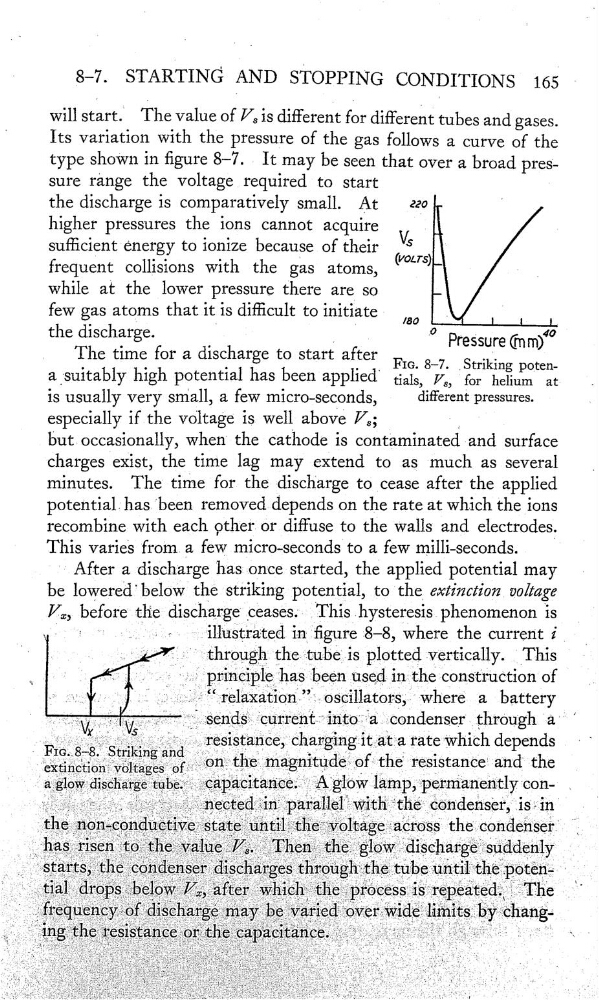
Its variation With the pressure of the gas follows a curve of the
type shoWn in gure 8—7. It may be seen that over a broad pres”—
sure range the voltage required to start
the discharge is comparatively small. At
220
'
higher pressures the ions cannot acquire
suicient energy to ionize because of their
VS
'
frequent collisions with the gas atoms,
(VOUS)
—
_
while at the lower pressure there are so
few gas atoms that it is difcult to initiate
/80
the discharge.
0
Pressure Cm m)“
The time for a discharge to start after
F
_
.
“.
_
_
.
_
_
IG. 8 7. _Stnkmg potena_-su1tably high potent1al has been appl1ed tials,
for helium
at
is usually very small, a few micro—seconds,
different pressures.
especially if the voltage is well above
_
butoccasionally, when“ the c‘athode is contaminated and surface
charges exist, the time lag may extend to as much as several
.
minutes.
The time for the discharge to cease after the applied
potential. has been removeddepends on the rate at which the ions
recombine with each other Or diffuse to the Walls and electrodes.
This varies from a few micro—seconds to a few milli—seconds.
'
After a discharge has once started, the applied potential may
—
be lowered'below the striking potential, to “the extinction voltage
Vw, before the discharge _cèa—ses:
hysteresis phenomenon is
in gure 8—8, Where the current z'
_
"
-
,
_'
«' “ through the tube. is plotted v“ertically. ‘_This
.
‘
‘
"
pr1nc1plehas'beçän Use…in=the constfüctionof
__
:“
J
'
a
battery
rate—which depends
'
‘
—
'
,
…
-
_
.
,
1gf°themagmtudesfxëhe
and the
‘
glwdhgtbcapac1tanœAglow lampaperma‘eycon- ,
»
.
mgtheresœtanœarthecapacmnœ
8—7.
STARTING AND STOPPING CONDITIONS
165
-
will
The value of 17
3
is different for different tubes and gases.
Its variation With the pressure of the gas follows a curve of the
type shoWn in gure 8—7. It may be seen that over a broad pres”—
sure range the voltage required to start
the discharge is comparatively small. At
220
'
higher pressures the ions cannot acquire
suicient energy to ionize because of their
VS
'
frequent collisions with the gas atoms,
(VOUS)
—
_
while at the lower pressure there are so
few gas atoms that it is difcult to initiate
/80
the discharge.
0
Pressure Cm m)“
The time for a discharge to start after
F
_
.
“.
_
_
.
_
_
IG. 8 7. _Stnkmg potena_-su1tably high potent1al has been appl1ed tials,
for helium
at
is usually very small, a few micro—seconds,
different pressures.
especially if the voltage is well above
_
butoccasionally, when“ the c‘athode is contaminated and surface
charges exist, the time lag may extend to as much as several
.
minutes.
The time for the discharge to cease after the applied
potential. has been removeddepends on the rate at which the ions
recombine with each other Or diffuse to the Walls and electrodes.
This varies from a few micro—seconds to a few milli—seconds.
'
After a discharge has once started, the applied potential may
—
be lowered'below the striking potential, to “the extinction voltage
Vw, before the discharge _cèa—ses:
hysteresis phenomenon is
in gure 8—8, Where the current z'
_
"
-
,
_'
«' “ through the tube. is plotted v“ertically. ‘_This
.
‘
‘
"
pr1nc1plehas'beçän Use…in=the constfüctionof
__
:“
J
'
a
battery
rate—which depends
'
‘
—
'
,
…
-
_
.
,
1gf°themagmtudesfxëhe
and the
‘
glwdhgtbcapac1tanœAglow lampaperma‘eycon- ,
»
.
mgtheresœtanœarthecapacmnœ