

158
8.
ELECTRICITY THROUGH GASES
The plates are charged to various potentials and the ow of current
(of ions) between them is observed with an electrometer, as in
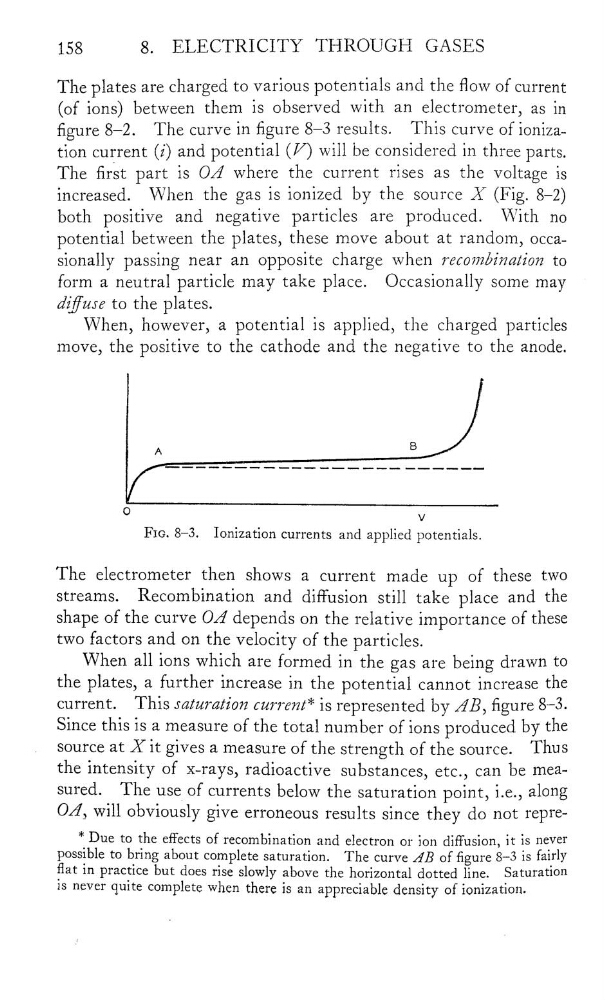
gure 8—2. The curve in gure 8—3 results.
This curve of ioniza—
tion current (1) and potential (V) will be considered in three parts.
The rst part is OÂ where the current rises as the voltage is
increased.
When the gas is ionized by the source X (Fig. 8—2)
both positive and negative particles are produced. With no
potential between the plates, these move about at random, occasionally passing near an opposite charge when recombinaz‘ion to
form a neutral particle may take place. Occasionally some may
duse to the plates.
When, however, a potential is applied, the charged particles
move, the positive to the cathode and the negative to the anode.
0
V
F1G. 8—3.
Ionization currents and applied potentials.
The electrometer then shows a current made up
of these two
streams.
Recombination and dilïusion still take place and the
shape of the curve OÂ depends on the relative importance of these
two factors and on the velocity of the particles.
When all ions which are formed in the gas are being drawn to
the plates, a further increase in the potential cannot increase the
current.
This mtumtion currem‘* is represented by ÂB, gure 8—3Since this is a measure of the total number of ions produced by the
.
source at X it gives a measure of the strength of the source. Thus
the intensity of X—rays, radioactive substances, etc., can be mea—
sured.
The use
of currents below the saturation point, i.e., along
OÂ, will obviously give erroneous results since they do not repre—
* Due to the effects of recombination and electron or ion diffusion, it is never
possible to bring about complete saturation. The curve 18 of gure 8—3 is fairly
at 1n practice but: does rise slowly above the horizontal dotted line. Saturatio
is never quite complete when there is an appreciable density of ionization.
8.
ELECTRICITY THROUGH GASES
The plates are charged to various potentials and the ow of current
(of ions) between them is observed with an electrometer, as in
gure 8—2. The curve in gure 8—3 results.
This curve of ioniza—
tion current (1) and potential (V) will be considered in three parts.
The rst part is OÂ where the current rises as the voltage is
increased.
When the gas is ionized by the source X (Fig. 8—2)
both positive and negative particles are produced. With no
potential between the plates, these move about at random, occasionally passing near an opposite charge when recombinaz‘ion to
form a neutral particle may take place. Occasionally some may
duse to the plates.
When, however, a potential is applied, the charged particles
move, the positive to the cathode and the negative to the anode.
0
V
F1G. 8—3.
Ionization currents and applied potentials.
The electrometer then shows a current made up
of these two
streams.
Recombination and dilïusion still take place and the
shape of the curve OÂ depends on the relative importance of these
two factors and on the velocity of the particles.
When all ions which are formed in the gas are being drawn to
the plates, a further increase in the potential cannot increase the
current.
This mtumtion currem‘* is represented by ÂB, gure 8—3Since this is a measure of the total number of ions produced by the
.
source at X it gives a measure of the strength of the source. Thus
the intensity of X—rays, radioactive substances, etc., can be mea—
sured.
The use
of currents below the saturation point, i.e., along
OÂ, will obviously give erroneous results since they do not repre—
* Due to the effects of recombination and electron or ion diffusion, it is never
possible to bring about complete saturation. The curve 18 of gure 8—3 is fairly
at 1n practice but: does rise slowly above the horizontal dotted line. Saturatio
is never quite complete when there is an appreciable density of ionization.