

8—3.
IONIZATION
157
their distance apart.
This phenomenon oers a means of measur—
ing high potentials in terms of the length of a spark gap.
8—3.
Ionization.—However, a gas may be made slightly con—
ductive
low potentials by many methods. For example, when
a ame 1s brought near a charged electroscope, charges of opposite
sign, which are in the gas, move to the leaves, neutralize their
charge and cause them to collapse.
These charges may be
ltered out by passing the air
from the ame through a glass
><
__
wool or cotton plug in a metal /_——__
ÏUbe (F1g 8—1) of through a long PIG. 8—1. The conductivity ofgases.
marrow
tube.
These experi—
ments
indicate that the charges diffuse readily to the walls of
bodies very close to them.
The charges may also be ltered
out by passing the gas between two charged metal plates. The
process of rendering a gas a conductor of electricity is called
'
“““—: l
+
——
l
_
[
l
-
l
!
:… !
X
;
_
[
...
___—__
_.
__
__
__..J
.
| !
]
,
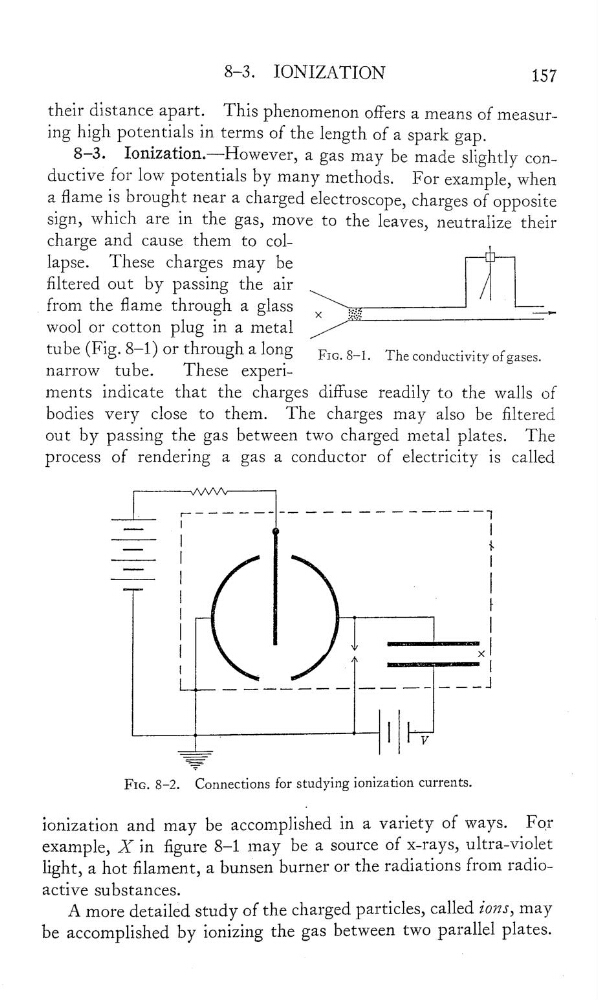
FIS. 8—2.
for studying ionization currents.
ionization and may be accomplished in a variety of ways.
example, X in gure 8—1 may be a source of X-rays, ultra—Violet
light, a hot lament, a bunSen burner or the radiations from radio—
active substances.
_
A more detailed study of the charged particles, called mns, may
be accomplished by ionizing the gas between two parallel plates.
IONIZATION
157
their distance apart.
This phenomenon oers a means of measur—
ing high potentials in terms of the length of a spark gap.
8—3.
Ionization.—However, a gas may be made slightly con—
ductive
low potentials by many methods. For example, when
a ame 1s brought near a charged electroscope, charges of opposite
sign, which are in the gas, move to the leaves, neutralize their
charge and cause them to collapse.
These charges may be
ltered out by passing the air
from the ame through a glass
><
__
wool or cotton plug in a metal /_——__
ÏUbe (F1g 8—1) of through a long PIG. 8—1. The conductivity ofgases.
marrow
tube.
These experi—
ments
indicate that the charges diffuse readily to the walls of
bodies very close to them.
The charges may also be ltered
out by passing the gas between two charged metal plates. The
process of rendering a gas a conductor of electricity is called
'
“““—: l
+
——
l
_
[
l
-
l
!
:… !
X
;
_
[
...
___—__
_.
__
__
__..J
.
| !
]
,
FIS. 8—2.
for studying ionization currents.
ionization and may be accomplished in a variety of ways.
example, X in gure 8—1 may be a source of X-rays, ultra—Violet
light, a hot lament, a bunSen burner or the radiations from radio—
active substances.
_
A more detailed study of the charged particles, called mns, may
be accomplished by ionizing the gas between two parallel plates.