

'
1—3.
THE OIL-DROP METHOD
5
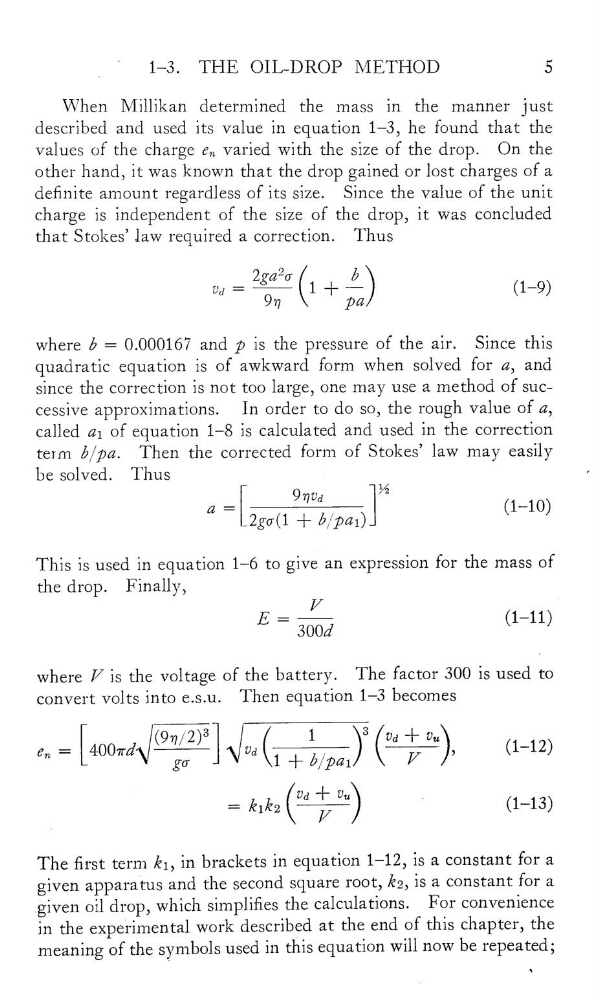
When Millikan determined the mass in the manner just
described and used its value in equation 1—3, he found that the
values of the charge en varied with the size of the drop.
On the
other hand, it was known that the drop gained or lost charges of a
denite amount regardless of its size.
Since the value of the unit
charge is independent of the size of the drop, it was concluded
that Stokes’ law required a correction.
Thus
2
2
à
vd =
—gd
” (1 + —>
(1—9)
977
pa
where b : 0.000167 and ;) is the pressure
of the air.
Since this
quadratic equation is of awkward form when solved for a, and
since the correction is not too large, one may use a method of successive approximations.
In order to do so, the rough value of a,
called all of equation 1—8 is calculated and used in the correction
term b/pa.
Then the corrected form of Stokes’ law may easily
be solved.
Thus
,
9
,
%
a
=
]
(1—10)
2g0<1 + b/Pal)
This is used in equation 1—6 to give an expression for the mass of
the drop.
Finally,
E — L
(1 11)
_
300d
Where V is the voltage of the battery.
The factor 300 is used to
convert volts into e.s.u.
Then equation 1—3 becomes
(
1
>3
+ vu)
:
——
——
——
,
1—12
en
w
1 + ä/pai
V
(
)
0
+ Un
.
=
k1k2
The rst term
in brackets in equation 1—12, is a constant for a
given apparatus and the second square root, kg, is a constant for a
given oil drop, which simplies the calculations. For convenience
in the experimental work described at the end of this chapter, the
meaning of the symbols
used in this equation Will now be repeated;
1—3.
THE OIL-DROP METHOD
5
When Millikan determined the mass in the manner just
described and used its value in equation 1—3, he found that the
values of the charge en varied with the size of the drop.
On the
other hand, it was known that the drop gained or lost charges of a
denite amount regardless of its size.
Since the value of the unit
charge is independent of the size of the drop, it was concluded
that Stokes’ law required a correction.
Thus
2
2
à
vd =
—gd
” (1 + —>
(1—9)
977
pa
where b : 0.000167 and ;) is the pressure
of the air.
Since this
quadratic equation is of awkward form when solved for a, and
since the correction is not too large, one may use a method of successive approximations.
In order to do so, the rough value of a,
called all of equation 1—8 is calculated and used in the correction
term b/pa.
Then the corrected form of Stokes’ law may easily
be solved.
Thus
,
9
,
%
a
=
]
(1—10)
2g0<1 + b/Pal)
This is used in equation 1—6 to give an expression for the mass of
the drop.
Finally,
E — L
(1 11)
_
300d
Where V is the voltage of the battery.
The factor 300 is used to
convert volts into e.s.u.
Then equation 1—3 becomes
(
1
>3
+ vu)
:
——
——
——
,
1—12
en
w
1 + ä/pai
V
(
)
0
+ Un
.
=
k1k2
The rst term
in brackets in equation 1—12, is a constant for a
given apparatus and the second square root, kg, is a constant for a
given oil drop, which simplies the calculations. For convenience
in the experimental work described at the end of this chapter, the
meaning of the symbols
used in this equation Will now be repeated;