

4
1.
THE CHARGE DE THE ELECTRON
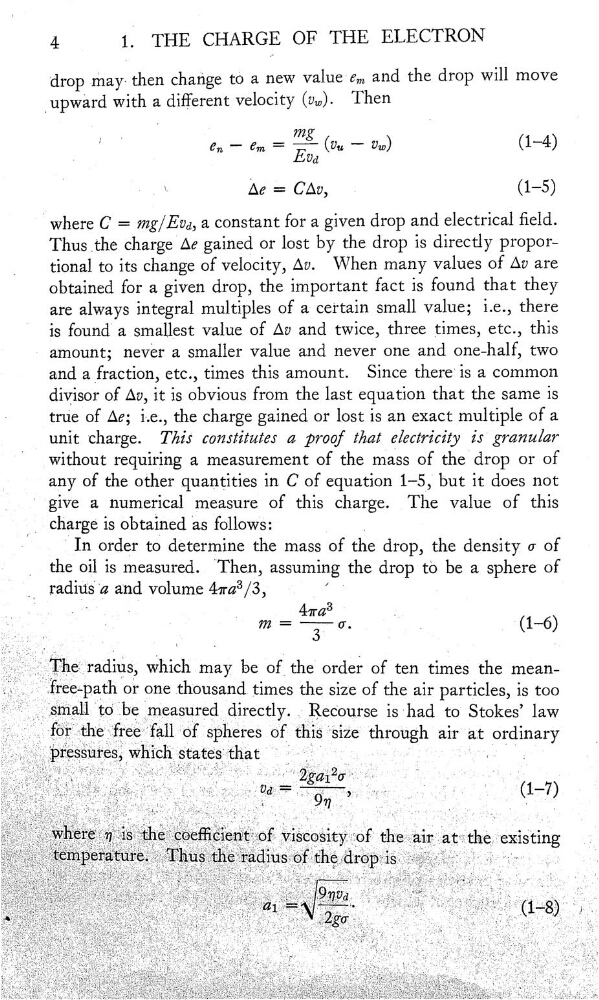
drop may then change to a new value 5… and the drop will move
upwàrd With a different velocity (vw). Then
,
_
'
mg
'
En _ €… = _— (Üu _ vw)
(1—4)
.
Eüd
'
.
_
Àe = CAv,
(1—5)
where C = mg/Evd, a constant for a given drop and electrical eld.
Thus the charge Ae gained or lost by the drop is directly propor_
tional to its change of velocity, Av. When many values of Av are
obtained for a given drop, the important fact is found that they
are always integral multiples of a certain small value; i.e., there
is found a smallest value of Av and twice, three times, etc., this
amount; never a smaller value and never one and one—half, two
and a fraction, etc., times this amount.
Since there is a common
divisor of Av, it is obvious from the last equation that the same is
—
true of Ae; ie, the charge gained or lost is an exact multiple of a
unit charge.
Tizi; constitutes & proof that electricity z's' granular
without requiring a measurement of the mass of the drop or of
any of the other quantities in C of equation 1—5,” but it does not
‘
give a numerical measure of this charge. The value of this
charge is obtained as follows:
.
»
'
In order to determine the mass of the drop, the density 0 of
the oil is measured. Then, assuming the drop to be a sphere of
radius'çz and volume 41ra3/3,
’
'
_,
-
'
'
‘
,
471113
_
Therad1us, which may be of
_
the order of ten times the meanone thousand times the size of the air particles, is too
small tri-be jmeasureddirectly. ._Rec‘ourse
to Stokes’ law
forthefreefall of sphères
of this “size through air “at ordinary
Ï
'
'
‘
Ÿ ‘
"
,ë'.î2.::'=ÿêugïy
;ræ} vd=_—
…
-
.'
“
'
‘
;
_1—7
.Ï
…-‘=ŸU “
1977 ? "' '
”
)
.
“1=\/ { ΑÎ
‘
”1 —‘ cÏ’ Ë" =î”Ï ‘(1’—”-8)f Î
.
“2g0
‘
1.
THE CHARGE DE THE ELECTRON
drop may then change to a new value 5… and the drop will move
upwàrd With a different velocity (vw). Then
,
_
'
mg
'
En _ €… = _— (Üu _ vw)
(1—4)
.
Eüd
'
.
_
Àe = CAv,
(1—5)
where C = mg/Evd, a constant for a given drop and electrical eld.
Thus the charge Ae gained or lost by the drop is directly propor_
tional to its change of velocity, Av. When many values of Av are
obtained for a given drop, the important fact is found that they
are always integral multiples of a certain small value; i.e., there
is found a smallest value of Av and twice, three times, etc., this
amount; never a smaller value and never one and one—half, two
and a fraction, etc., times this amount.
Since there is a common
divisor of Av, it is obvious from the last equation that the same is
—
true of Ae; ie, the charge gained or lost is an exact multiple of a
unit charge.
Tizi; constitutes & proof that electricity z's' granular
without requiring a measurement of the mass of the drop or of
any of the other quantities in C of equation 1—5,” but it does not
‘
give a numerical measure of this charge. The value of this
charge is obtained as follows:
.
»
'
In order to determine the mass of the drop, the density 0 of
the oil is measured. Then, assuming the drop to be a sphere of
radius'çz and volume 41ra3/3,
’
'
_,
-
'
'
‘
,
471113
_
Therad1us, which may be of
_
the order of ten times the meanone thousand times the size of the air particles, is too
small tri-be jmeasureddirectly. ._Rec‘ourse
to Stokes’ law
forthefreefall of sphères
of this “size through air “at ordinary
Ï
'
'
‘
Ÿ ‘
"
,ë'.î2.::'=ÿêugïy
;ræ} vd=_—
…
-
.'
“
'
‘
;
_1—7
.Ï
…-‘=ŸU “
1977 ? "' '
”
)
.
“1=\/ { ΑÎ
‘
”1 —‘ cÏ’ Ë" =î”Ï ‘(1’—”-8)f Î
.
“2g0
‘