

132
6.
HIGH VACUUM, LOWVOLTAGE TUBES
built up
of layers, each of constant index, with boundaries at the
equi-potential surfaces. ln further contrast with optical systems,
it is necessary for accurate work to consider the mutual repulsion
‘
between the electrons in the beam, their alteration of the elds and
«
the effectsof other space charges such'as gaseous ions.
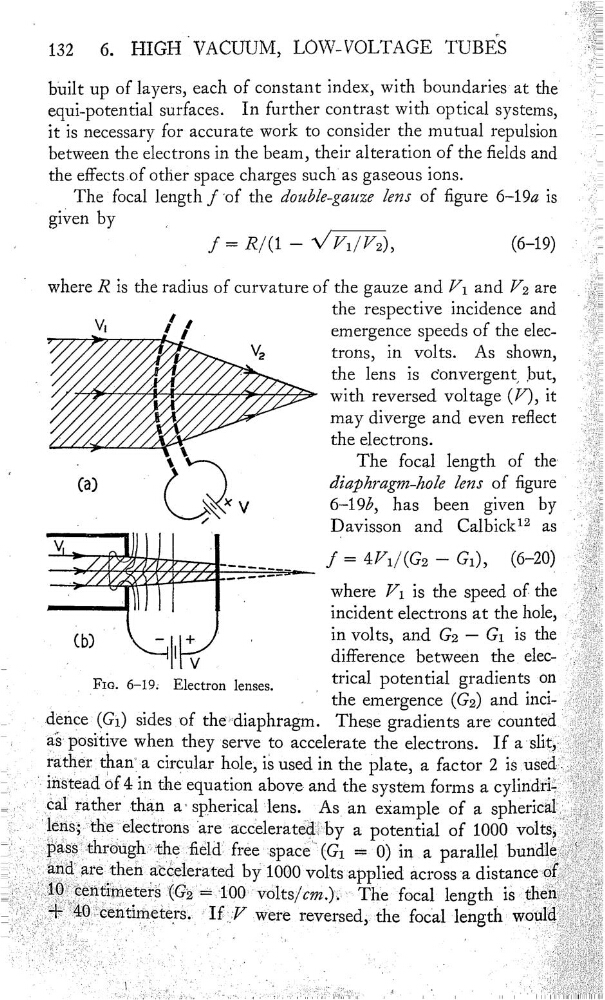
The focal length f of the douôle-gauze lens of gure 6—194 is
..
{ÎÏ
given by
»
f = R/<1 — \/ V1/V2>,
(6—19) .
:_
where R is the radius of curvature of the gauze and V1 and 17 2 are
,
,
the respective incidence and
V'
' ['
emergence speeds of the elec—
//'/{7
V2
trous, in volts.
As shown,
"
_
the lens is c‘onvergent but,
’
‘' _
with reversed voltage (V), it
W
may diverge and even reect
the electrons.
.
\
‘
The focal length of the
(a)
'
diaphragm-Ïzole lens of gure
'
…
\X v
6—19b, has been given by
'
Davisson and Calbick12 as Ï
V
f = 4V1/(G2 — G1),
(6—20)
.
Æ'lÀ'JYJÜ'IIII ——--—" ‘
.
'
.
"
where 171 is the speed of- the
*
'
incident electrons at the hole,
(b)
—
+,
"
,
in volts, and G2 — G1 is the
_
I‘ V
difference between the elecFm. 6—19.—
Electron lenses.
trical P0tentî31 gradients on
‘
'
…
'
the emergence (GZ) and incidence (Gi) sides of
These gradients are counted
_
as positive when they serve to accelerate the electrons. If asht,
;
__
rather than’ÿa circular hole, is used in the plate, a factor 2 is used
instead of 4 in the equation above and the system forms a cyl1ndr1—
:
cal
than
spherical lens.
an eXample of a
lens,the eÏCCËÏ'OS ‘are' ‘acceleratéäiäèby a potential of 1000 volts,
PaSSthr®ugh ÏChe>éld
(G1 = 0) in a parallel
applied across 'a d1stanceof
cm) " The focal length is then
+40œnlmeters
Were
the 'foc‘al length would
6.
HIGH VACUUM, LOWVOLTAGE TUBES
built up
of layers, each of constant index, with boundaries at the
equi-potential surfaces. ln further contrast with optical systems,
it is necessary for accurate work to consider the mutual repulsion
‘
between the electrons in the beam, their alteration of the elds and
«
the effectsof other space charges such'as gaseous ions.
The focal length f of the douôle-gauze lens of gure 6—194 is
..
{ÎÏ
given by
»
f = R/<1 — \/ V1/V2>,
(6—19) .
:_
where R is the radius of curvature of the gauze and V1 and 17 2 are
,
,
the respective incidence and
V'
' ['
emergence speeds of the elec—
//'/{7
V2
trous, in volts.
As shown,
"
_
the lens is c‘onvergent but,
’
‘' _
with reversed voltage (V), it
W
may diverge and even reect
the electrons.
.
\
‘
The focal length of the
(a)
'
diaphragm-Ïzole lens of gure
'
…
\X v
6—19b, has been given by
'
Davisson and Calbick12 as Ï
V
f = 4V1/(G2 — G1),
(6—20)
.
Æ'lÀ'JYJÜ'IIII ——--—" ‘
.
'
.
"
where 171 is the speed of- the
*
'
incident electrons at the hole,
(b)
—
+,
"
,
in volts, and G2 — G1 is the
_
I‘ V
difference between the elecFm. 6—19.—
Electron lenses.
trical P0tentî31 gradients on
‘
'
…
'
the emergence (GZ) and incidence (Gi) sides of
These gradients are counted
_
as positive when they serve to accelerate the electrons. If asht,
;
__
rather than’ÿa circular hole, is used in the plate, a factor 2 is used
instead of 4 in the equation above and the system forms a cyl1ndr1—
:
cal
than
spherical lens.
an eXample of a
lens,the eÏCCËÏ'OS ‘are' ‘acceleratéäiäèby a potential of 1000 volts,
PaSSthr®ugh ÏChe>éld
(G1 = 0) in a parallel
applied across 'a d1stanceof
cm) " The focal length is then
+40œnlmeters
Were
the 'foc‘al length would