

136
THE SEAS
'
its relatives such as the cockle and
When taken
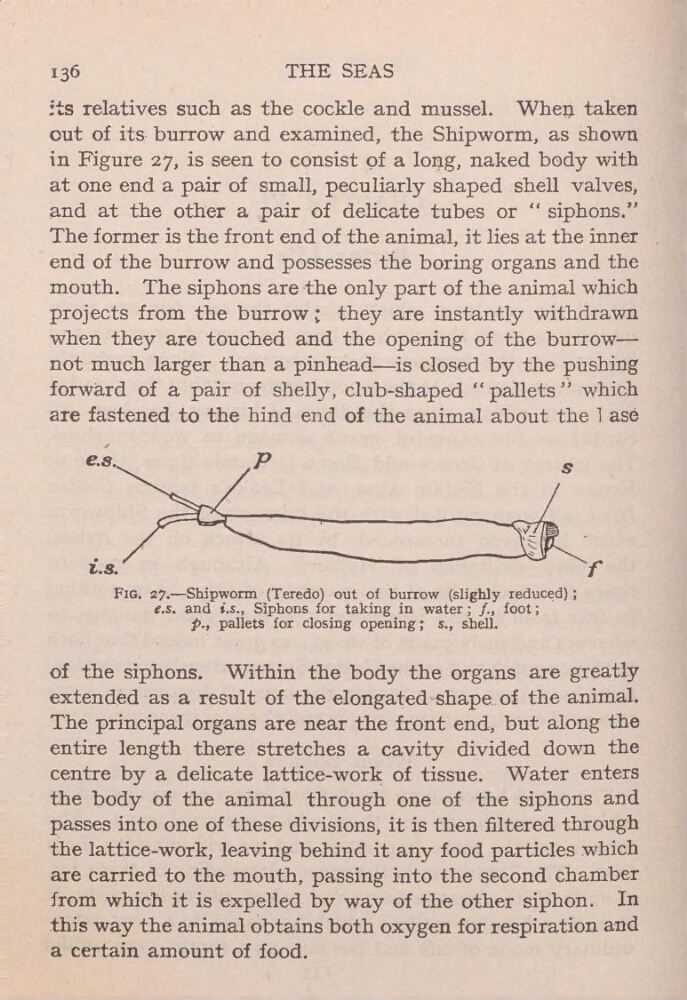
out of its burroW and examined, the Shipworm, as Showu''
:
in Figure 27, is seen to consist of a long, naked body With ;
at one end a pair of small, peculiarly shaped shell valves,
"
and at the other a pair of delicate tubes or “ siphons.”
The former is the front end of the animal, it lies at the inner
_
'
end of the bùrrow and possesses the boring organs and the
mouth.
The siphons are the only part of the animal which "
,
projects from the burroW; they are instantly
when they are touched and the opening of the burrow—
not much larger than a pinhead—is closed by the pùshing
forw'ard of a pair of shelly, club—shaped
which -
are fastened to the bind end of the animal about the 1 ase
e.ê.
P
3
'
__
Ut
-
i.s'.
'
.
f
_
FIG. 27.—Shipworm-(Teredo) out of burrow (slighly reduced);
.
6.5.
and i.s., Siphons for taking in water; f., foot;
'
for closing opening; s., shell.
of the siphons.
Within the body the organs ‘are greatly
'
result
elongated«shape.of the animal. _
The principal organs are near the front end, but along the
entire length there stretches a cavity divided down the
centre by a delicate lattice—work of tissue.
Water enters
the body of_ the animal through one of the siphons and
passes
into one of these divisions; it is then ltered through
the lattice—work, leaving behind it any food particles which
'
‘
are carried to the mouth, passing into the second chamber '
from which‘itis expelled by way of the other siphon.
In
this way the animal obtains both oxygen for respiration and
a Certain amount of food;
-
-
'
-
THE SEAS
'
its relatives such as the cockle and
When taken
out of its burroW and examined, the Shipworm, as Showu''
:
in Figure 27, is seen to consist of a long, naked body With ;
at one end a pair of small, peculiarly shaped shell valves,
"
and at the other a pair of delicate tubes or “ siphons.”
The former is the front end of the animal, it lies at the inner
_
'
end of the bùrrow and possesses the boring organs and the
mouth.
The siphons are the only part of the animal which "
,
projects from the burroW; they are instantly
when they are touched and the opening of the burrow—
not much larger than a pinhead—is closed by the pùshing
forw'ard of a pair of shelly, club—shaped
which -
are fastened to the bind end of the animal about the 1 ase
e.ê.
P
3
'
__
Ut
-
i.s'.
'
.
f
_
FIG. 27.—Shipworm-(Teredo) out of burrow (slighly reduced);
.
6.5.
and i.s., Siphons for taking in water; f., foot;
'
for closing opening; s., shell.
of the siphons.
Within the body the organs ‘are greatly
'
result
elongated«shape.of the animal. _
The principal organs are near the front end, but along the
entire length there stretches a cavity divided down the
centre by a delicate lattice—work of tissue.
Water enters
the body of_ the animal through one of the siphons and
passes
into one of these divisions; it is then ltered through
the lattice—work, leaving behind it any food particles which
'
‘
are carried to the mouth, passing into the second chamber '
from which‘itis expelled by way of the other siphon.
In
this way the animal obtains both oxygen for respiration and
a Certain amount of food;
-
-
'
-