

46
E. Romstad
emissions from agriculture are not readily observable. That
makes it difficult to introduce emission taxes (or subsidies to
reduce emissions). There are, however, several other policy
instruments available for reducing emissions that are not
readily observable:
1. Command-and-control (CAC) regulations, i.e., the regulatory authorities by law require polluters to undertake
certain actions that have been found to reduce emissions
or improve the environmental quality of the recipient of
the pollution.
2. Procedural regulations, often in the form of taxes on undesirable practices or payments (subsidies), for desirable
practices.
3. Input taxes (or subsidies), i.e., input uses that are strongly
linked to emissions become more expensive, which in
turn lead to reduced use of the polluting input. Pesticide
taxes are one example of such a tax.
4. Ambient regulations, i.e., those polluters are issued a tax
if the environmental quality falls below a certain level,
or are paid if environmental quality improves. Here, it
should be noted that while nonpoint source emissions are
difficult to observe, the resulting impacts on recipients
may be readily observed.
Before proceeding with a discussion of these four main types
of regulatory instruments, we need to have some notions
about what is meant by environmental damages, optimal policies, and cost effectiveness. Briefly, optimality entails comparing the (expected) costs and (expected) benefits of policies to avoid levying too strict policies if perceived benefits
are small compared to costs, or more commonly, to sharpen
policies if costs are small compared to perceived benefits.
The structure of this chapter is as follows. First, I briefly discuss the linkages between physical damages and the
economic concepts of environmental damages before cost
effectiveness and optimality are addressed. Then, I frame
nonpoint source pollution in an economic context with particular emphasis on asymmetric information. The following
sections deal with the three types of economic instruments
applied to nonpoint source pollution. Next, I present a brief
overview of some computable (economic) models of nonpoint source pollution.
4.2 Environmental Damages
Economic analysis is not limited to policy instruments. Assessing the costs to society from pollution is another important branch of economic research. The intersection between
the marginal abatement costs, i.e., the costs of reducing pollution, and the marginal benefits from pollution reductions,
marks the optimal emission level from an economic angle.
Estimates for society’s marginal willingness-to-pay for pollution reductions can be obtained in many different ways.
For a natural science readership, the least controversial way
to get such estimates would most likely be to look at the
physical damages caused by pollution and assess some monetary value to these damages. Usually, physical damages
increase with higher pollution levels. This implies that the
damages in economic terms would follow the same pattern.
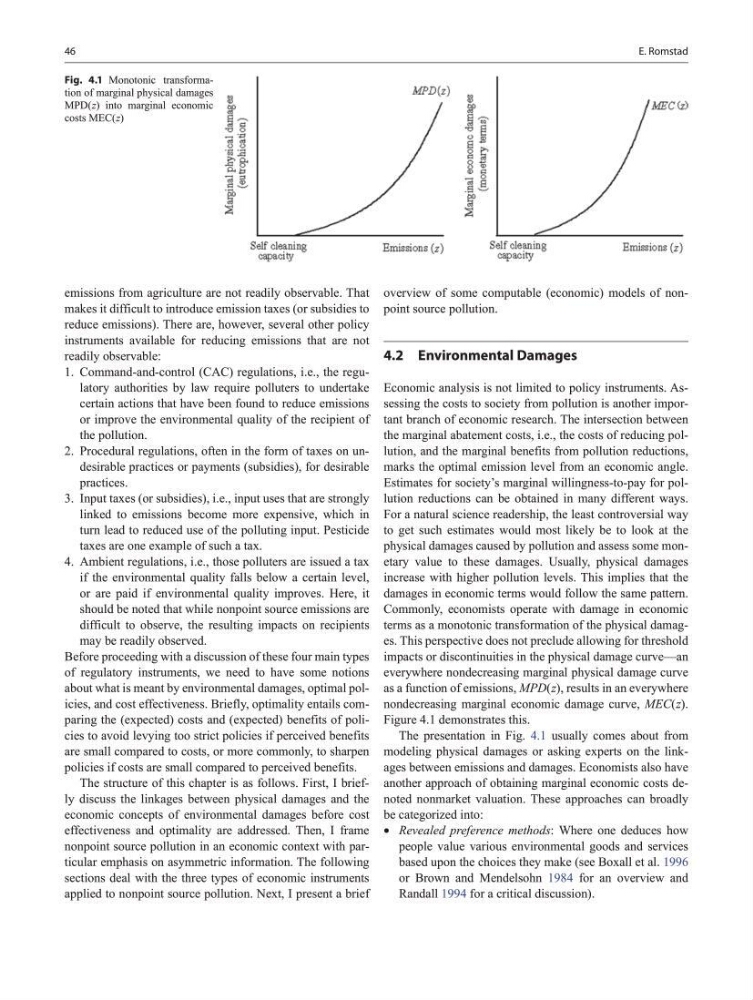
Commonly, economists operate with damage in economic
terms as a monotonic transformation of the physical damages. This perspective does not preclude allowing for threshold
impacts or discontinuities in the physical damage curve—an
everywhere nondecreasing marginal physical damage curve
as a function of emissions, MPD( z), results in an everywhere
nondecreasing marginal economic damage curve, MEC( z).
Figure 4.1 demonstrates this.
The presentation in Fig. 4.1 usually comes about from
modeling physical damages or asking experts on the linkages between emissions and damages. Economists also have
another approach of obtaining marginal economic costs denoted nonmarket valuation. These approaches can broadly
be categorized into:
• Revealed preference methods: Where one deduces how
people value various environmental goods and services
based upon the choices they make (see Boxall et al. 1996
or Brown and Mendelsohn 1984 for an overview and
Randall 1994 for a critical discussion).
Fig. 4.1 Monotonic transformation of marginal physical damages
MPD( z) into marginal economic
costs MEC( z)
E. Romstad
emissions from agriculture are not readily observable. That
makes it difficult to introduce emission taxes (or subsidies to
reduce emissions). There are, however, several other policy
instruments available for reducing emissions that are not
readily observable:
1. Command-and-control (CAC) regulations, i.e., the regulatory authorities by law require polluters to undertake
certain actions that have been found to reduce emissions
or improve the environmental quality of the recipient of
the pollution.
2. Procedural regulations, often in the form of taxes on undesirable practices or payments (subsidies), for desirable
practices.
3. Input taxes (or subsidies), i.e., input uses that are strongly
linked to emissions become more expensive, which in
turn lead to reduced use of the polluting input. Pesticide
taxes are one example of such a tax.
4. Ambient regulations, i.e., those polluters are issued a tax
if the environmental quality falls below a certain level,
or are paid if environmental quality improves. Here, it
should be noted that while nonpoint source emissions are
difficult to observe, the resulting impacts on recipients
may be readily observed.
Before proceeding with a discussion of these four main types
of regulatory instruments, we need to have some notions
about what is meant by environmental damages, optimal policies, and cost effectiveness. Briefly, optimality entails comparing the (expected) costs and (expected) benefits of policies to avoid levying too strict policies if perceived benefits
are small compared to costs, or more commonly, to sharpen
policies if costs are small compared to perceived benefits.
The structure of this chapter is as follows. First, I briefly discuss the linkages between physical damages and the
economic concepts of environmental damages before cost
effectiveness and optimality are addressed. Then, I frame
nonpoint source pollution in an economic context with particular emphasis on asymmetric information. The following
sections deal with the three types of economic instruments
applied to nonpoint source pollution. Next, I present a brief
overview of some computable (economic) models of nonpoint source pollution.
4.2 Environmental Damages
Economic analysis is not limited to policy instruments. Assessing the costs to society from pollution is another important branch of economic research. The intersection between
the marginal abatement costs, i.e., the costs of reducing pollution, and the marginal benefits from pollution reductions,
marks the optimal emission level from an economic angle.
Estimates for society’s marginal willingness-to-pay for pollution reductions can be obtained in many different ways.
For a natural science readership, the least controversial way
to get such estimates would most likely be to look at the
physical damages caused by pollution and assess some monetary value to these damages. Usually, physical damages
increase with higher pollution levels. This implies that the
damages in economic terms would follow the same pattern.
Commonly, economists operate with damage in economic
terms as a monotonic transformation of the physical damages. This perspective does not preclude allowing for threshold
impacts or discontinuities in the physical damage curve—an
everywhere nondecreasing marginal physical damage curve
as a function of emissions, MPD( z), results in an everywhere
nondecreasing marginal economic damage curve, MEC( z).
Figure 4.1 demonstrates this.
The presentation in Fig. 4.1 usually comes about from
modeling physical damages or asking experts on the linkages between emissions and damages. Economists also have
another approach of obtaining marginal economic costs denoted nonmarket valuation. These approaches can broadly
be categorized into:
• Revealed preference methods: Where one deduces how
people value various environmental goods and services
based upon the choices they make (see Boxall et al. 1996
or Brown and Mendelsohn 1984 for an overview and
Randall 1994 for a critical discussion).
Fig. 4.1 Monotonic transformation of marginal physical damages
MPD( z) into marginal economic
costs MEC( z)