

259
18 Ultraviolet Radiation and Bromide as Limiting Factors in Eutrophication Processes in Semiarid Climate Zones
and NO 3 concentrations of 0.5 and 15 mg/l, respectively,
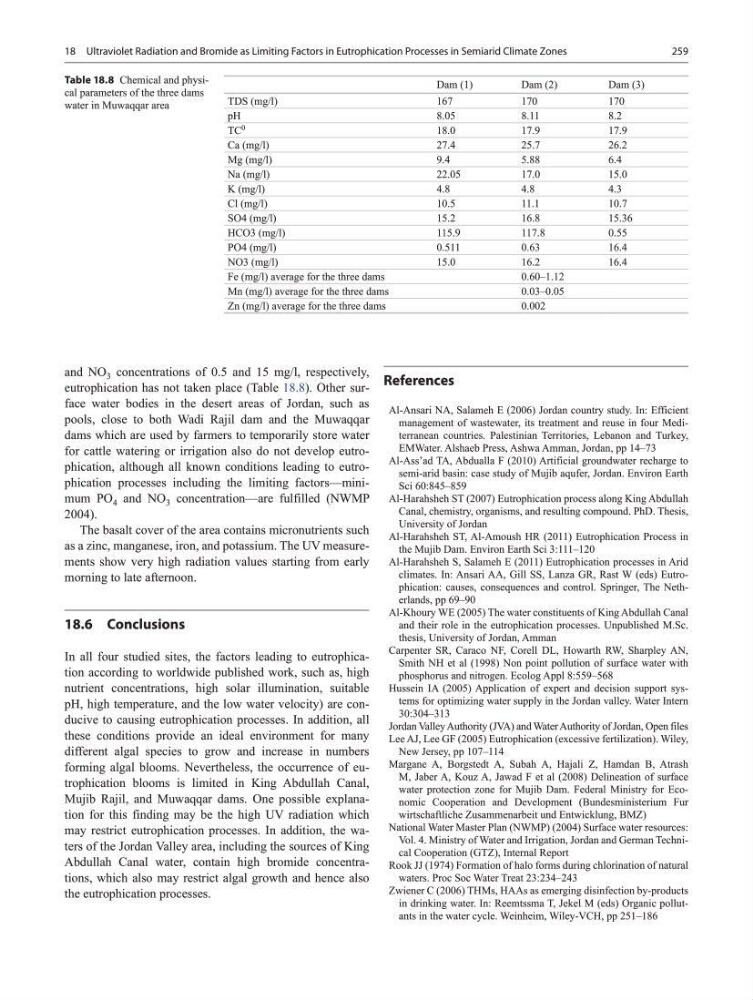
eutrophication has not taken place (Table 18.8). Other surface water bodies in the desert areas of Jordan, such as
pools, close to both Wadi Rajil dam and the Muwaqqar
dams which are used by farmers to temporarily store water
for cattle watering or irrigation also do not develop eutrophication, although all known conditions leading to eutrophication processes including the limiting factors—minimum PO 4 and NO 3 concentration—are fulfilled (NWMP
2004).
The basalt cover of the area contains micronutrients such
as a zinc, manganese, iron, and potassium. The UV measurements show very high radiation values starting from early
morning to late afternoon.
18.6 Conclusions
In all four studied sites, the factors leading to eutrophication according to worldwide published work, such as, high
nutrient concentrations, high solar illumination, suitable
pH, high temperature, and the low water velocity) are conducive to causing eutrophication processes. In addition, all
these conditions provide an ideal environment for many
different algal species to grow and increase in numbers
forming algal blooms. Nevertheless, the occurrence of eutrophication blooms is limited in King Abdullah Canal,
Mujib Rajil, and Muwaqqar dams. One possible explanation for this finding may be the high UV radiation which
may restrict eutrophication processes. In addition, the waters of the Jordan Valley area, including the sources of King
Abdullah Canal water, contain high bromide concentrations, which also may restrict algal growth and hence also
the eutrophication processes.
References
Al-Ansari NA, Salameh E (2006) Jordan country study. In: Efficient
management of wastewater, its treatment and reuse in four Mediterranean countries. Palestinian Territories, Lebanon and Turkey,
EMWater. Alshaeb Press, Ashwa Amman, Jordan, pp 14–73
Al-Ass’ad TA, Abdualla F (2010) Artificial groundwater recharge to
semi-arid basin: case study of Mujib aqufer, Jordan. Environ Earth
Sci 60:845–859
Al-Harahsheh ST (2007) Eutrophication process along King Abdullah
Canal, chemistry, organisms, and resulting compound. PhD. Thesis,
University of Jordan
Al-Harahsheh ST, Al-Amoush HR (2011) Eutrophication Process in
the Mujib Dam. Environ Earth Sci 3:111–120
Al-Harahsheh S, Salameh E (2011) Eutrophication processes in Arid
climates. In: Ansari AA, Gill SS, Lanza GR, Rast W (eds) Eutrophication: causes, consequences and control. Springer, The Netherlands, pp 69–90
Al-Khoury WE (2005) The water constituents of King Abdullah Canal
and their role in the eutrophication processes. Unpublished M.Sc.
thesis, University of Jordan, Amman
Carpenter SR, Caraco NF, Corell DL, Howarth RW, Sharpley AN,
Smith NH et al (1998) Non point pollution of surface water with
phosphorus and nitrogen. Ecolog Appl 8:559–568
Hussein IA (2005) Application of expert and decision support systems for optimizing water supply in the Jordan valley. Water Intern
30:304–313
Jordan Valley Authority (JVA) and Water Authority of Jordan, Open files
Lee AJ, Lee GF (2005) Eutrophication (excessive fertilization). Wiley,
New Jersey, pp 107–114
Margane A, Borgstedt A, Subah A, Hajali Z, Hamdan B, Atrash
M, Jaber A, Kouz A, Jawad F et al (2008) Delineation of surface
water protection zone for Mujib Dam. Federal Ministry for Economic Cooperation and Development (Bundesministerium Fur
wirtschaftliche Zusammenarbeit und Entwicklung, BMZ)
National Water Master Plan (NWMP) (2004) Surface water resources:
Vol. 4. Ministry of Water and Irrigation, Jordan and German Technical Cooperation (GTZ), Internal Report
Rook JJ (1974) Formation of halo forms during chlorination of natural
waters. Proc Soc Water Treat 23:234–243
Zwiener C (2006) THMs, HAAs as emerging disinfection by-products
in drinking water. In: Reemtssma T, Jekel M (eds) Organic pollutants in the water cycle. Weinheim, Wiley-VCH, pp 251–186
Dam (1)
Dam (2)
Dam (3)
TDS (mg/l)
167
170
170
pH
8.05
8.11
8.2
TC 0
18.0
17.9
17.9
Ca (mg/l)
27.4
25.7
26.2
Mg (mg/l)
9.4
5.88
6.4
Na (mg/l)
22.05
17.0
15.0
K (mg/l)
4.8
4.8
4.3
Cl (mg/l)
10.5
11.1
10.7
SO4 (mg/l)
15.2
16.8
15.36
HCO3 (mg/l)
115.9
117.8
0.55
PO4 (mg/l)
0.511
0.63
16.4
NO3 (mg/l)
15.0
16.2
16.4
Fe (mg/l) average for the three dams
0.60–1.12
Mn (mg/l) average for the three dams
0.03–0.05
Zn (mg/l) average for the three dams
0.002
Table 18.8 Chemical and physical parameters of the three dams
water in Muwaqqar area
18 Ultraviolet Radiation and Bromide as Limiting Factors in Eutrophication Processes in Semiarid Climate Zones
and NO 3 concentrations of 0.5 and 15 mg/l, respectively,
eutrophication has not taken place (Table 18.8). Other surface water bodies in the desert areas of Jordan, such as
pools, close to both Wadi Rajil dam and the Muwaqqar
dams which are used by farmers to temporarily store water
for cattle watering or irrigation also do not develop eutrophication, although all known conditions leading to eutrophication processes including the limiting factors—minimum PO 4 and NO 3 concentration—are fulfilled (NWMP
2004).
The basalt cover of the area contains micronutrients such
as a zinc, manganese, iron, and potassium. The UV measurements show very high radiation values starting from early
morning to late afternoon.
18.6 Conclusions
In all four studied sites, the factors leading to eutrophication according to worldwide published work, such as, high
nutrient concentrations, high solar illumination, suitable
pH, high temperature, and the low water velocity) are conducive to causing eutrophication processes. In addition, all
these conditions provide an ideal environment for many
different algal species to grow and increase in numbers
forming algal blooms. Nevertheless, the occurrence of eutrophication blooms is limited in King Abdullah Canal,
Mujib Rajil, and Muwaqqar dams. One possible explanation for this finding may be the high UV radiation which
may restrict eutrophication processes. In addition, the waters of the Jordan Valley area, including the sources of King
Abdullah Canal water, contain high bromide concentrations, which also may restrict algal growth and hence also
the eutrophication processes.
References
Al-Ansari NA, Salameh E (2006) Jordan country study. In: Efficient
management of wastewater, its treatment and reuse in four Mediterranean countries. Palestinian Territories, Lebanon and Turkey,
EMWater. Alshaeb Press, Ashwa Amman, Jordan, pp 14–73
Al-Ass’ad TA, Abdualla F (2010) Artificial groundwater recharge to
semi-arid basin: case study of Mujib aqufer, Jordan. Environ Earth
Sci 60:845–859
Al-Harahsheh ST (2007) Eutrophication process along King Abdullah
Canal, chemistry, organisms, and resulting compound. PhD. Thesis,
University of Jordan
Al-Harahsheh ST, Al-Amoush HR (2011) Eutrophication Process in
the Mujib Dam. Environ Earth Sci 3:111–120
Al-Harahsheh S, Salameh E (2011) Eutrophication processes in Arid
climates. In: Ansari AA, Gill SS, Lanza GR, Rast W (eds) Eutrophication: causes, consequences and control. Springer, The Netherlands, pp 69–90
Al-Khoury WE (2005) The water constituents of King Abdullah Canal
and their role in the eutrophication processes. Unpublished M.Sc.
thesis, University of Jordan, Amman
Carpenter SR, Caraco NF, Corell DL, Howarth RW, Sharpley AN,
Smith NH et al (1998) Non point pollution of surface water with
phosphorus and nitrogen. Ecolog Appl 8:559–568
Hussein IA (2005) Application of expert and decision support systems for optimizing water supply in the Jordan valley. Water Intern
30:304–313
Jordan Valley Authority (JVA) and Water Authority of Jordan, Open files
Lee AJ, Lee GF (2005) Eutrophication (excessive fertilization). Wiley,
New Jersey, pp 107–114
Margane A, Borgstedt A, Subah A, Hajali Z, Hamdan B, Atrash
M, Jaber A, Kouz A, Jawad F et al (2008) Delineation of surface
water protection zone for Mujib Dam. Federal Ministry for Economic Cooperation and Development (Bundesministerium Fur
wirtschaftliche Zusammenarbeit und Entwicklung, BMZ)
National Water Master Plan (NWMP) (2004) Surface water resources:
Vol. 4. Ministry of Water and Irrigation, Jordan and German Technical Cooperation (GTZ), Internal Report
Rook JJ (1974) Formation of halo forms during chlorination of natural
waters. Proc Soc Water Treat 23:234–243
Zwiener C (2006) THMs, HAAs as emerging disinfection by-products
in drinking water. In: Reemtssma T, Jekel M (eds) Organic pollutants in the water cycle. Weinheim, Wiley-VCH, pp 251–186
Dam (1)
Dam (2)
Dam (3)
TDS (mg/l)
167
170
170
pH
8.05
8.11
8.2
TC 0
18.0
17.9
17.9
Ca (mg/l)
27.4
25.7
26.2
Mg (mg/l)
9.4
5.88
6.4
Na (mg/l)
22.05
17.0
15.0
K (mg/l)
4.8
4.8
4.3
Cl (mg/l)
10.5
11.1
10.7
SO4 (mg/l)
15.2
16.8
15.36
HCO3 (mg/l)
115.9
117.8
0.55
PO4 (mg/l)
0.511
0.63
16.4
NO3 (mg/l)
15.0
16.2
16.4
Fe (mg/l) average for the three dams
0.60–1.12
Mn (mg/l) average for the three dams
0.03–0.05
Zn (mg/l) average for the three dams
0.002
Table 18.8 Chemical and physical parameters of the three dams
water in Muwaqqar area