

256
E. Salameh et al.
climatic variations occur between the winters and summer
seasons. The seasonal average of some chemical laboratory
analyses of water samples are given in Figs. 18.7 and 18.8.
18.3.2.1 Nutrients (PO 4
3− , NO 3
− , SiO 2 )
The PO
3−
4 , NO 3
− , and SiO 2 concentrations ranged between
0.01, 0.94, and 0.356 mg/l to 0.177, 3.98, and 15.55 mg/l,
respectively. In general, the average concentrations of PO
3−
4 ,
NO 3
− , and SiO 2 are higher in winter than in summer, except
Table 18.4 UV radiation in Deir Alla areas (midday)
Radiation
Wave length (nm)
Intensity (mv/cm 2 )
UV a
(315–400)
361
UV b
(280–315)
1.36
UV c
(200–280)
0.00
for the year 2006 when there was flushing of the soil by the
runoff (Fig. 18.7). The concentrations of all the nutrients are
above the eutrophication level. The NO 3
− and PO
3−
4 concentrations necessary for the eutrophication process (Fig. 18.7)
are 0.2–0.3 and 0.01 mg/l, respectively (Lee and Lee 2005).
The main sources of nutrients are natural PO
3−
4 originating from the phosphate deposits within the catchment area,
natural NO 3
− from soils and the atmosphere and disposal of
wastewater in cesspits, chicken farms, and cultivated lands
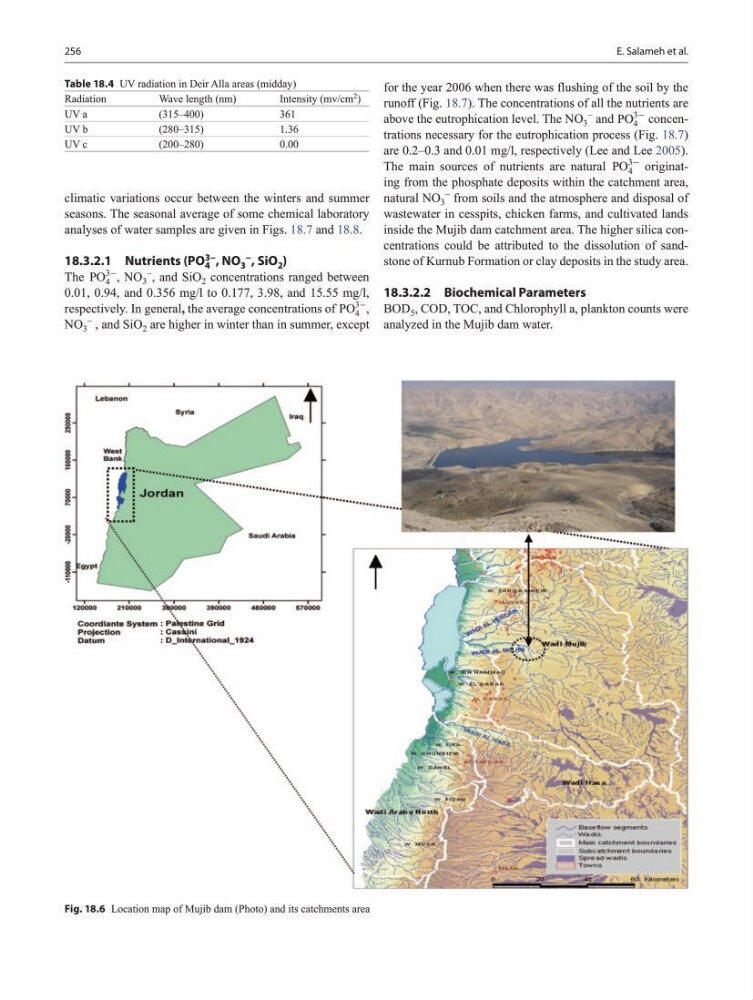
inside the Mujib dam catchment area. The higher silica concentrations could be attributed to the dissolution of sandstone of Kurnub Formation or clay deposits in the study area.
18.3.2.2 Biochemical Parameters
BOD 5 , COD, TOC, and Chlorophyll a, plankton counts were
analyzed in the Mujib dam water.
Fig. 18.6 Location map of Mujib dam (Photo) and its catchments area
E. Salameh et al.
climatic variations occur between the winters and summer
seasons. The seasonal average of some chemical laboratory
analyses of water samples are given in Figs. 18.7 and 18.8.
18.3.2.1 Nutrients (PO 4
3− , NO 3
− , SiO 2 )
The PO
3−
4 , NO 3
− , and SiO 2 concentrations ranged between
0.01, 0.94, and 0.356 mg/l to 0.177, 3.98, and 15.55 mg/l,
respectively. In general, the average concentrations of PO
3−
4 ,
NO 3
− , and SiO 2 are higher in winter than in summer, except
Table 18.4 UV radiation in Deir Alla areas (midday)
Radiation
Wave length (nm)
Intensity (mv/cm 2 )
UV a
(315–400)
361
UV b
(280–315)
1.36
UV c
(200–280)
0.00
for the year 2006 when there was flushing of the soil by the
runoff (Fig. 18.7). The concentrations of all the nutrients are
above the eutrophication level. The NO 3
− and PO
3−
4 concentrations necessary for the eutrophication process (Fig. 18.7)
are 0.2–0.3 and 0.01 mg/l, respectively (Lee and Lee 2005).
The main sources of nutrients are natural PO
3−
4 originating from the phosphate deposits within the catchment area,
natural NO 3
− from soils and the atmosphere and disposal of
wastewater in cesspits, chicken farms, and cultivated lands
inside the Mujib dam catchment area. The higher silica concentrations could be attributed to the dissolution of sandstone of Kurnub Formation or clay deposits in the study area.
18.3.2.2 Biochemical Parameters
BOD 5 , COD, TOC, and Chlorophyll a, plankton counts were
analyzed in the Mujib dam water.
Fig. 18.6 Location map of Mujib dam (Photo) and its catchments area