

195
14 Phytoplankton Assemblages as an Indicator of Water Quality in Seven Temperate Estuarine Lakes in South-East Australia
14.3.3 Spatial Variation of Phytoplankton
Assemblages
In this study, 145 phytoplankton species were identified.
These cover five groups, Cyanophyta, Chlorophyta, Chromophyta, Diatoms, and Pyrrophyta. The main contributors to
the phytoplankton assemblages were diatoms with 95 species,
followed by 34 Pyrrophyta species, 8 Cyanophyta species, 3
Chlorophyta, and 2 Chromophyta species (Table 14.3).
Temperate species dominated the phytoplankton assemblages, but, a few tropical species were identified (e.g.,
Hemidiscus hardmannianus, Prorocentrum mexicanum),
and some Protoperidinium species with a preference for
temperate conditions (Hasle and Syvertsen 1997) were often
observed (Table 14.3). The ecological preference of the phytoplankton species reflected the temperate to warm climatic
regime of these estuaries.
Owing to the effect of shallow water (the average water
depth is usually no more than about 3 m), and the large-scale
distribution of seagrass and macroalgae in these coastal
lakes, phytoplankton assemblages displayed a combination
of euplanktonic (e.g., Coscinodiscus centralis), tychoplanktonic (e.g., Pleurosigma normanii), epiphytic (e.g., Amphora
hyalina), and periphytic species (e.g., Achnanthes longipes)
(Hasle and Syvertsen 1997; Guo and Qian 2003). Moreover,
the different proportions of freshwater species (e.g., Tabellaria fenestrata), brackish species (e.g., Amphora hyalina)
and marine species (e.g., Lauderia borealis) in the phytoplankton assemblages were an indication of the variable salinity of these estuaries.
Species similarity analyses based on phytoplankton composition indicated that there were consistent differences between the lakes (Fig. 14.4).
St. Georges Basin and Durras Lake had the highest similarity in species composition, followed by Coila Lake, and
then Lake Illawarra. However, lower species similarities
were found for Burrill Lake, Conjola Lake, and Swan Lake.
High concentrations of dinoflagellates in Burrill Lake and
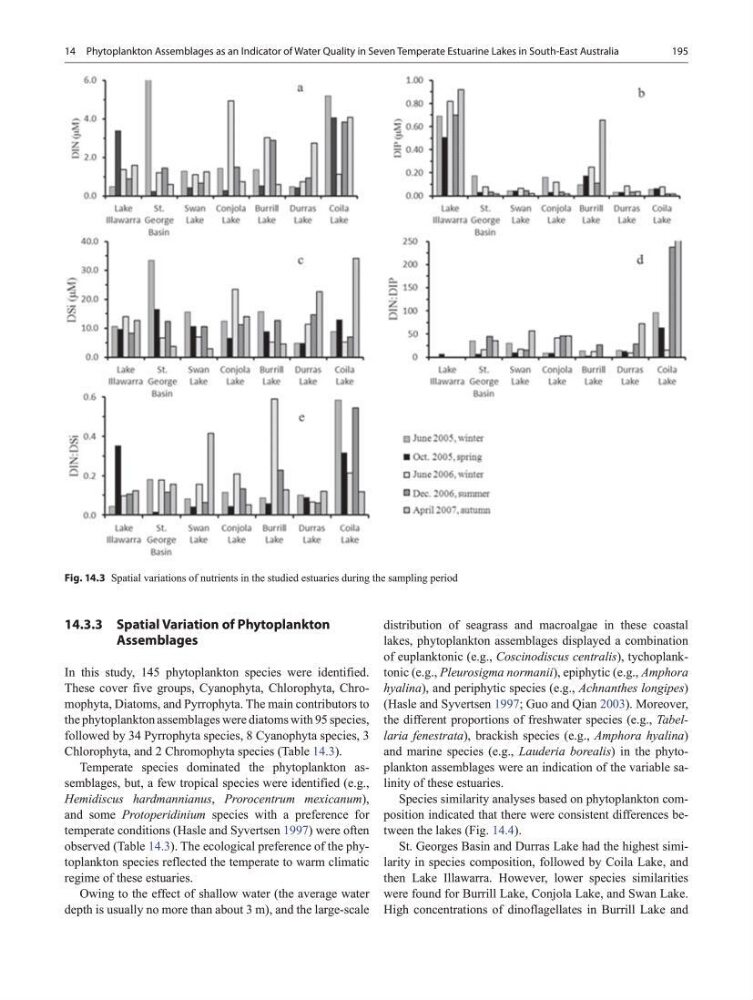
Fig. 14.3 Spatial variations of nutrients in the studied estuaries during the sampling period
14 Phytoplankton Assemblages as an Indicator of Water Quality in Seven Temperate Estuarine Lakes in South-East Australia
14.3.3 Spatial Variation of Phytoplankton
Assemblages
In this study, 145 phytoplankton species were identified.
These cover five groups, Cyanophyta, Chlorophyta, Chromophyta, Diatoms, and Pyrrophyta. The main contributors to
the phytoplankton assemblages were diatoms with 95 species,
followed by 34 Pyrrophyta species, 8 Cyanophyta species, 3
Chlorophyta, and 2 Chromophyta species (Table 14.3).
Temperate species dominated the phytoplankton assemblages, but, a few tropical species were identified (e.g.,
Hemidiscus hardmannianus, Prorocentrum mexicanum),
and some Protoperidinium species with a preference for
temperate conditions (Hasle and Syvertsen 1997) were often
observed (Table 14.3). The ecological preference of the phytoplankton species reflected the temperate to warm climatic
regime of these estuaries.
Owing to the effect of shallow water (the average water
depth is usually no more than about 3 m), and the large-scale
distribution of seagrass and macroalgae in these coastal
lakes, phytoplankton assemblages displayed a combination
of euplanktonic (e.g., Coscinodiscus centralis), tychoplanktonic (e.g., Pleurosigma normanii), epiphytic (e.g., Amphora
hyalina), and periphytic species (e.g., Achnanthes longipes)
(Hasle and Syvertsen 1997; Guo and Qian 2003). Moreover,
the different proportions of freshwater species (e.g., Tabellaria fenestrata), brackish species (e.g., Amphora hyalina)
and marine species (e.g., Lauderia borealis) in the phytoplankton assemblages were an indication of the variable salinity of these estuaries.
Species similarity analyses based on phytoplankton composition indicated that there were consistent differences between the lakes (Fig. 14.4).
St. Georges Basin and Durras Lake had the highest similarity in species composition, followed by Coila Lake, and
then Lake Illawarra. However, lower species similarities
were found for Burrill Lake, Conjola Lake, and Swan Lake.
High concentrations of dinoflagellates in Burrill Lake and
Fig. 14.3 Spatial variations of nutrients in the studied estuaries during the sampling period