

177
13 Estimating Fish Production in the Itaipu Reservoir (Brazil): The Relationship Between Fish Trophic Guilds, Limnology …
of nutrients in the aquatic ecosystem. On the banks of the
reservoir, on the Brazilian side, there are large areas that contribute to the acceleration of eutrophication of the reservoir
(diffuse pollution), while on the Paraguayan side there are
still large areas of forests along the reservoir.
A study in the São Simão Reservoir (MG) showed that the
highest concentrations of nutrients and solids flowing into
the reservoir were found in rivers where there was agriculture and livestock (Pinto Coelho et al. 2005). The same effect
can be observed in cascade reservoirs of the Paranapanema
River (Nogueira et al. 2005).
Temperature is one of the most important variables (a)
in the distribution and physiology of aquatic organisms,
what may cause altercations in the dynamics of nutrients in
the water column (Esteves 1988) and (b) in studies of the
food web and biomanipulation in lakes and reservoirs, influencing the metabolic rates of fish (Jezierska 1979). The
ammonia excretion rates increase with the increase of this
variable (Iwakuma et al. 1990) and phosphorus cycling by
fish is accelerated (Andersson et al. 1988; Persson 1997).
In the Itaipu Reservoir water temperature showed a distinct
pattern of seasonal variation, with the highest temperatures
recorded between November and March and the lowest from
May to August. The highest temperature was found in the lacustrine zone (30.4°C). These data are consistent with those
described by Agostinho et al. (1997b) and Andrade et al.
(1988), and in reservoirs located in the Serra do Mar, state of
Paraná (Pagioro et al. 2005a).
Water transparency has a strong influence on the trophic
aquatic environments, and penetration of light determines
the development of phytoplanktonic organisms and therefore environmental enrichment (Esteves 1988; Wetzel 1990;
Henry 1990). In addition to the input of allochthonous material, which is transported and sedimented in water, contributing to the reduction of water transparency, high fish biomasses can also reduce water transparency (Shapiro et al. 1975;
Mcqueen et al. 1990; Sondergaard et al. 1997) because of increased nutrients owing to the excretions of fishes (Drenner
et al. 1996; Starling 1998).
In the Itaipu Reservoir the lowest water transparencies
were recorded in the riverine zone owing to the transportation of particles and sedimentation rates, which are directly
associated with the inflow of water courses. The data analysis of suspended solids indicates that, as this variable diminishes, water transparency increases, as noted by Andrade
et al. (1988), Agostinho et al. (1997).
The values of water transparency were related with some
limnological variables and the results indicate that the chlorophyll-a, turbidity, suspended solids, and total phosphorus
variables influenced negatively water transparency. This can
be explained by the fact that when the independent variables
increase in value, the dependent variable increases, interfering directly in the amount of light in the system. The variables ammonia nitrogen and TKN showed a positive effect,
contributing to the increase in water transparency. This occurred because the forms of nutrients are related with the
increase of primary productivity, indicating casual relations,
so that these variables have their effects limited by the availability of light into the water environment.
The concentration of suspended solids in the water, besides the water cycle and turbidity, is also one of the most
important limiting factors to primary production in environments that present high values of this variable, influencing
the photosynthetic behavior and causing changes in the ecology of the ecosystem (Calijuri and Tundisi 1990). It is important to note that climatic factors such as rainfall play an
important role especially with regard to the water transparency variable. The results of the analyses comparing rainfall and water transparency demonstrate the negative effect,
what means that this variable is of great importance to measure the productivity of aquatic environments. Souza Filho
and Stevaux (1997) emphasize that the discharge of solids in
the Paraná River was at around 30 million tons per year, of
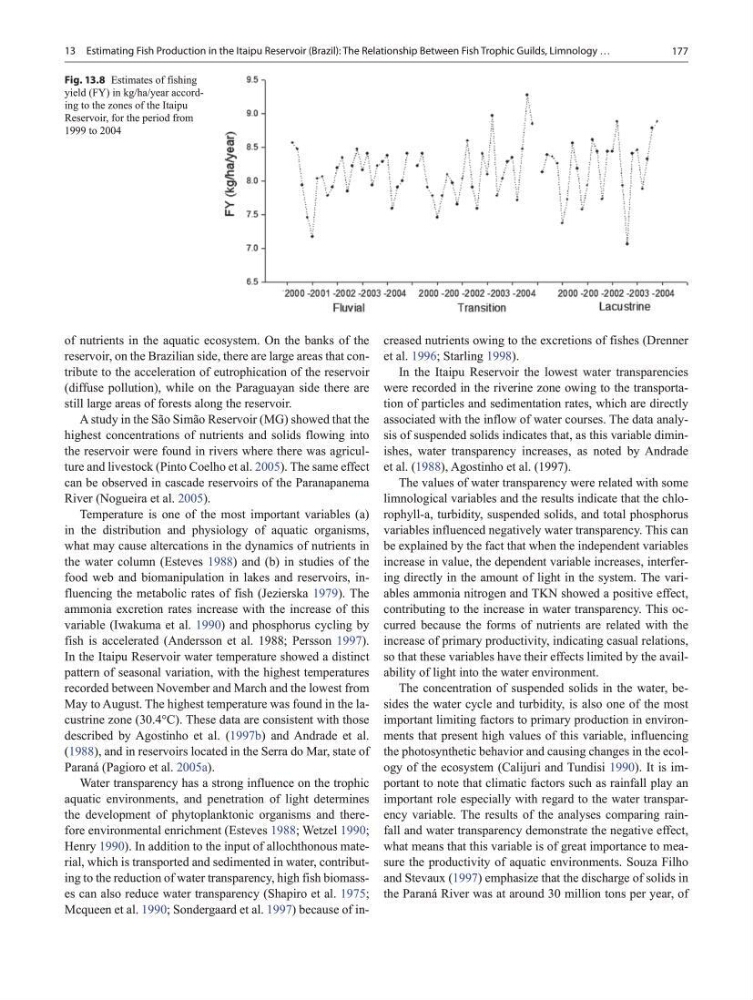
Fig. 13.8 Estimates of fishing
yield (FY) in kg/ha/year according to the zones of the Itaipu
Reservoir, for the period from
1999 to 2004
13 Estimating Fish Production in the Itaipu Reservoir (Brazil): The Relationship Between Fish Trophic Guilds, Limnology …
of nutrients in the aquatic ecosystem. On the banks of the
reservoir, on the Brazilian side, there are large areas that contribute to the acceleration of eutrophication of the reservoir
(diffuse pollution), while on the Paraguayan side there are
still large areas of forests along the reservoir.
A study in the São Simão Reservoir (MG) showed that the
highest concentrations of nutrients and solids flowing into
the reservoir were found in rivers where there was agriculture and livestock (Pinto Coelho et al. 2005). The same effect
can be observed in cascade reservoirs of the Paranapanema
River (Nogueira et al. 2005).
Temperature is one of the most important variables (a)
in the distribution and physiology of aquatic organisms,
what may cause altercations in the dynamics of nutrients in
the water column (Esteves 1988) and (b) in studies of the
food web and biomanipulation in lakes and reservoirs, influencing the metabolic rates of fish (Jezierska 1979). The
ammonia excretion rates increase with the increase of this
variable (Iwakuma et al. 1990) and phosphorus cycling by
fish is accelerated (Andersson et al. 1988; Persson 1997).
In the Itaipu Reservoir water temperature showed a distinct
pattern of seasonal variation, with the highest temperatures
recorded between November and March and the lowest from
May to August. The highest temperature was found in the lacustrine zone (30.4°C). These data are consistent with those
described by Agostinho et al. (1997b) and Andrade et al.
(1988), and in reservoirs located in the Serra do Mar, state of
Paraná (Pagioro et al. 2005a).
Water transparency has a strong influence on the trophic
aquatic environments, and penetration of light determines
the development of phytoplanktonic organisms and therefore environmental enrichment (Esteves 1988; Wetzel 1990;
Henry 1990). In addition to the input of allochthonous material, which is transported and sedimented in water, contributing to the reduction of water transparency, high fish biomasses can also reduce water transparency (Shapiro et al. 1975;
Mcqueen et al. 1990; Sondergaard et al. 1997) because of increased nutrients owing to the excretions of fishes (Drenner
et al. 1996; Starling 1998).
In the Itaipu Reservoir the lowest water transparencies
were recorded in the riverine zone owing to the transportation of particles and sedimentation rates, which are directly
associated with the inflow of water courses. The data analysis of suspended solids indicates that, as this variable diminishes, water transparency increases, as noted by Andrade
et al. (1988), Agostinho et al. (1997).
The values of water transparency were related with some
limnological variables and the results indicate that the chlorophyll-a, turbidity, suspended solids, and total phosphorus
variables influenced negatively water transparency. This can
be explained by the fact that when the independent variables
increase in value, the dependent variable increases, interfering directly in the amount of light in the system. The variables ammonia nitrogen and TKN showed a positive effect,
contributing to the increase in water transparency. This occurred because the forms of nutrients are related with the
increase of primary productivity, indicating casual relations,
so that these variables have their effects limited by the availability of light into the water environment.
The concentration of suspended solids in the water, besides the water cycle and turbidity, is also one of the most
important limiting factors to primary production in environments that present high values of this variable, influencing
the photosynthetic behavior and causing changes in the ecology of the ecosystem (Calijuri and Tundisi 1990). It is important to note that climatic factors such as rainfall play an
important role especially with regard to the water transparency variable. The results of the analyses comparing rainfall and water transparency demonstrate the negative effect,
what means that this variable is of great importance to measure the productivity of aquatic environments. Souza Filho
and Stevaux (1997) emphasize that the discharge of solids in
the Paraná River was at around 30 million tons per year, of
Fig. 13.8 Estimates of fishing
yield (FY) in kg/ha/year according to the zones of the Itaipu
Reservoir, for the period from
1999 to 2004