

175
13 Estimating Fish Production in the Itaipu Reservoir (Brazil): The Relationship Between Fish Trophic Guilds, Limnology …
The abundance of cladocerans and copepods positively
interfere in the concentration of chlorophyll-a, that is, the
more abundant are these groups are, the greater the concentration of chlorophyll-a will be. Observing the dependence
of the chlorophyll-a in relation to the previous level, it is
possible to see that the total phosphorus positively affects the
concentration of chlorophyll-a (Table 13.5).
13.3.7 Analysis of Trophic Interactions in the
Itaipu Reservoir: Indirect Effects
Table 13.5 presents the indirect relationships between chlorophyll-a and fish trophic guilds in the reservoir. The groups
of fish that had an influence on chlorophyll-a concentrations
were: omnivores and insectivores (negative relationship),
and detritivores and iliophagous (positive relationship).
Table 13.5 presents the results of indirect interactions between the concentration of total phosphorus and groups of
fishes. Insectivores and herbivores were the groups of fishes
that showed negative interference on the concentrations of
total phosphorus.
Table 13.5 shows the results of indirect interactions between the cyanobacteria biomass and groups of fishes.
Omnivores, detritivores, and insectivores showed negative
interference on the abundance of cyanobacteria, while zooplanktivores had a positive relationship.
Table 13.5 shows the positive dependence between chlorophyll-a and cyanobacteria, indicating that the increased
concentration of cyanobacteria favors increased chlorophylla concentration.
13.3.8 Analysis of the Relationship Between
Cyanobacteria and Total Phosphorus
and Fishes in the Itaipu Reservoir
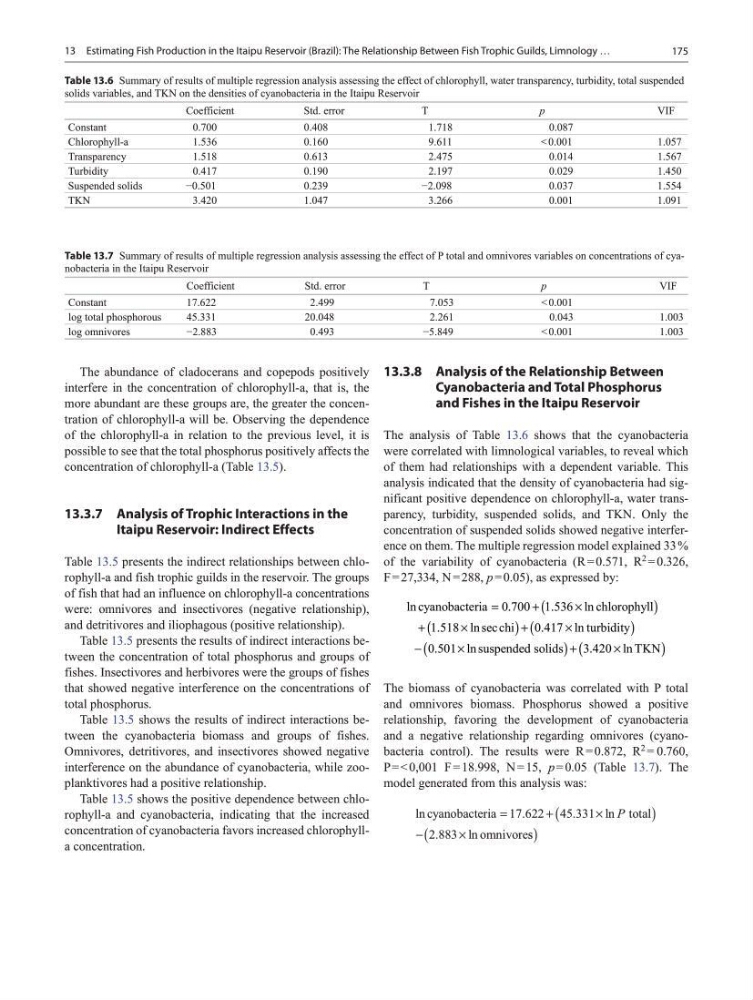
The analysis of Table 13.6 shows that the cyanobacteria
were correlated with limnological variables, to reveal which
of them had relationships with a dependent variable. This
analysis indicated that the density of cyanobacteria had significant positive dependence on chlorophyll-a, water transparency, turbidity, suspended solids, and TKN. Only the
concentration of suspended solids showed negative interference on them. The multiple regression model explained 33 %
of the variability of cyanobacteria (R = 0.571, R
2
= 0.326,
F = 27,334, N = 288, p = 0.05), as expressed by:
(
)
(
) (
)
(
) (
)
ln cyanobacteria 0.700 1.536 ln chlorophyll
1.518 ln sec chi
0.417 ln turbidity
0.501 ln suspended solids
3.420 ln TKN
=
+
×
+
×
+
×
−
×
+
×
The biomass of cyanobacteria was correlated with P total
and omnivores biomass. Phosphorus showed a positive
relationship, favoring the development of cyanobacteria
and a negative relationship regarding omnivores (cyanobacteria control). The results were R = 0.872, R 2 = 0.760,
P = < 0,001 F = 18.998, N = 15, p = 0.05 (Table 13.7). The
model generated from this analysis was:
ln
.
.
ln
.
ln
cyanobacteria
total
omnivore
=
+
×
(
)
−
×
17 622 45 331
2 883
P
s s
(
)
Table 13.6 Summary of results of multiple regression analysis assessing the effect of chlorophyll, water transparency, turbidity, total suspended
solids variables, and TKN on the densities of cyanobacteria in the Itaipu Reservoir
Coefficient
Std. error
T
p
VIF
Constant
0.700
0.408
1.718
0.087
Chlorophyll-a
1.536
0.160
9.611
< 0.001
1.057
Transparency
1.518
0.613
2.475
0.014
1.567
Turbidity
0.417
0.190
2.197
0.029
1.450
Suspended solids
−0.501
0.239
−2.098
0.037
1.554
TKN
3.420
1.047
3.266
0.001
1.091
Table 13.7 Summary of results of multiple regression analysis assessing the effect of P total and omnivores variables on concentrations of cyanobacteria in the Itaipu Reservoir
Coefficient
Std. error
T
p
VIF
Constant
17.622
2.499
7.053
< 0.001
log total phosphorous
45.331
20.048
2.261
0.043
1.003
log omnivores
−2.883
0.493
−5.849
< 0.001
1.003
13 Estimating Fish Production in the Itaipu Reservoir (Brazil): The Relationship Between Fish Trophic Guilds, Limnology …
The abundance of cladocerans and copepods positively
interfere in the concentration of chlorophyll-a, that is, the
more abundant are these groups are, the greater the concentration of chlorophyll-a will be. Observing the dependence
of the chlorophyll-a in relation to the previous level, it is
possible to see that the total phosphorus positively affects the
concentration of chlorophyll-a (Table 13.5).
13.3.7 Analysis of Trophic Interactions in the
Itaipu Reservoir: Indirect Effects
Table 13.5 presents the indirect relationships between chlorophyll-a and fish trophic guilds in the reservoir. The groups
of fish that had an influence on chlorophyll-a concentrations
were: omnivores and insectivores (negative relationship),
and detritivores and iliophagous (positive relationship).
Table 13.5 presents the results of indirect interactions between the concentration of total phosphorus and groups of
fishes. Insectivores and herbivores were the groups of fishes
that showed negative interference on the concentrations of
total phosphorus.
Table 13.5 shows the results of indirect interactions between the cyanobacteria biomass and groups of fishes.
Omnivores, detritivores, and insectivores showed negative
interference on the abundance of cyanobacteria, while zooplanktivores had a positive relationship.
Table 13.5 shows the positive dependence between chlorophyll-a and cyanobacteria, indicating that the increased
concentration of cyanobacteria favors increased chlorophylla concentration.
13.3.8 Analysis of the Relationship Between
Cyanobacteria and Total Phosphorus
and Fishes in the Itaipu Reservoir
The analysis of Table 13.6 shows that the cyanobacteria
were correlated with limnological variables, to reveal which
of them had relationships with a dependent variable. This
analysis indicated that the density of cyanobacteria had significant positive dependence on chlorophyll-a, water transparency, turbidity, suspended solids, and TKN. Only the
concentration of suspended solids showed negative interference on them. The multiple regression model explained 33 %
of the variability of cyanobacteria (R = 0.571, R
2
= 0.326,
F = 27,334, N = 288, p = 0.05), as expressed by:
(
)
(
) (
)
(
) (
)
ln cyanobacteria 0.700 1.536 ln chlorophyll
1.518 ln sec chi
0.417 ln turbidity
0.501 ln suspended solids
3.420 ln TKN
=
+
×
+
×
+
×
−
×
+
×
The biomass of cyanobacteria was correlated with P total
and omnivores biomass. Phosphorus showed a positive
relationship, favoring the development of cyanobacteria
and a negative relationship regarding omnivores (cyanobacteria control). The results were R = 0.872, R 2 = 0.760,
P = < 0,001 F = 18.998, N = 15, p = 0.05 (Table 13.7). The
model generated from this analysis was:
ln
.
.
ln
.
ln
cyanobacteria
total
omnivore
=
+
×
(
)
−
×
17 622 45 331
2 883
P
s s
(
)
Table 13.6 Summary of results of multiple regression analysis assessing the effect of chlorophyll, water transparency, turbidity, total suspended
solids variables, and TKN on the densities of cyanobacteria in the Itaipu Reservoir
Coefficient
Std. error
T
p
VIF
Constant
0.700
0.408
1.718
0.087
Chlorophyll-a
1.536
0.160
9.611
< 0.001
1.057
Transparency
1.518
0.613
2.475
0.014
1.567
Turbidity
0.417
0.190
2.197
0.029
1.450
Suspended solids
−0.501
0.239
−2.098
0.037
1.554
TKN
3.420
1.047
3.266
0.001
1.091
Table 13.7 Summary of results of multiple regression analysis assessing the effect of P total and omnivores variables on concentrations of cyanobacteria in the Itaipu Reservoir
Coefficient
Std. error
T
p
VIF
Constant
17.622
2.499
7.053
< 0.001
log total phosphorous
45.331
20.048
2.261
0.043
1.003
log omnivores
−2.883
0.493
−5.849
< 0.001
1.003