

173
13 Estimating Fish Production in the Itaipu Reservoir (Brazil): The Relationship Between Fish Trophic Guilds, Limnology …
Abundância relativa (%)
0
10
20
30
40
50
60
70
80
90
100
Cyanophyceae
Chlorophyceae
Bacillariophyceae
Fitoflagelados
1999-2000-2001-2002-2003-2004
fluvial
1999-2000-2001-2002-2003-2004
transição
1999-2000-2001-2002-2003-2004
lacustre
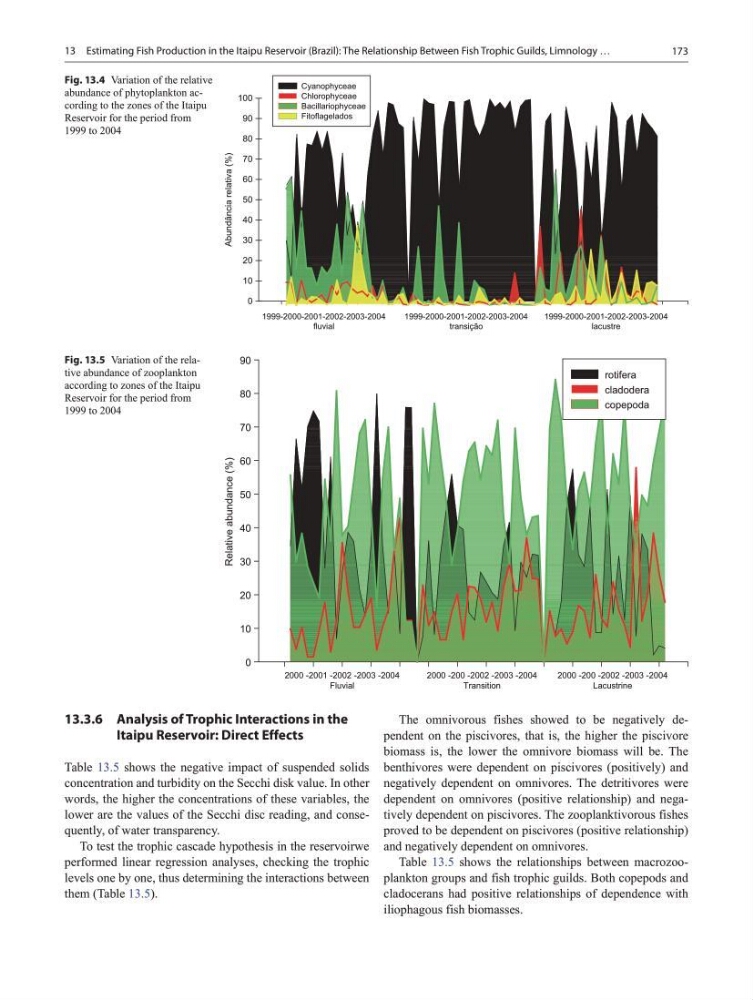
Fig. 13.4 Variation of the relative
abundance of phytoplankton according to the zones of the Itaipu
Reservoir for the period from
1999 to 2004
Relative abundance (%)
0
10
20
30
40
50
60
70
80
90
rotifera
cladodera
copepoda
2000 -200 -2002 -2003 -2004
Transition
2000 -200 -2002 -2003 -2004
Lacustrine
2000 -2001 -2002 -2003 -2004
Fluvial
Fig. 13.5 Variation of the relative abundance of zooplankton
according to zones of the Itaipu
Reservoir for the period from
1999 to 2004
13.3.6 Analysis of Trophic Interactions in the
Itaipu Reservoir: Direct Effects
Table 13.5 shows the negative impact of suspended solids
concentration and turbidity on the Secchi disk value. In other
words, the higher the concentrations of these variables, the
lower are the values of the Secchi disc reading, and consequently, of water transparency.
To test the trophic cascade hypothesis in the reservoirwe
performed linear regression analyses, checking the trophic
levels one by one, thus determining the interactions between
them (Table 13.5).
The omnivorous fishes showed to be negatively dependent on the piscivores, that is, the higher the piscivore
biomass is, the lower the omnivore biomass will be. The
benthivores were dependent on piscivores (positively) and
negatively dependent on omnivores. The detritivores were
dependent on omnivores (positive relationship) and negatively dependent on piscivores. The zooplanktivorous fishes
proved to be dependent on piscivores (positive relationship)
and negatively dependent on omnivores.
Table 13.5 shows the relationships between macrozooplankton groups and fish trophic guilds. Both copepods and
cladocerans had positive relationships of dependence with
iliophagous fish biomasses.
13 Estimating Fish Production in the Itaipu Reservoir (Brazil): The Relationship Between Fish Trophic Guilds, Limnology …
Abundância relativa (%)
0
10
20
30
40
50
60
70
80
90
100
Cyanophyceae
Chlorophyceae
Bacillariophyceae
Fitoflagelados
1999-2000-2001-2002-2003-2004
fluvial
1999-2000-2001-2002-2003-2004
transição
1999-2000-2001-2002-2003-2004
lacustre
Fig. 13.4 Variation of the relative
abundance of phytoplankton according to the zones of the Itaipu
Reservoir for the period from
1999 to 2004
Relative abundance (%)
0
10
20
30
40
50
60
70
80
90
rotifera
cladodera
copepoda
2000 -200 -2002 -2003 -2004
Transition
2000 -200 -2002 -2003 -2004
Lacustrine
2000 -2001 -2002 -2003 -2004
Fluvial
Fig. 13.5 Variation of the relative abundance of zooplankton
according to zones of the Itaipu
Reservoir for the period from
1999 to 2004
13.3.6 Analysis of Trophic Interactions in the
Itaipu Reservoir: Direct Effects
Table 13.5 shows the negative impact of suspended solids
concentration and turbidity on the Secchi disk value. In other
words, the higher the concentrations of these variables, the
lower are the values of the Secchi disc reading, and consequently, of water transparency.
To test the trophic cascade hypothesis in the reservoirwe
performed linear regression analyses, checking the trophic
levels one by one, thus determining the interactions between
them (Table 13.5).
The omnivorous fishes showed to be negatively dependent on the piscivores, that is, the higher the piscivore
biomass is, the lower the omnivore biomass will be. The
benthivores were dependent on piscivores (positively) and
negatively dependent on omnivores. The detritivores were
dependent on omnivores (positive relationship) and negatively dependent on piscivores. The zooplanktivorous fishes
proved to be dependent on piscivores (positive relationship)
and negatively dependent on omnivores.
Table 13.5 shows the relationships between macrozooplankton groups and fish trophic guilds. Both copepods and
cladocerans had positive relationships of dependence with
iliophagous fish biomasses.