

168
R. A. Ribeiro Filho et al.
Energy production is the main use of the Itaipu reservoir, which was the primary motivation for its construction.
However, other secondary uses are currently coming into
scene, especially (i) navigation, facilitated by the drowning
of The Sete Quedas Falls (Guaira), (ii) recreation and tourism, mainly in five artificial beaches built on its banks, (iii)
water supply for cities and irrigation of smallholdings, and
(iv) professional fishing (Agostinho et al. 1997a).
Based on Carlson’s trophic state index (phosphorus and
chlorophyll-a), this reservoir was classified as mesotrophic,
and some eutrophic areas may be found in its arms during certain periods of the year. It presents an annual cycle
of thermal stratification in its main body (spring-summer),
which classifies it as a monomictic hot lake, besides daily
stratification processes in its arms.
The fish assemblage of the Itaipu reservoir and its catchment area is composed of 114 species in all environments.
The dominant species vary with the type of environment, because this is a factor that contributes significantly to the structure of this assemblage (annual report Itaipu Binacional).
13.2.2 Characterization of the Sampling
Stations
To establish the location of the sampling stations we considered the compartmentalization of the Itaipu Reservoir, which
is composed by three horizontal regions, along the main
body of the reservoir (Agostinho et al. 1997b; Agostinho
et al. 1999; IAP 2003; Oliveira et al. 2005): (1) the riverine
zone: located at the beginning of the reservoir, (2) the transition region: between the lotic and lentic regions, and (3) the
lentic region, called ‘‘lacustrine region,’’ where the reservoir
is usually deeper and wider.
Furthermore, the Itaipu Reservoir has a dendritic form,
what means that attached to its central body there are branches on the sides called reservoir arms which present systems
that are almost independent from the main body system and
that have their own particular characteristics. Owing to this
compartmentalization, a network of water quality monitors
was established, totaling 12 sampling stations (Fig. 13.2).
Stations E1, E2, E3, and E7, in areas of lotic characteristics are in the riverine zone. Stations E5, E11, E12, E14, and
E20 are in the lacustrine region and stations E8 and E12 are
in the transition region.
13.2.3 Data Collection
The data analyzed in this study were provided by Itaipu
Binacional. Limnological analyses, including physical and
chemical water variables, phytoplankton, and zooplankton
were made by Instituto Ambiental do Paraná (IAP), the Environmental Institute of Paraná, based on quarterly collections,
between 1999 and 2004. Information on fish stocks are from
the studies conducted by Núcleo de Pesquisa em Limnologia, Ictiologia e Aquicultura (NUPELIA/UEM), the Center
for Research in Limnology, Ichthyology and Aquaculture.
According to the IAP (2003), samples were collected at
the water surface, and the physical, chemical, and biological
water quality variables were monitored in all field samplings. The following variables were measured in the field:
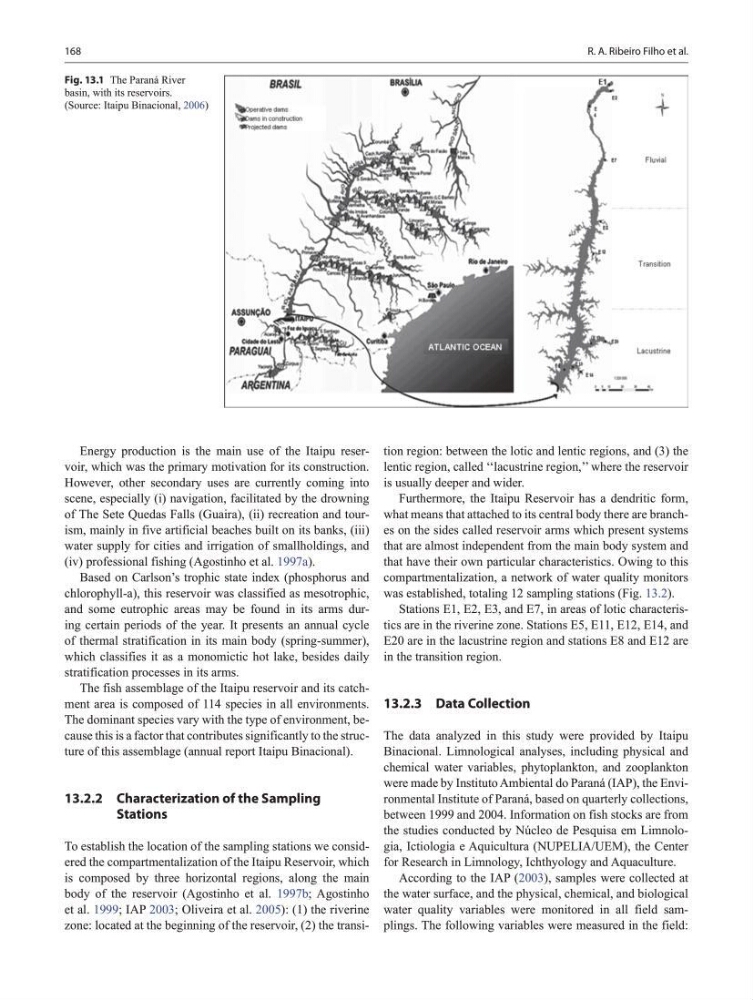
Fig. 13.1 The Paraná River
basin, with its reservoirs.
(Source: Itaipu Binacional, 2006)
R. A. Ribeiro Filho et al.
Energy production is the main use of the Itaipu reservoir, which was the primary motivation for its construction.
However, other secondary uses are currently coming into
scene, especially (i) navigation, facilitated by the drowning
of The Sete Quedas Falls (Guaira), (ii) recreation and tourism, mainly in five artificial beaches built on its banks, (iii)
water supply for cities and irrigation of smallholdings, and
(iv) professional fishing (Agostinho et al. 1997a).
Based on Carlson’s trophic state index (phosphorus and
chlorophyll-a), this reservoir was classified as mesotrophic,
and some eutrophic areas may be found in its arms during certain periods of the year. It presents an annual cycle
of thermal stratification in its main body (spring-summer),
which classifies it as a monomictic hot lake, besides daily
stratification processes in its arms.
The fish assemblage of the Itaipu reservoir and its catchment area is composed of 114 species in all environments.
The dominant species vary with the type of environment, because this is a factor that contributes significantly to the structure of this assemblage (annual report Itaipu Binacional).
13.2.2 Characterization of the Sampling
Stations
To establish the location of the sampling stations we considered the compartmentalization of the Itaipu Reservoir, which
is composed by three horizontal regions, along the main
body of the reservoir (Agostinho et al. 1997b; Agostinho
et al. 1999; IAP 2003; Oliveira et al. 2005): (1) the riverine
zone: located at the beginning of the reservoir, (2) the transition region: between the lotic and lentic regions, and (3) the
lentic region, called ‘‘lacustrine region,’’ where the reservoir
is usually deeper and wider.
Furthermore, the Itaipu Reservoir has a dendritic form,
what means that attached to its central body there are branches on the sides called reservoir arms which present systems
that are almost independent from the main body system and
that have their own particular characteristics. Owing to this
compartmentalization, a network of water quality monitors
was established, totaling 12 sampling stations (Fig. 13.2).
Stations E1, E2, E3, and E7, in areas of lotic characteristics are in the riverine zone. Stations E5, E11, E12, E14, and
E20 are in the lacustrine region and stations E8 and E12 are
in the transition region.
13.2.3 Data Collection
The data analyzed in this study were provided by Itaipu
Binacional. Limnological analyses, including physical and
chemical water variables, phytoplankton, and zooplankton
were made by Instituto Ambiental do Paraná (IAP), the Environmental Institute of Paraná, based on quarterly collections,
between 1999 and 2004. Information on fish stocks are from
the studies conducted by Núcleo de Pesquisa em Limnologia, Ictiologia e Aquicultura (NUPELIA/UEM), the Center
for Research in Limnology, Ichthyology and Aquaculture.
According to the IAP (2003), samples were collected at
the water surface, and the physical, chemical, and biological
water quality variables were monitored in all field samplings. The following variables were measured in the field:
Fig. 13.1 The Paraná River
basin, with its reservoirs.
(Source: Itaipu Binacional, 2006)