

144
statistically following Dospekhov (1984) for mean ± standard deviation, percent variation, and significance of the
variation over control.
12.2.8 Parameters Studied
The following parameters were studied:
12.2.8.1 Characteristics of the Varying
Concentrations of Detergent Solution
1. Turbidity
2. pH
3. Dissolved oxygen
4. Nitrates
5. Phosphates
6. Potassium
12.2.8.2 Growth Parameters
1. Dry weight of plant
2. Chlorophyll a
3. Chlorophyll b
4. Total chlorophyll
12.2.8.3 Nutrient Uptake in Plants
1. Nitrogen content
2. Phosphorus content
3. Potassium content
Characteristics of Varying Grades of Detergent
Solutions
The water analysis of varying grades of detergent solution
was carried out following Trivedi et al. (1987). The turbidity,
pH, dissolved oxygen, nitrates, phosphates, and potassium
contents of detergent solution were analyzed after the termination of experiments.
1. pH
The pH was determined with the help of pH meter (Elico,
Elico Ltd. Hyderabad, India). The pH meter was calibrated
with standard buffer of known pH before use.
2. Turbidity
Turbidity was determined with the help of Nephroturbidity
meter (Elico, Elico Ltd. Hyderabad, India). The turbidity
meter was calibrated with the standard solutions of known
turbidity.
3. Dissolved oxygen (DO)
Dissolved oxygen content was calculated with the help of
following formula:
Where, V 1 = volume of sample bottle
V 2 = volume of content titrated
V = volume of MnSO 4 and KI added (2 mL) to the
sample
DO
(ml N) of sodium thiosulphate 8 1000
V [(V V)/V ]
mg/1
=
×
××
−
2
1
1
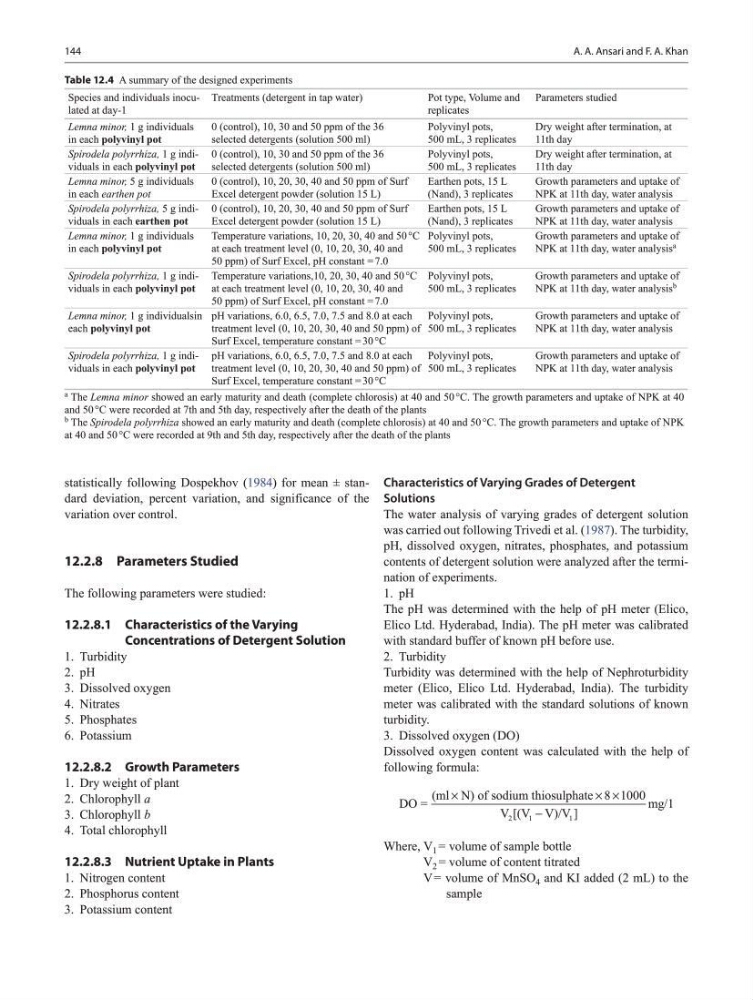
Table 12.4 A summary of the designed experiments
Species and individuals inoculated at day-1
Treatments (detergent in tap water)
Pot type, Volume and
replicates
Parameters studied
Lemna minor, 1 g individuals
in each polyvinyl pot
0 (control), 10, 30 and 50 ppm of the 36
selected detergents (solution 500 ml)
Polyvinyl pots,
500 mL, 3 replicates
Dry weight after termination, at
11th day
Spirodela polyrrhiza, 1 g individuals in each polyvinyl pot
0 (control), 10, 30 and 50 ppm of the 36
selected detergents (solution 500 ml)
Polyvinyl pots,
500 mL, 3 replicates
Dry weight after termination, at
11th day
Lemna minor, 5 g individuals
in each earthen pot
0 (control), 10, 20, 30, 40 and 50 ppm of Surf
Excel detergent powder (solution 15 L)
Earthen pots, 15 L
(Nand), 3 replicates
Growth parameters and uptake of
NPK at 11th day, water analysis
Spirodela polyrrhiza, 5 g individuals in each earthen pot
0 (control), 10, 20, 30, 40 and 50 ppm of Surf
Excel detergent powder (solution 15 L)
Earthen pots, 15 L
(Nand), 3 replicates
Growth parameters and uptake of
NPK at 11th day, water analysis
Lemna minor, 1 g individuals
in each polyvinyl pot
Temperature variations, 10, 20, 30, 40 and 50 °C
at each treatment level (0, 10, 20, 30, 40 and
50 ppm) of Surf Excel, pH constant = 7.0
Polyvinyl pots,
500 mL, 3 replicates
Growth parameters and uptake of
NPK at 11th day, water analysis a
Spirodela polyrrhiza, 1 g individuals in each polyvinyl pot
Temperature variations,10, 20, 30, 40 and 50 °C
at each treatment level (0, 10, 20, 30, 40 and
50 ppm) of Surf Excel, pH constant = 7.0
Polyvinyl pots,
500 mL, 3 replicates
Growth parameters and uptake of
NPK at 11th day, water analysis b
Lemna minor, 1 g individualsin
each polyvinyl pot
pH variations, 6.0, 6.5, 7.0, 7.5 and 8.0 at each
treatment level (0, 10, 20, 30, 40 and 50 ppm) of
Surf Excel, temperature constant = 30 °C
Polyvinyl pots,
500 mL, 3 replicates
Growth parameters and uptake of
NPK at 11th day, water analysis
Spirodela polyrrhiza, 1 g individuals in each polyvinyl pot
pH variations, 6.0, 6.5, 7.0, 7.5 and 8.0 at each
treatment level (0, 10, 20, 30, 40 and 50 ppm) of
Surf Excel, temperature constant = 30 °C
Polyvinyl pots,
500 mL, 3 replicates
Growth parameters and uptake of
NPK at 11th day, water analysis
a
The Lemna minor showed an early maturity and death (complete chlorosis) at 40 and 50 °C. The growth parameters and uptake of NPK at 40
and 50 °C were recorded at 7th and 5th day, respectively after the death of the plants
b
The Spirodela polyrrhiza showed an early maturity and death (complete chlorosis) at 40 and 50 °C. The growth parameters and uptake of NPK
at 40 and 50 °C were recorded at 9th and 5th day, respectively after the death of the plants
A. A. Ansari and F. A. Khan
statistically following Dospekhov (1984) for mean ± standard deviation, percent variation, and significance of the
variation over control.
12.2.8 Parameters Studied
The following parameters were studied:
12.2.8.1 Characteristics of the Varying
Concentrations of Detergent Solution
1. Turbidity
2. pH
3. Dissolved oxygen
4. Nitrates
5. Phosphates
6. Potassium
12.2.8.2 Growth Parameters
1. Dry weight of plant
2. Chlorophyll a
3. Chlorophyll b
4. Total chlorophyll
12.2.8.3 Nutrient Uptake in Plants
1. Nitrogen content
2. Phosphorus content
3. Potassium content
Characteristics of Varying Grades of Detergent
Solutions
The water analysis of varying grades of detergent solution
was carried out following Trivedi et al. (1987). The turbidity,
pH, dissolved oxygen, nitrates, phosphates, and potassium
contents of detergent solution were analyzed after the termination of experiments.
1. pH
The pH was determined with the help of pH meter (Elico,
Elico Ltd. Hyderabad, India). The pH meter was calibrated
with standard buffer of known pH before use.
2. Turbidity
Turbidity was determined with the help of Nephroturbidity
meter (Elico, Elico Ltd. Hyderabad, India). The turbidity
meter was calibrated with the standard solutions of known
turbidity.
3. Dissolved oxygen (DO)
Dissolved oxygen content was calculated with the help of
following formula:
Where, V 1 = volume of sample bottle
V 2 = volume of content titrated
V = volume of MnSO 4 and KI added (2 mL) to the
sample
DO
(ml N) of sodium thiosulphate 8 1000
V [(V V)/V ]
mg/1
=
×
××
−
2
1
1
Table 12.4 A summary of the designed experiments
Species and individuals inoculated at day-1
Treatments (detergent in tap water)
Pot type, Volume and
replicates
Parameters studied
Lemna minor, 1 g individuals
in each polyvinyl pot
0 (control), 10, 30 and 50 ppm of the 36
selected detergents (solution 500 ml)
Polyvinyl pots,
500 mL, 3 replicates
Dry weight after termination, at
11th day
Spirodela polyrrhiza, 1 g individuals in each polyvinyl pot
0 (control), 10, 30 and 50 ppm of the 36
selected detergents (solution 500 ml)
Polyvinyl pots,
500 mL, 3 replicates
Dry weight after termination, at
11th day
Lemna minor, 5 g individuals
in each earthen pot
0 (control), 10, 20, 30, 40 and 50 ppm of Surf
Excel detergent powder (solution 15 L)
Earthen pots, 15 L
(Nand), 3 replicates
Growth parameters and uptake of
NPK at 11th day, water analysis
Spirodela polyrrhiza, 5 g individuals in each earthen pot
0 (control), 10, 20, 30, 40 and 50 ppm of Surf
Excel detergent powder (solution 15 L)
Earthen pots, 15 L
(Nand), 3 replicates
Growth parameters and uptake of
NPK at 11th day, water analysis
Lemna minor, 1 g individuals
in each polyvinyl pot
Temperature variations, 10, 20, 30, 40 and 50 °C
at each treatment level (0, 10, 20, 30, 40 and
50 ppm) of Surf Excel, pH constant = 7.0
Polyvinyl pots,
500 mL, 3 replicates
Growth parameters and uptake of
NPK at 11th day, water analysis a
Spirodela polyrrhiza, 1 g individuals in each polyvinyl pot
Temperature variations,10, 20, 30, 40 and 50 °C
at each treatment level (0, 10, 20, 30, 40 and
50 ppm) of Surf Excel, pH constant = 7.0
Polyvinyl pots,
500 mL, 3 replicates
Growth parameters and uptake of
NPK at 11th day, water analysis b
Lemna minor, 1 g individualsin
each polyvinyl pot
pH variations, 6.0, 6.5, 7.0, 7.5 and 8.0 at each
treatment level (0, 10, 20, 30, 40 and 50 ppm) of
Surf Excel, temperature constant = 30 °C
Polyvinyl pots,
500 mL, 3 replicates
Growth parameters and uptake of
NPK at 11th day, water analysis
Spirodela polyrrhiza, 1 g individuals in each polyvinyl pot
pH variations, 6.0, 6.5, 7.0, 7.5 and 8.0 at each
treatment level (0, 10, 20, 30, 40 and 50 ppm) of
Surf Excel, temperature constant = 30 °C
Polyvinyl pots,
500 mL, 3 replicates
Growth parameters and uptake of
NPK at 11th day, water analysis
a
The Lemna minor showed an early maturity and death (complete chlorosis) at 40 and 50 °C. The growth parameters and uptake of NPK at 40
and 50 °C were recorded at 7th and 5th day, respectively after the death of the plants
b
The Spirodela polyrrhiza showed an early maturity and death (complete chlorosis) at 40 and 50 °C. The growth parameters and uptake of NPK
at 40 and 50 °C were recorded at 9th and 5th day, respectively after the death of the plants
A. A. Ansari and F. A. Khan