

142
Fruit A ribbed seed develops in a balloon like bag (utricle).
Seed The seed possess a thick fleshy outer and a thin inner
coat. The embryo consists of a large cotyledon surrounded
by scanty endosperm.
Pollination The pollination is affected by wind, water or
animals.
Propagation Reproduces quickly by asexual budding, seeds
and over winters as dark green or buds on the sediments.
Importance of plant Provides a high protein food source
for ducks and geese, also eaten by certain fish in Africa and
Asia, giant duckweed has been harvested for cattle and pig
feed. Grows quickly, especially the water is warm and nutrient enriched. It has been used to reduce nutrients in sewage
effluents.
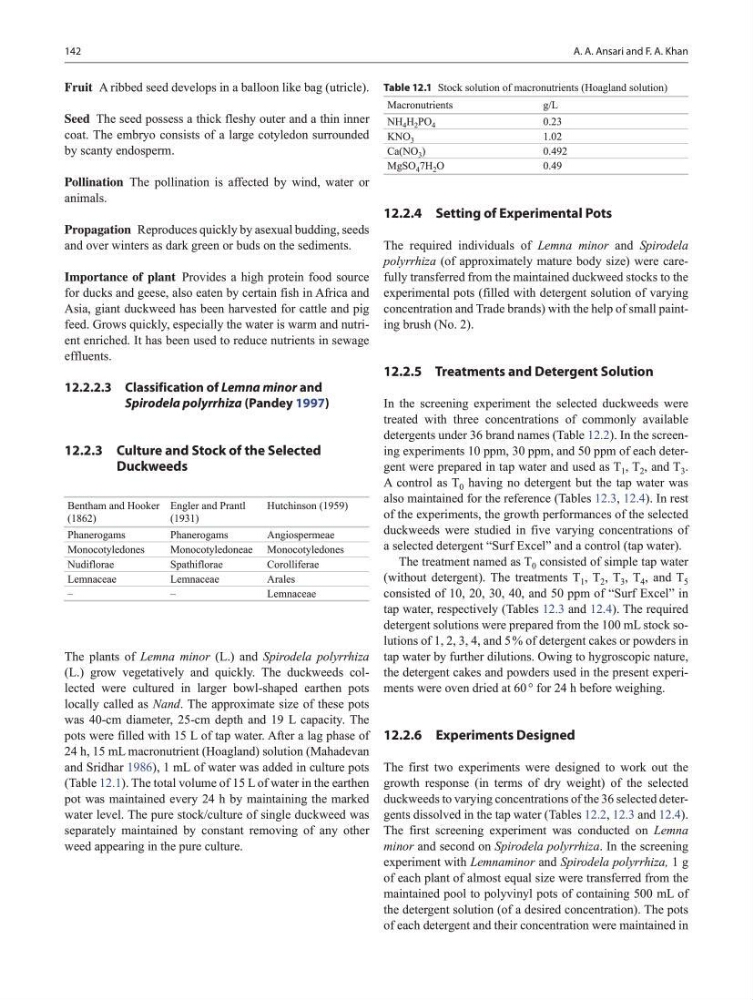
12.2.2.3 Classification of Lemna minor and
Spirodela polyrrhiza (Pandey 1997)
12.2.3 Culture and Stock of the Selected
Duckweeds
The plants of Lemna minor (L.) and Spirodela polyrrhiza
(L.) grow vegetatively and quickly. The duckweeds collected were cultured in larger bowl-shaped earthen pots
locally called as Nand. The approximate size of these pots
was 40-cm diameter, 25-cm depth and 19 L capacity. The
pots were filled with 15 L of tap water. After a lag phase of
24 h, 15 mL macronutrient (Hoagland) solution (Mahadevan
and Sridhar 1986), 1 mL of water was added in culture pots
(Table 12.1). The total volume of 15 L of water in the earthen
pot was maintained every 24 h by maintaining the marked
water level. The pure stock/culture of single duckweed was
separately maintained by constant removing of any other
weed appearing in the pure culture.
12.2.4 Setting of Experimental Pots
The required individuals of Lemna minor and Spirodela
polyrrhiza (of approximately mature body size) were carefully transferred from the maintained duckweed stocks to the
experimental pots (filled with detergent solution of varying
concentration and Trade brands) with the help of small painting brush (No. 2).
12.2.5 Treatments and Detergent Solution
In the screening experiment the selected duckweeds were
treated with three concentrations of commonly available
detergents under 36 brand names (Table 12.2). In the screening experiments 10 ppm, 30 ppm, and 50 ppm of each detergent were prepared in tap water and used as T 1 , T 2 , and T 3 .
A control as T 0 having no detergent but the tap water was
also maintained for the reference (Tables 12.3, 12.4). In rest
of the experiments, the growth performances of the selected
duckweeds were studied in five varying concentrations of
a selected detergent “Surf Excel” and a control (tap water).
The treatment named as T 0 consisted of simple tap water
(without detergent). The treatments T 1 , T 2 , T 3 , T 4 , and T 5
consisted of 10, 20, 30, 40, and 50 ppm of “Surf Excel” in
tap water, respectively (Tables 12.3 and 12.4). The required
detergent solutions were prepared from the 100 mL stock solutions of 1, 2, 3, 4, and 5 % of detergent cakes or powders in
tap water by further dilutions. Owing to hygroscopic nature,
the detergent cakes and powders used in the present experiments were oven dried at 60 ° for 24 h before weighing.
12.2.6 Experiments Designed
The first two experiments were designed to work out the
growth response (in terms of dry weight) of the selected
duckweeds to varying concentrations of the 36 selected detergents dissolved in the tap water (Tables 12.2, 12.3 and 12.4).
The first screening experiment was conducted on Lemna
minor and second on Spirodela polyrrhiza. In the screening
experiment with Lemnaminor and Spirodela polyrrhiza, 1 g
of each plant of almost equal size were transferred from the
maintained pool to polyvinyl pots of containing 500 mL of
the detergent solution (of a desired concentration). The pots
of each detergent and their concentration were maintained in
Table 12.1 Stock solution of macronutrients (Hoagland solution)
Macronutrients
g/L
NH 4 H 2 PO 4
0.23
KNO 3
1.02
Ca(NO 3 )
0.492
MgSO 4 7H 2 O
0.49
Bentham and Hooker
(1862)
Engler and Prantl
(1931)
Hutchinson (1959)
Phanerogams
Phanerogams
Angiospermeae
Monocotyledones
Monocotyledoneae Monocotyledones
Nudiflorae
Spathiflorae
Corolliferae
Lemnaceae
Lemnaceae
Arales
–
–
Lemnaceae
A. A. Ansari and F. A. Khan
Fruit A ribbed seed develops in a balloon like bag (utricle).
Seed The seed possess a thick fleshy outer and a thin inner
coat. The embryo consists of a large cotyledon surrounded
by scanty endosperm.
Pollination The pollination is affected by wind, water or
animals.
Propagation Reproduces quickly by asexual budding, seeds
and over winters as dark green or buds on the sediments.
Importance of plant Provides a high protein food source
for ducks and geese, also eaten by certain fish in Africa and
Asia, giant duckweed has been harvested for cattle and pig
feed. Grows quickly, especially the water is warm and nutrient enriched. It has been used to reduce nutrients in sewage
effluents.
12.2.2.3 Classification of Lemna minor and
Spirodela polyrrhiza (Pandey 1997)
12.2.3 Culture and Stock of the Selected
Duckweeds
The plants of Lemna minor (L.) and Spirodela polyrrhiza
(L.) grow vegetatively and quickly. The duckweeds collected were cultured in larger bowl-shaped earthen pots
locally called as Nand. The approximate size of these pots
was 40-cm diameter, 25-cm depth and 19 L capacity. The
pots were filled with 15 L of tap water. After a lag phase of
24 h, 15 mL macronutrient (Hoagland) solution (Mahadevan
and Sridhar 1986), 1 mL of water was added in culture pots
(Table 12.1). The total volume of 15 L of water in the earthen
pot was maintained every 24 h by maintaining the marked
water level. The pure stock/culture of single duckweed was
separately maintained by constant removing of any other
weed appearing in the pure culture.
12.2.4 Setting of Experimental Pots
The required individuals of Lemna minor and Spirodela
polyrrhiza (of approximately mature body size) were carefully transferred from the maintained duckweed stocks to the
experimental pots (filled with detergent solution of varying
concentration and Trade brands) with the help of small painting brush (No. 2).
12.2.5 Treatments and Detergent Solution
In the screening experiment the selected duckweeds were
treated with three concentrations of commonly available
detergents under 36 brand names (Table 12.2). In the screening experiments 10 ppm, 30 ppm, and 50 ppm of each detergent were prepared in tap water and used as T 1 , T 2 , and T 3 .
A control as T 0 having no detergent but the tap water was
also maintained for the reference (Tables 12.3, 12.4). In rest
of the experiments, the growth performances of the selected
duckweeds were studied in five varying concentrations of
a selected detergent “Surf Excel” and a control (tap water).
The treatment named as T 0 consisted of simple tap water
(without detergent). The treatments T 1 , T 2 , T 3 , T 4 , and T 5
consisted of 10, 20, 30, 40, and 50 ppm of “Surf Excel” in
tap water, respectively (Tables 12.3 and 12.4). The required
detergent solutions were prepared from the 100 mL stock solutions of 1, 2, 3, 4, and 5 % of detergent cakes or powders in
tap water by further dilutions. Owing to hygroscopic nature,
the detergent cakes and powders used in the present experiments were oven dried at 60 ° for 24 h before weighing.
12.2.6 Experiments Designed
The first two experiments were designed to work out the
growth response (in terms of dry weight) of the selected
duckweeds to varying concentrations of the 36 selected detergents dissolved in the tap water (Tables 12.2, 12.3 and 12.4).
The first screening experiment was conducted on Lemna
minor and second on Spirodela polyrrhiza. In the screening
experiment with Lemnaminor and Spirodela polyrrhiza, 1 g
of each plant of almost equal size were transferred from the
maintained pool to polyvinyl pots of containing 500 mL of
the detergent solution (of a desired concentration). The pots
of each detergent and their concentration were maintained in
Table 12.1 Stock solution of macronutrients (Hoagland solution)
Macronutrients
g/L
NH 4 H 2 PO 4
0.23
KNO 3
1.02
Ca(NO 3 )
0.492
MgSO 4 7H 2 O
0.49
Bentham and Hooker
(1862)
Engler and Prantl
(1931)
Hutchinson (1959)
Phanerogams
Phanerogams
Angiospermeae
Monocotyledones
Monocotyledoneae Monocotyledones
Nudiflorae
Spathiflorae
Corolliferae
Lemnaceae
Lemnaceae
Arales
–
–
Lemnaceae
A. A. Ansari and F. A. Khan