

10 Seasonal and Spatial Nutrient Dynamics in Saronikos Gulf: The Impact of Sewage Effluents …
113
the Aegean Sea at its south end and is bounded by the coast
of Peloponnisos to the west and the coast of Attica to the
north and east. The islands of Salamina and Aigina and the
plateau (< 100 m) between them divide the Gulf into two basins.
The western basin includes an elongated north–south
through with maximum depths of ~ 220 m in the north and
~ 450 m in the south. The northern part of the eastern basin,
called Inner Saronikos Gulf, is the area upon which we focus
and apply our nutrient data, since it receives the treated
wastes of ~ 5 million people from a point source that discharges into the sea bottom at 63 m water depth just south
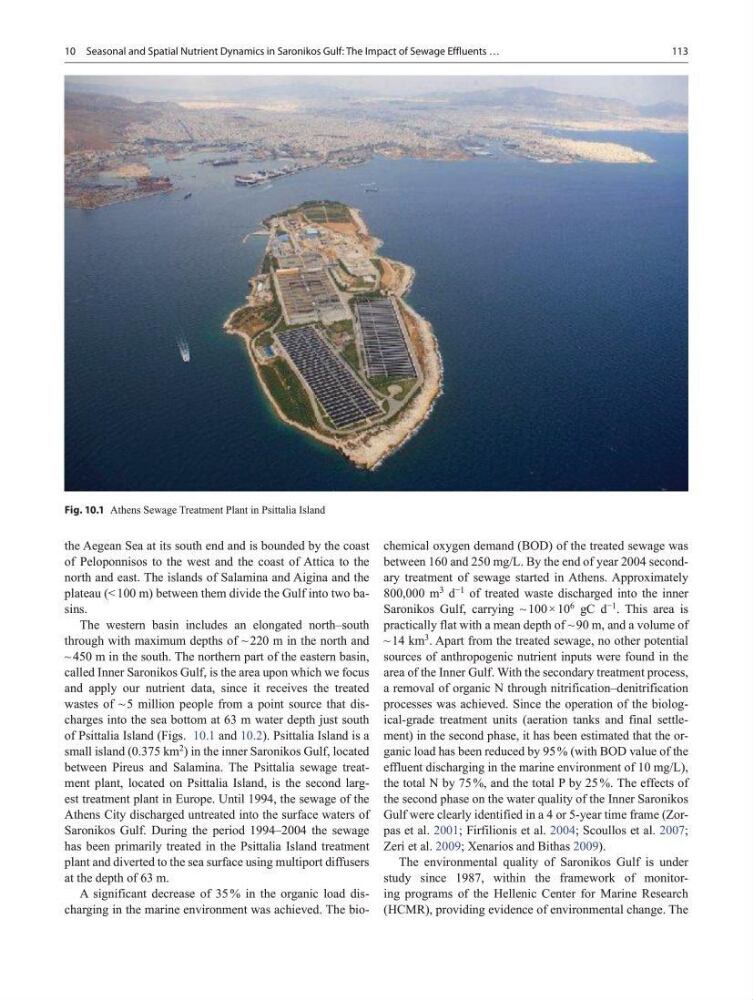
of Psittalia Island (Figs. 10.1 and 10.2). Psittalia Island is a
small island (0.375 km
2
) in the inner Saronikos Gulf, located
between Pireus and Salamina. The Psittalia sewage treatment plant, located on Psittalia Island, is the second largest treatment plant in Europe. Until 1994, the sewage of the
Athens City discharged untreated into the surface waters of
Saronikos Gulf. During the period 1994–2004 the sewage
has been primarily treated in the Psittalia Island treatment
plant and diverted to the sea surface using multiport diffusers
at the depth of 63 m.
A significant decrease of 35 % in the organic load discharging in the marine environment was achieved. The biochemical oxygen demand (BOD) of the treated sewage was
between 160 and 250 mg/L. By the end of year 2004 secondary treatment of sewage started in Athens. Approximately
800,000 m
3
d
−1
of treated waste discharged into the inner
Saronikos Gulf, carrying ~ 100 × 10
6
gC d
−1
. This area is
practically flat with a mean depth of ~ 90 m, and a volume of
~ 14 km
3
. Apart from the treated sewage, no other potential
sources of anthropogenic nutrient inputs were found in the
area of the Inner Gulf. With the secondary treatment process,
a removal of organic N through nitrification–denitrification
processes was achieved. Since the operation of the biological-grade treatment units (aeration tanks and final settlement) in the second phase, it has been estimated that the organic load has been reduced by 95 % (with BOD value of the
effluent discharging in the marine environment of 10 mg/L),
the total N by 75 %, and the total P by 25 %. The effects of
the second phase on the water quality of the Inner Saronikos
Gulf were clearly identified in a 4 or 5-year time frame (Zorpas et al. 2001; Firfilionis et al. 2004; Scoullos et al. 2007;
Zeri et al. 2009; Xenarios and Bithas 2009).
The environmental quality of Saronikos Gulf is under
study since 1987, within the framework of monitoring programs of the Hellenic Center for Marine Research
(HCMR), providing evidence of environmental change. The
Fig. 10.1 Athens Sewage Treatment Plant in Psittalia Island
113
the Aegean Sea at its south end and is bounded by the coast
of Peloponnisos to the west and the coast of Attica to the
north and east. The islands of Salamina and Aigina and the
plateau (< 100 m) between them divide the Gulf into two basins.
The western basin includes an elongated north–south
through with maximum depths of ~ 220 m in the north and
~ 450 m in the south. The northern part of the eastern basin,
called Inner Saronikos Gulf, is the area upon which we focus
and apply our nutrient data, since it receives the treated
wastes of ~ 5 million people from a point source that discharges into the sea bottom at 63 m water depth just south
of Psittalia Island (Figs. 10.1 and 10.2). Psittalia Island is a
small island (0.375 km
2
) in the inner Saronikos Gulf, located
between Pireus and Salamina. The Psittalia sewage treatment plant, located on Psittalia Island, is the second largest treatment plant in Europe. Until 1994, the sewage of the
Athens City discharged untreated into the surface waters of
Saronikos Gulf. During the period 1994–2004 the sewage
has been primarily treated in the Psittalia Island treatment
plant and diverted to the sea surface using multiport diffusers
at the depth of 63 m.
A significant decrease of 35 % in the organic load discharging in the marine environment was achieved. The biochemical oxygen demand (BOD) of the treated sewage was
between 160 and 250 mg/L. By the end of year 2004 secondary treatment of sewage started in Athens. Approximately
800,000 m
3
d
−1
of treated waste discharged into the inner
Saronikos Gulf, carrying ~ 100 × 10
6
gC d
−1
. This area is
practically flat with a mean depth of ~ 90 m, and a volume of
~ 14 km
3
. Apart from the treated sewage, no other potential
sources of anthropogenic nutrient inputs were found in the
area of the Inner Gulf. With the secondary treatment process,
a removal of organic N through nitrification–denitrification
processes was achieved. Since the operation of the biological-grade treatment units (aeration tanks and final settlement) in the second phase, it has been estimated that the organic load has been reduced by 95 % (with BOD value of the
effluent discharging in the marine environment of 10 mg/L),
the total N by 75 %, and the total P by 25 %. The effects of
the second phase on the water quality of the Inner Saronikos
Gulf were clearly identified in a 4 or 5-year time frame (Zorpas et al. 2001; Firfilionis et al. 2004; Scoullos et al. 2007;
Zeri et al. 2009; Xenarios and Bithas 2009).
The environmental quality of Saronikos Gulf is under
study since 1987, within the framework of monitoring programs of the Hellenic Center for Marine Research
(HCMR), providing evidence of environmental change. The
Fig. 10.1 Athens Sewage Treatment Plant in Psittalia Island