

102
M. T. Dokulil
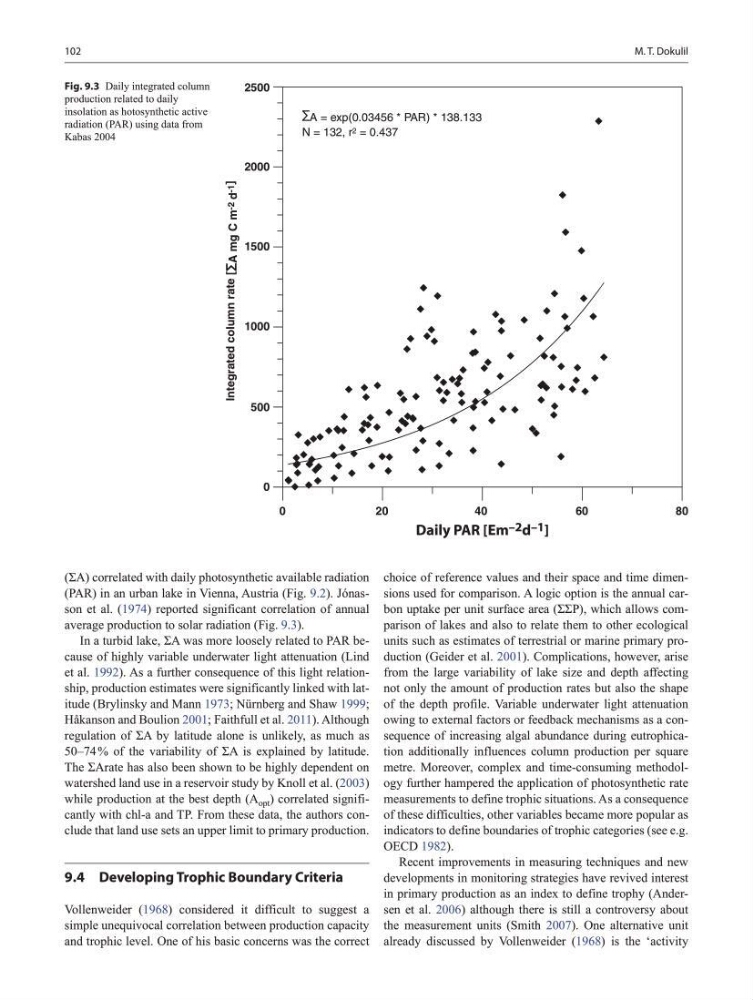
(ΣA) correlated with daily photosynthetic available radiation
(PAR) in an urban lake in Vienna, Austria (Fig. 9.2). Jónasson et al. (1974) reported significant correlation of annual
average production to solar radiation (Fig. 9.3).
In a turbid lake, ΣA was more loosely related to PAR because of highly variable underwater light attenuation (Lind
et al. 1992). As a further consequence of this light relationship, production estimates were significantly linked with latitude (Brylinsky and Mann 1973; Nürnberg and Shaw 1999;
Håkanson and Boulion 2001; Faithfull et al. 2011). Although
regulation of ΣA by latitude alone is unlikely, as much as
50–74 % of the variability of ΣA is explained by latitude.
The ΣArate has also been shown to be highly dependent on
watershed land use in a reservoir study by Knoll et al. (2003)
while production at the best depth (A opt ) correlated significantly with chl-a and TP. From these data, the authors conclude that land use sets an upper limit to primary production.
9.4 Developing Trophic Boundary Criteria
Vollenweider (1968) considered it difficult to suggest a
simple unequivocal correlation between production capacity
and trophic level. One of his basic concerns was the correct
choice of reference values and their space and time dimensions used for comparison. A logic option is the annual carbon uptake per unit surface area (ΣΣP), which allows comparison of lakes and also to relate them to other ecological
units such as estimates of terrestrial or marine primary production (Geider et al. 2001). Complications, however, arise
from the large variability of lake size and depth affecting
not only the amount of production rates but also the shape
of the depth profile. Variable underwater light attenuation
owing to external factors or feedback mechanisms as a consequence of increasing algal abundance during eutrophication additionally influences column production per square
metre. Moreover, complex and time-consuming methodology further hampered the application of photosynthetic rate
measurements to define trophic situations. As a consequence
of these difficulties, other variables became more popular as
indicators to define boundaries of trophic categories (see e.g.
OECD 1982).
Recent improvements in measuring techniques and new
developments in monitoring strategies have revived interest
in primary production as an index to define trophy (Andersen et al. 2006) although there is still a controversy about
the measurement units (Smith 2007). One alternative unit
already discussed by Vollenweider (1968) is the ‘activity
∑ A = exp(0.03456 * PAR) * 138.133
N = 132, r 2 = 0.437
Integrated column rate [∑
A mg C m -2
d -1
[
2000
1500
1000
500
0
0
2 0
6 0
8 0
40
2500
Fig. 9.3 Daily integrated column
production related to daily
insolation as hotosynthetic active
radiation (PAR) using data from
Kabas 2004
M. T. Dokulil
(ΣA) correlated with daily photosynthetic available radiation
(PAR) in an urban lake in Vienna, Austria (Fig. 9.2). Jónasson et al. (1974) reported significant correlation of annual
average production to solar radiation (Fig. 9.3).
In a turbid lake, ΣA was more loosely related to PAR because of highly variable underwater light attenuation (Lind
et al. 1992). As a further consequence of this light relationship, production estimates were significantly linked with latitude (Brylinsky and Mann 1973; Nürnberg and Shaw 1999;
Håkanson and Boulion 2001; Faithfull et al. 2011). Although
regulation of ΣA by latitude alone is unlikely, as much as
50–74 % of the variability of ΣA is explained by latitude.
The ΣArate has also been shown to be highly dependent on
watershed land use in a reservoir study by Knoll et al. (2003)
while production at the best depth (A opt ) correlated significantly with chl-a and TP. From these data, the authors conclude that land use sets an upper limit to primary production.
9.4 Developing Trophic Boundary Criteria
Vollenweider (1968) considered it difficult to suggest a
simple unequivocal correlation between production capacity
and trophic level. One of his basic concerns was the correct
choice of reference values and their space and time dimensions used for comparison. A logic option is the annual carbon uptake per unit surface area (ΣΣP), which allows comparison of lakes and also to relate them to other ecological
units such as estimates of terrestrial or marine primary production (Geider et al. 2001). Complications, however, arise
from the large variability of lake size and depth affecting
not only the amount of production rates but also the shape
of the depth profile. Variable underwater light attenuation
owing to external factors or feedback mechanisms as a consequence of increasing algal abundance during eutrophication additionally influences column production per square
metre. Moreover, complex and time-consuming methodology further hampered the application of photosynthetic rate
measurements to define trophic situations. As a consequence
of these difficulties, other variables became more popular as
indicators to define boundaries of trophic categories (see e.g.
OECD 1982).
Recent improvements in measuring techniques and new
developments in monitoring strategies have revived interest
in primary production as an index to define trophy (Andersen et al. 2006) although there is still a controversy about
the measurement units (Smith 2007). One alternative unit
already discussed by Vollenweider (1968) is the ‘activity
∑ A = exp(0.03456 * PAR) * 138.133
N = 132, r 2 = 0.437
Integrated column rate [∑
A mg C m -2
d -1
[
2000
1500
1000
500
0
0
2 0
6 0
8 0
40
2500
Fig. 9.3 Daily integrated column
production related to daily
insolation as hotosynthetic active
radiation (PAR) using data from
Kabas 2004