

88
Engelkes (1985) and Gieskes et al. (1991) recorded the appearance of a fucoxanthin derivative
when copepods grazed diatoms (Fig. 15), and peridinin and other carotenoid derivatives were
reported by Gieskes and Kraay (1984) and Nelson (1989). Superfluous copepod feeding can
6,--------------------------,
®
5
@
------------ -------------o
o
o
o 0
10
20
30
40
50
60
70
time in hours
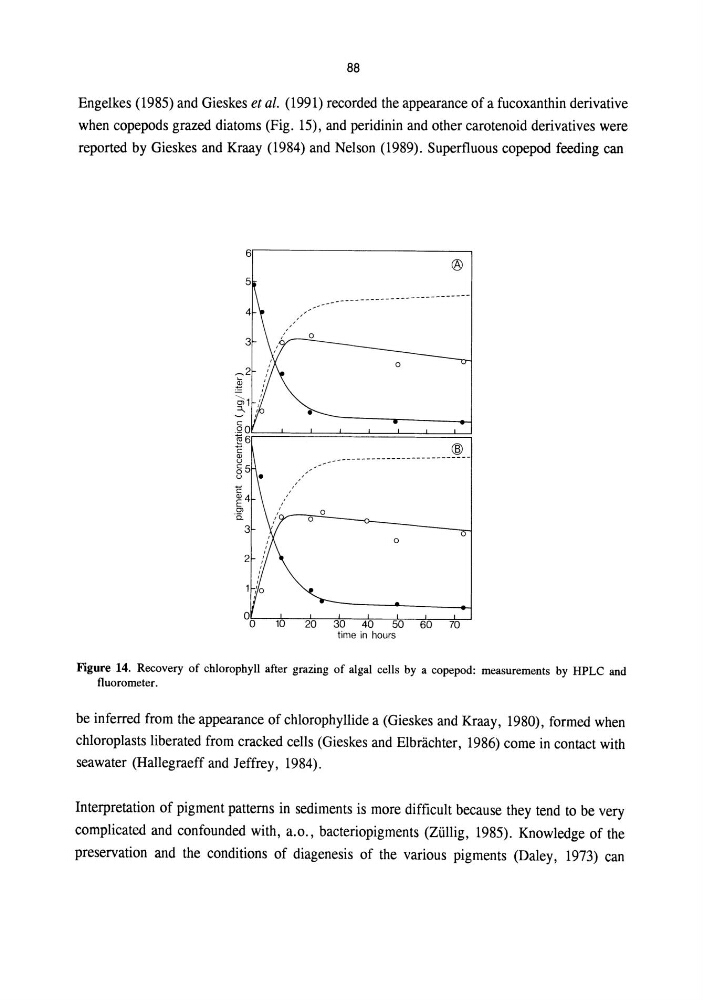
Figure 14. Recovery of chlorophyll after grazing of algal cells by a copepod: measurements by HPLC and
fluorometer.
be inferred from the appearance of chlorophyllide a (Gieskes and Kraay, 1980), formed when
chloroplasts liberated from cracked cells (Gieskes and Elbdichter, 1986) come in contact with
seawater (Hallegraeff and Jeffrey, 1984).
Interpretation of pigment patterns in sediments is more difficult because they tend to be very
complicated and confounded with, a.o., bacteriopigments (Ztillig, 1985). Knowledge of the
preservation and the conditions of diagenesis of the various pigments (Daley, 1973) can
Engelkes (1985) and Gieskes et al. (1991) recorded the appearance of a fucoxanthin derivative
when copepods grazed diatoms (Fig. 15), and peridinin and other carotenoid derivatives were
reported by Gieskes and Kraay (1984) and Nelson (1989). Superfluous copepod feeding can
6,--------------------------,
®
5
@
------------ -------------o
o
o
o 0
10
20
30
40
50
60
70
time in hours
Figure 14. Recovery of chlorophyll after grazing of algal cells by a copepod: measurements by HPLC and
fluorometer.
be inferred from the appearance of chlorophyllide a (Gieskes and Kraay, 1980), formed when
chloroplasts liberated from cracked cells (Gieskes and Elbdichter, 1986) come in contact with
seawater (Hallegraeff and Jeffrey, 1984).
Interpretation of pigment patterns in sediments is more difficult because they tend to be very
complicated and confounded with, a.o., bacteriopigments (Ztillig, 1985). Knowledge of the
preservation and the conditions of diagenesis of the various pigments (Daley, 1973) can