

71
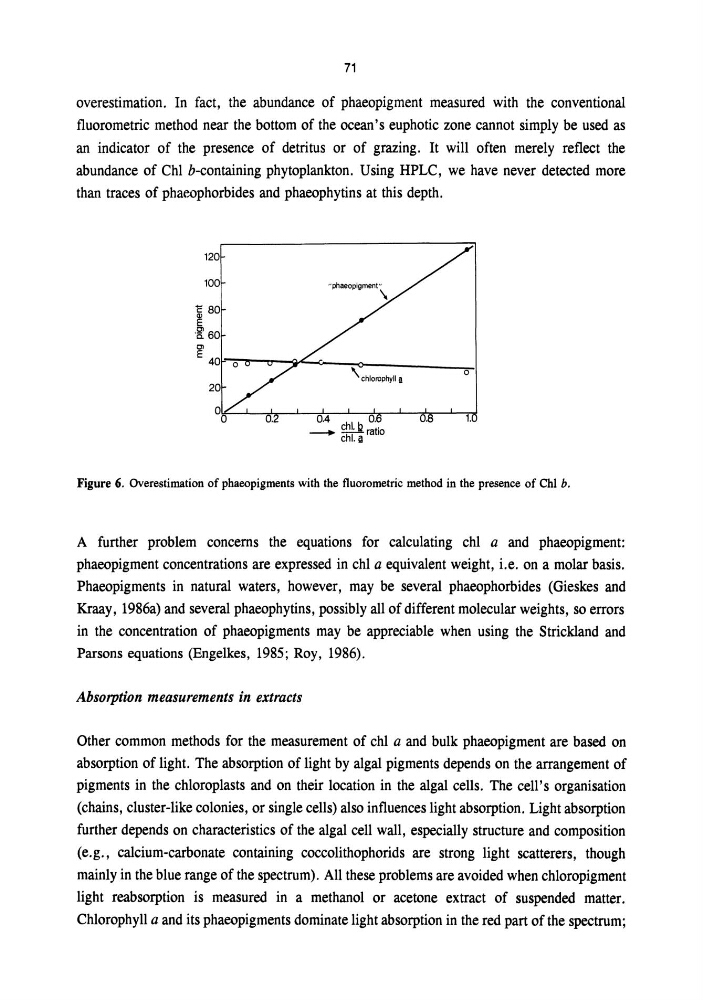
overestimation. In fact, the abundance of phaeopigment measured with the conventional
fluorometric method near the bottom of the ocean's euphotic zone cannot simply be used as
an indicator of the presence of detritus or of grazing. It will often merely reflect the
abundance of ChI b-containing phytoplankton. Using HPLC, we have never detected more
than traces of phat",ophorbides and phaeophytins at this depth.
120
100
to 80
~
·~60
'" E 40 0
0
20
Figure 6. Overestimation of phaeopigments with the fluorometric method in the presence of Chl b.
A further problem concerns the equations for calculating chI a and phaeopigment:
phaeopigment concentrations are expressed in chI a equivalent weight, i.e. on a molar basis.
Phaeopigments in natural waters, however, may be several phaeophorbides (Gieskes and
Kraay, 1986a) and several phaeophytins, possibly all of different molecular weights, so errors
in the concentration of phaeopigments may be appreciable when using the Strickland and
Parsons equations (Engelkes, 1985; Roy, 1986).
Absorption measurements in extracts
Other common methods for the measurement of chI a and bulk phaeopigment are based on
absorption of light. The absorption of light by algal pigments depends on the arrangement of
pigments in the chloroplasts and on their location in the algal cells. The cell's organisation
(chains, cluster-like colonies, or single cells) also influences light absorption. Light absorption
further depends on characteristics of the algal cell wall, especially structure and composition
(e.g., calcium-carbonate containing coccolithophorids are strong light scatterers, though
mainly in the blue range of the spectrum). All these problems are avoided when chloropigment
light reabsorption is measured in a methanol or acetone extract of suspended matter.
Chlorophyll a and its phaeopigments dominate light absorption in the red part of the spectrum;
overestimation. In fact, the abundance of phaeopigment measured with the conventional
fluorometric method near the bottom of the ocean's euphotic zone cannot simply be used as
an indicator of the presence of detritus or of grazing. It will often merely reflect the
abundance of ChI b-containing phytoplankton. Using HPLC, we have never detected more
than traces of phat",ophorbides and phaeophytins at this depth.
120
100
to 80
~
·~60
'" E 40 0
0
20
Figure 6. Overestimation of phaeopigments with the fluorometric method in the presence of Chl b.
A further problem concerns the equations for calculating chI a and phaeopigment:
phaeopigment concentrations are expressed in chI a equivalent weight, i.e. on a molar basis.
Phaeopigments in natural waters, however, may be several phaeophorbides (Gieskes and
Kraay, 1986a) and several phaeophytins, possibly all of different molecular weights, so errors
in the concentration of phaeopigments may be appreciable when using the Strickland and
Parsons equations (Engelkes, 1985; Roy, 1986).
Absorption measurements in extracts
Other common methods for the measurement of chI a and bulk phaeopigment are based on
absorption of light. The absorption of light by algal pigments depends on the arrangement of
pigments in the chloroplasts and on their location in the algal cells. The cell's organisation
(chains, cluster-like colonies, or single cells) also influences light absorption. Light absorption
further depends on characteristics of the algal cell wall, especially structure and composition
(e.g., calcium-carbonate containing coccolithophorids are strong light scatterers, though
mainly in the blue range of the spectrum). All these problems are avoided when chloropigment
light reabsorption is measured in a methanol or acetone extract of suspended matter.
Chlorophyll a and its phaeopigments dominate light absorption in the red part of the spectrum;