

70
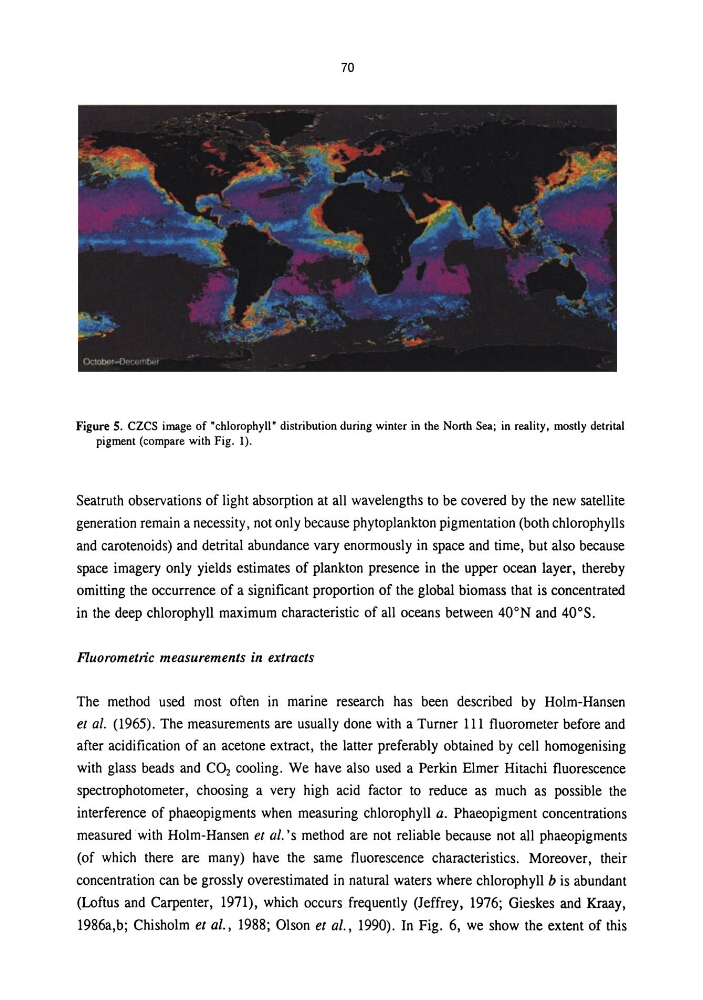
Figure 5. CZCS image of "chlorophyll" distribution during winter in the North Sea; in reality, mostly detrital
pigment (compare with Fig. 1).
Seatruth observations of light absorption at all wavelengths to be covered by the new satellite
generation remain a necessity, not only because phytoplankton pigmentation (both chlorophylls
and carotenoids) and detrital abundance vary enormously in space and time, but also because
space imagery only yields estimates of plankton presence in the upper ocean layer, thereby
omitting the occurrence of a significant proportion of the global biomass that is concentrated
in the deep chlorophyll maximum characteristic of all oceans between 40 0 N and 40 o S.
Fluorometdc measurements in extracts
The method used most often in marine research has been described by Holm-Hansen
et aZ. (1965). The measurements are usually done with a Turner 111 fluorometer before and
after acidification of an acetone extract, the latter preferably obtained by cell homogenising
with glass beads and CO2 cooling. We have also used a Perkin Elmer Hitachi fluorescence
spectrophotometer, choosing a very high acid factor to reduce as much as possible the
interference of phaeopigments when measuring chlorophyll a. Phaeopigment concentrations
measured with Holm-Hansen et aZ. 's method are not reliable because not all phaeopigments
(of which there are many) have the same fluorescence characteristics. Moreover, their
concentration can be grossly overestimated in natural waters where chlorophyll b is abundant
(Loftus and Carpenter, 1971), which occurs frequently (Jeffrey, 1976; Gieskes and Kraay,
1986a,b; Chisholm et aZ., 1988; Olson et aZ., 1990). In Fig. 6, we show the extent of this
Figure 5. CZCS image of "chlorophyll" distribution during winter in the North Sea; in reality, mostly detrital
pigment (compare with Fig. 1).
Seatruth observations of light absorption at all wavelengths to be covered by the new satellite
generation remain a necessity, not only because phytoplankton pigmentation (both chlorophylls
and carotenoids) and detrital abundance vary enormously in space and time, but also because
space imagery only yields estimates of plankton presence in the upper ocean layer, thereby
omitting the occurrence of a significant proportion of the global biomass that is concentrated
in the deep chlorophyll maximum characteristic of all oceans between 40 0 N and 40 o S.
Fluorometdc measurements in extracts
The method used most often in marine research has been described by Holm-Hansen
et aZ. (1965). The measurements are usually done with a Turner 111 fluorometer before and
after acidification of an acetone extract, the latter preferably obtained by cell homogenising
with glass beads and CO2 cooling. We have also used a Perkin Elmer Hitachi fluorescence
spectrophotometer, choosing a very high acid factor to reduce as much as possible the
interference of phaeopigments when measuring chlorophyll a. Phaeopigment concentrations
measured with Holm-Hansen et aZ. 's method are not reliable because not all phaeopigments
(of which there are many) have the same fluorescence characteristics. Moreover, their
concentration can be grossly overestimated in natural waters where chlorophyll b is abundant
(Loftus and Carpenter, 1971), which occurs frequently (Jeffrey, 1976; Gieskes and Kraay,
1986a,b; Chisholm et aZ., 1988; Olson et aZ., 1990). In Fig. 6, we show the extent of this